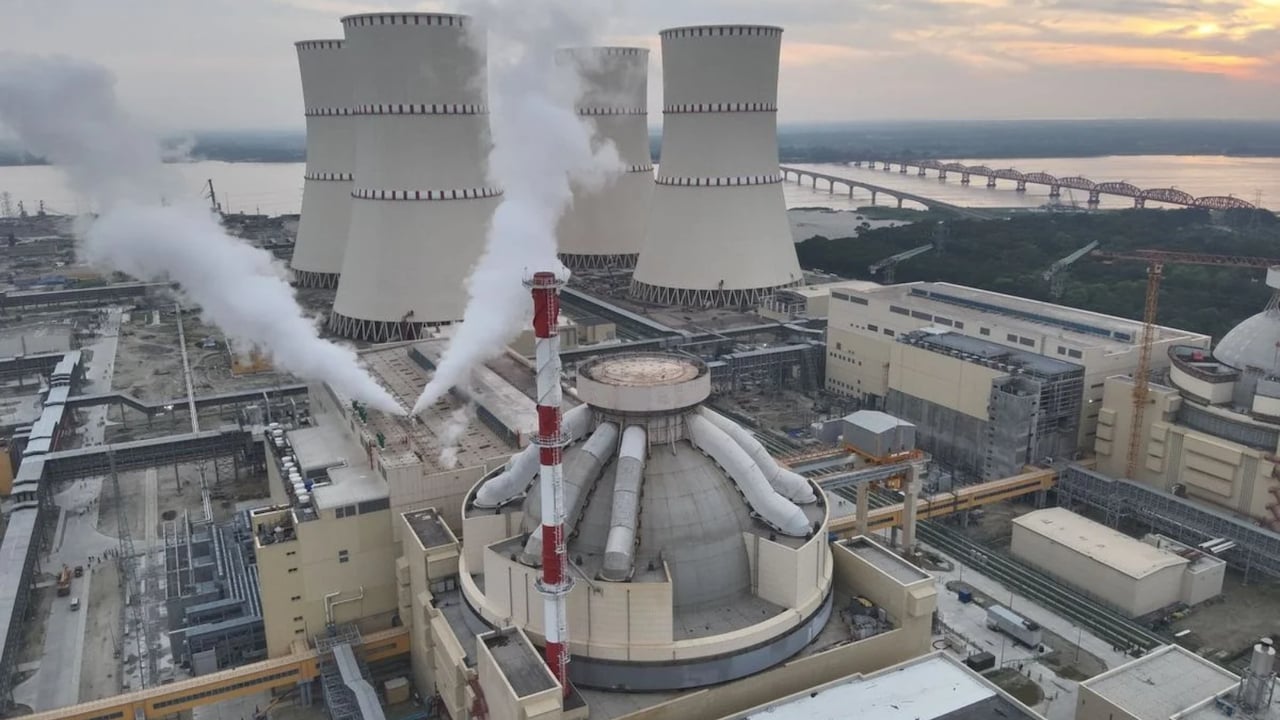
Synchronizing a 2,400-megawatt nuclear generation facility to a developing electrical grid is not a ceremonial milestone; it is a high-stakes exercise in grid frequency management, sovereign debt structuring, and supply chain dependency. When Bangladesh initiates power transmission from the Rooppur Nuclear Power Plant—constructed by Russia’s state atomic corporation, Rosatom—it alters the thermodynamic and financial architecture of South Asia’s fastest-growing energy market. Standard media coverage frames this event as a simple switch-flipping triumph. In reality, integrating two VVER-1200 pressurized water reactors into the Power Grid Company of Bangladesh (PGCB) network introduces acute technical bottlenecks, foreign exchange liabilities, and single-vendor operational risks that will define Dhaka's industrial competitiveness for the next six decades.
The Three Pillars of the Rooppur Energy Transition
To evaluate the operational reality of Bangladesh’s entry into nuclear power, analysts must separate political signaling from three structural variables: baseload displacement, transmission stability, and capital amortization.
1. Baseload Displacement and Fuel Import Substitution
Bangladesh’s historical power generation mix has relied heavily on domestic natural gas reserves and imported heavy fuel oil (HFO) or liquefied natural gas (LNG). As domestic gas fields in the Bengal Basin depleted, the Bangladesh Power Development Board (BPDB) became acutely exposed to global spot-market volatility. LNG price spikes repeatedly forced load-shedding across textile and manufacturing zones, directly compressing export margins.
Nuclear generation alters this marginal cost structure. Once a VVER-1200 reactor reaches criticality and commercial operation, its fuel cost per megawatt-hour (MWh) is low and insulated from short-term hydrocarbon price shocks. Uranium fuel assemblies are refueled on an 18-month cycle, turning an unpredictable monthly foreign currency drain for fossil fuels into a predictable, multi-year procurement schedule.
2. The Transmission Bottleneck and Spinning Reserve Deficit
Generating electricity at the Ishwardi site in Pabna district is only half the engineering problem; evacuating 2,400 MW across the Padma and Jamuna rivers without triggering cascading blackouts is the primary operational constraint.
A fundamental law of electrical grid engineering dictates that supply and demand must remain balanced at a strict 50 Hertz (Hz) frequency in Bangladesh. The PGCB grid historically operated with smaller thermal units where the loss of a single generator represented a manageable percentage of total system load. Introducing two 1,200 MW units creates an N-1 contingency problem of unprecedented scale for Dhaka. If a single 1,200 MW unit trips offline unexpectedly due to a turbine fault or transmission fault, the grid loses a massive block of real power instantaneously.
Without sufficient spinning reserves—online, unloaded generation capacity capable of ramping up within seconds—system frequency drops below the 49.0 Hz threshold, triggering automatic under-frequency load shedding (UFLS) or total grid collapse. High-voltage 400 kV transmission lines, including dedicated river-crossing corridors, had to be built from scratch to prevent localized congestion. Any delay in commissioning these specific evacuation lines forces the plant to operate at derated capacity, destroying its economic efficiency.
3. The Sovereign Debt and Sanctions Friction
The financial architecture of Rooppur relies on an intergovernmental credit agreement totaling roughly $11.38 billion in Russian state loans, covering 90% of the estimated $12.65 billion project cost. While the loan carries favorable concessional interest rates and a grace period tied to plant commissioning, repayment obligations are denominated in hard currency.
The geopolitical friction lies in payment mechanics. Western financial sanctions targeting Russian state entities and banking institutions (specifically exclusion from SWIFT and restrictions on US dollar clearing) complicated Dhaka's ability to service debt and pay contractors. Bangladesh and Russia had to engineer alternative settlement mechanisms, including escrow accounts and non-dollar currency arrangements (such as Chinese Yuan or direct Ruble-Taka clearing). This creates ongoing treasury friction: Bangladesh earns its primary export revenues in US dollars and Euros from the ready-made garment sector, yet must convert those receipts through complex intermediary channels to satisfy Russian sovereign obligations without triggering secondary sanctions on Bangladeshi commercial banks.
Thermodynamic Mechanics of the VVER-1200 Architecture
Understanding why Rooppur operates differently from legacy power plants requires examining the Generation III+ VVER-1200 reactor design. Unlike older Generation II designs that rely on active safety systems—pumps, diesel generators, and operator intervention—the VVER-1200 integrates passive safety architectures governed by basic physics: gravity, natural convection, and evaporation.
- Passive Heat Removal System (PHRS): In the event of a station blackout where all external power and emergency diesel generators fail, air-cooled heat exchangers located outside the containment dome draw heat away from the steam generators via natural air draft. Cold air enters at the bottom, heats up, rises, and exits through a stack, continuously cooling the reactor core without a single moving pump.
- Core Catcher (Melt Localization Device): Positioned directly beneath the reactor pressure vessel is a cone-shaped steel vessel filled with sacrificial materials (iron and aluminum oxides). If a severe beyond-design-basis accident melts the core, the molten corium drops into the catcher, mixes with the sacrificial oxides to lower its temperature and density, and spreads out to prevent penetration of the concrete containment basemat.
- Double Containment Structure: The reactor is housed within an inner prestressed concrete containment shell lined with steel to maintain leak-tightness, surrounded by an outer reinforced concrete shell engineered to withstand external impacts, earthquakes, and extreme weather events common to the Ganges-Brahmaputra delta.
These engineering layers reduce core damage frequency probabilities by orders of magnitude compared to older reactors. However, passive safety systems introduce immense capital intensity and strict quality-assurance tolerances during construction, which explains why nuclear projects experience chronic schedule extensions when civil engineering standards diverge from Russian nuclear regulatory norms.
The Cost Function of Single-Vendor Dependency
In infrastructure strategy, vendor lock-in represents a long-term balance-sheet liability. By selecting Rosatom under a turnkey Engineering, Procurement, and Construction (EPC) contract, Bangladesh compressed the timeline required to build a nuclear workforce from zero. Yet this model locks Dhaka into a closed ecosystem across four operational dimensions:
- Fuel Fabrication Monopoly: VVER-1200 reactors require hexagonal fuel assemblies manufactured specifically by TVEL, Rosatom’s fuel division. While Western suppliers like Westinghouse have developed compatible VVER-1000 fuel assemblies for Eastern European reactors, qualifying a non-Russian fuel vendor for a VVER-1200 core requires years of regulatory licensing, neutronics modeling, and core-loading safety validations. Dhaka has zero short-term fuel diversification options.
- Maintenance and Spare Parts: Specialized reactor coolant pumps, control rod drive mechanisms, and digital instrumentation and control (I&C) systems are proprietary. Outage maintenance cycles depend entirely on Russian technicians and logistics chains.
- Human Capital Pipeline: Bangladesh established the Nuclear Power Plant Company Bangladesh Limited (NPCBL) to operate the facility, sending hundreds of engineers to Russia’s National Research Nuclear University (MEPhI) and Novovoronezh training centers. While domestic operators staff the control rooms, high-level nuclear engineering oversight remains tethered to Russian technical support agreements during the initial years of commercial operation.
- Spent Fuel Repatriation: Under bilateral agreements, Russia committed to taking back spent nuclear fuel for reprocessing. While this solves Bangladesh's immediate high-level radioactive waste disposal problem—a critical advantage in one of the world's most densely populated, flood-prone countries—it gives Moscow permanent leverage over the back end of the fuel cycle.
Operational Realities: Capacity Factor vs. Grid Demand
Nuclear economics are governed by fixed costs. Capital expenditure accounts for roughly 70% to 80% of the levelized cost of electricity (LCOE) for a new nuclear build. Unlike a combined-cycle gas turbine (CCGT) plant, which saves money when turned down because it burns less fuel, a nuclear plant incurs nearly identical daily debt-service, staffing, and maintenance expenses whether it runs at 100% power or 50% power.
Therefore, Rooppur must operate as a pure baseload asset with a target capacity factor exceeding 85% to 90%. This creates a structural operational challenge in Bangladesh due to extreme seasonal and diurnal demand curves.
During peak summer afternoons, industrial air conditioning and agricultural irrigation push national demand toward maximum generation capacity. Conversely, during winter nights or national holidays like Eid, industrial textile factories shut down, causing national electricity demand to plummet by 40% to 50%.
When total system demand drops overnight, grid operators at the National Load Dispatch Center (NLDC) must decide which power plants to curtail. Because nuclear reactors are technically complex and economically punitive to cycle up and down daily (load-following induces xenon poisoning in the reactor core, temporarily suppressing reactivity and accelerating thermal fatigue on fuel cladding), Rooppur must stay at full output. This forces the NLDC to shut down private Independent Power Producers (IPPs) running on gas or coal.
Under standard Power Purchase Agreements (PPAs) in Bangladesh, idle IPPs still collect "capacity payments"—fixed fees guaranteed by the government regardless of whether electricity is actually dispatched. Consequently, running Rooppur at full baseload during low-demand periods increases the effective cost of idle fossil-fuel capacity sitting on the sidelines. The financial savings from nuclear fuel substitution are partially cannibalized by capacity payments owed to underutilized private thermal plants.
Regulatory Independence and the Safety Paradox
A foundational principle of the International Atomic Energy Agency (IAEA) is the absolute operational and financial independence of the national nuclear regulatory body from the entity promoting or operating the power plant. In Bangladesh, the Bangladesh Atomic Energy Regulatory Authority (BAERA) oversees licensing, inspection, and safety compliance, while the Bangladesh Atomic Energy Commission (BAEC) acts as the project owner.
In developing economies executing their first nuclear project, regulatory asymmetry is a persistent risk. The vendor (Rosatom) possesses decades of institutional knowledge, thousands of nuclear physicists, and proprietary design data. The nascent regulator (BAERA) must audit and verify safety submissions with a fraction of the staff and institutional history.
To bridge this gap, Dhaka relied heavily on IAEA Integrated Nuclear Infrastructure Review (INIR) missions and third-party technical support organizations. However, political pressure to announce commercial power delivery and begin generating revenue to offset loan repayments creates an institutional tension: schedule adherence versus exhaustive regulatory verification. When a government ties national prestige to a specific commissioning deadline, the regulatory body faces immense implicit pressure to expedite fuel-loading and criticality permits. True operational maturity is measured not by the speed of grid connection, but by the regulator's willingness to halt commissioning if containment leak-rate tests or emergency core cooling calibrations deviate by a fraction of a percent.
Strategic Execution for Grid and Financial Optimization
To extract maximum economic value from Rooppur while containing systemic grid and financial risks, energy planners and financial policymakers in Dhaka must execute four concrete interventions:
- Retire or Renegotiate Legacy Capacity Contracts: The BPDB must aggressively phase out expired oil-fired rental power plants and renegotiate take-or-pay capacity charges with aging thermal IPPs. Retaining redundant fossil-fuel capacity solely for seasonal peaks destroys the LCOE advantage of nuclear baseload.
- Deploy Grid-Scale Battery Energy Storage Systems (BESS) and Pumped Hydro: To resolve the diurnal demand trough without cycling the VVER-1200 reactors, PGCB should deploy utility-scale BESS at key 400 kV substations. Charging batteries during low-demand winter nights using cheap nuclear baseload and discharging during evening peaks eliminates the need for expensive peaking diesel generators and provides instantaneous frequency response if a reactor trips.
- Ring-Fence Foreign Exchange Reserves for Debt Service: The Ministry of Finance must establish a dedicated, automated foreign-currency sinking fund fed directly by industrial tariff collections from export-oriented economic zones supplied by Rooppur power. Relying on ad-hoc central bank reserve allocations exposes debt servicing to macroeconomic balance-of-payments crises.
- Institutionalize Bilateral Payment Channels: Formalize multi-currency clearing protocols with Moscow that operate independently of Western correspondent banking networks, ensuring that routine spare-part shipments and fuel-assembly deliveries are never interrupted by external geopolitical sanctions.


