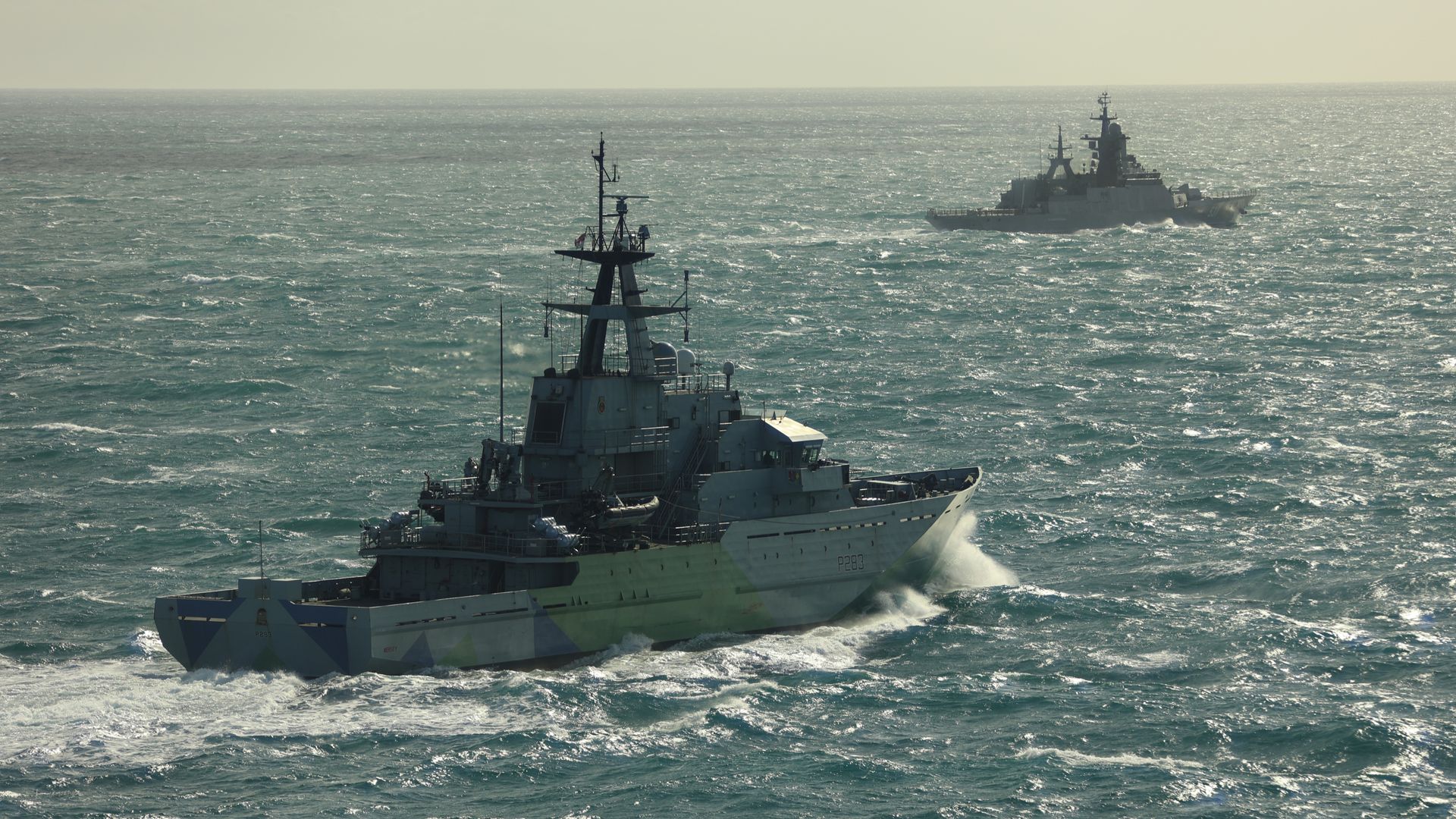
The UK and its allies are currently patting themselves on the back for assembling a "multinational force" to counter Russian naval aggression. They call it a show of strength. I call it a target-rich environment.
For decades, the naval establishment has operated under the delusion that big ships and big coalitions equal big security. We are still obsessed with the 19th-century Mahanian concept of "command of the sea" via massive surface fleets. But while the UK Ministry of Defence issues press releases about carrier strike groups and "interoperability," the reality of modern warfare has shifted beneath their keels.
The "Russian threat" isn't a fleet of cruisers looking for a fair fight. It is a distributed network of sub-surface drones, hypersonic missiles, and asymmetrical electronic warfare. Sending a cluster of expensive, manned surface vessels into the North Sea to "deter" Russia is like bringing a sword to a drone fight. It is performative defense, and it is dangerously outdated.
The Myth of the Multinational Deterrent
The standard narrative suggests that when ten nations sail together, they are ten times stronger. This is a mathematical fallacy. In reality, a multinational naval force is only as fast as its slowest communication protocol.
I have spent years watching these exercises. The friction is palpable. Language barriers are the least of it. The real killers are the incompatible data links and the national caveats that prevent a French ship from sharing specific sensor data with a British one in real-time. We pretend we have a "plug and play" navy. We actually have a "plug and pray" navy.
When you bundle these ships together, you aren't creating a wall. You are creating a massive signature on a radar screen that can be seen from space. You are concentrating your most expensive assets in a single geographic box, making the targeting solution for an adversary trivial. A single 3M22 Zircon missile, traveling at Mach 9, does not care how many flags are flying on the mast.
Why Quantity is No Longer Quality
The old adage that "quantity has a quality of its own" assumes your quantity can actually hit back.
- The Cost Asymmetry: A Type 45 destroyer costs roughly £1 billion. A swarm of autonomous underwater vehicles (AUVs) or a battery of shore-based missiles costs a fraction of that.
- The Repair Gap: If a Russian submarine disables a NATO frigate’s propulsion in the high North, that ship is out of the war. There is no forward repair capacity. We are one lucky hit away from a multi-billion-pound liability.
- The Intelligence Leak: Every nation added to a "multinational force" is a new potential point of failure for signals intelligence.
Russia is Playing a Different Game
While the West focuses on "patrolling" and "presence," Russia has focused on sea denial. They aren't trying to control the Atlantic; they are trying to make it too expensive and too dangerous for us to be there.
They have invested heavily in the "Kalibr-ization" of their fleet. Even their small corvettes carry long-range land-attack and anti-ship missiles. They don't need a massive blue-water navy because they have turned the ocean into a "no-go" zone via land-based A2/AD (Anti-Access/Area Denial) bubbles.
The UK's strategy of "rallying navies" ignores this. We are trying to win a 1944 war in 2026. We are focused on hulls. Russia is focused on the kill chain. If you cannot break the enemy's ability to see you, it doesn't matter how many destroyers you have. You are just a high-value target waiting for a terminal phase.
The Hidden Fragility of Subsea Infrastructure
The biggest irony of this multinational naval buildup is that it does almost nothing to protect what actually matters: the cables.
Over 95% of global data and trillions of dollars in daily financial transactions travel through subsea fiber-optic cables. Russia knows this. Their GUGI (Main Directorate of Deep-Sea Research) operates specialized "mother ships" and midget submarines designed specifically to manipulate or sever this infrastructure.
A carrier strike group sitting on the surface is useless against a drone 3,000 meters below it. You can't "deter" a silent robot with a deck gun. By the time the UK realizes the cables are cut, the economic damage will be done, and the multinational fleet will be bobbing on the surface, unable to communicate with its own headquarters.
The Real Cost of "Solidarity"
Politicians love naval deployments because they look good on the evening news. Big ships look like power. But "showing the flag" is not a military strategy; it is a PR campaign.
Every pound spent on maintaining a surface presence in contested waters is a pound not spent on:
- Mass-produced maritime drones.
- Hardening subsea infrastructure.
- Cyber-resilience for naval command and control.
We are sacrificing actual lethality for the sake of looking unified. It is a vanity project disguised as a defense policy.
The Tech Gap: Hypersonics vs. Heritage
Let's talk about the math of an intercept. Standard naval air defense systems are designed to track and kill targets moving at subsonic or low supersonic speeds on predictable trajectories.
Imagine a scenario where a multinational force is shadowed by a Russian Yasen-class submarine. The submarine doesn't need to surface. It launches a salvo of Zircon missiles.
$v = \text{Mach 9} \approx 3,000 \text{ m/s}$
At that speed, the reaction time for a human operator is non-existent. Even automated systems struggle with the plasma cloud that forms around a hypersonic vehicle, which can scramble radar returns. The defense-to-offense cost ratio is completely inverted. We spend millions on an interceptor missile to maybe—maybe—stop a missile that cost the enemy half as much.
If we lose one ship, the political fallout in London or Paris is catastrophic. If Russia loses a missile, they just reload. This is not a winning trade.
Stop Building Ships, Start Building Networks
The "lazy consensus" says we need more hulls. The truth is we need fewer hulls and more nodes.
If I were designing a maritime strategy to actually scare the Kremlin, I wouldn't send a flotilla. I would flood the Baltic and the North Sea with thousands of small, cheap, expendable sensors and autonomous strike craft.
We need to move away from the "Exquisite Platform" model. A Type 26 frigate is an "exquisite platform." It is beautiful, capable, and irreplaceable. That makes it a liability in a high-intensity conflict. We need "attritable" systems—things we can afford to lose.
The Uncomfortable Reality of Interoperability
We talk about "seamless integration" with allies. It’s a lie.
I’ve seen it firsthand in the Mediterranean and the North Atlantic. You have different rules of engagement. You have different risk tolerances. If a Russian aircraft buzzes a multinational force, the British might have orders to hold fire while the Americans are on hair-trigger alert. This hesitation is where wars are lost.
A coalition is a political body, not a tactical one. In a real shooting war, the time required to achieve "multinational consensus" is longer than the flight time of a missile.
The Actionable Pivot
If the UK actually wants to lead, it should stop trying to be a miniature version of the US Navy. We cannot compete on scale. We must compete on intelligence and asymmetry.
- Divest from Surface Sunk Costs: Stop the obsession with keeping aging frigates on life support. Retire them and shift the funding to undersea warfare.
- Weaponize the Seabed: Instead of patrolling the surface, we should be installing permanent, passive acoustic arrays and "sleeper" mines that can be activated remotely.
- Decentralize Command: The current model of a flagship commanding a fleet is a single point of failure. We need a mesh-networked command structure where every drone is a sensor and every sensor is a shooter.
The current "rallying of navies" is a security theater production designed to reassure a public that doesn't understand the physics of modern missiles. We are grouping our assets together for the convenience of our enemies. We are celebrating "unity" while ignoring the fact that our shiny, expensive fleet is effectively a collection of legacy hardware in a software-defined warzone.
Stop looking at the horizon for ships. The threat is already underneath you, and it’s moving faster than your committee-designed fleet can think.
The era of the "Great White Fleet" is over. We are just the last ones to realize it.