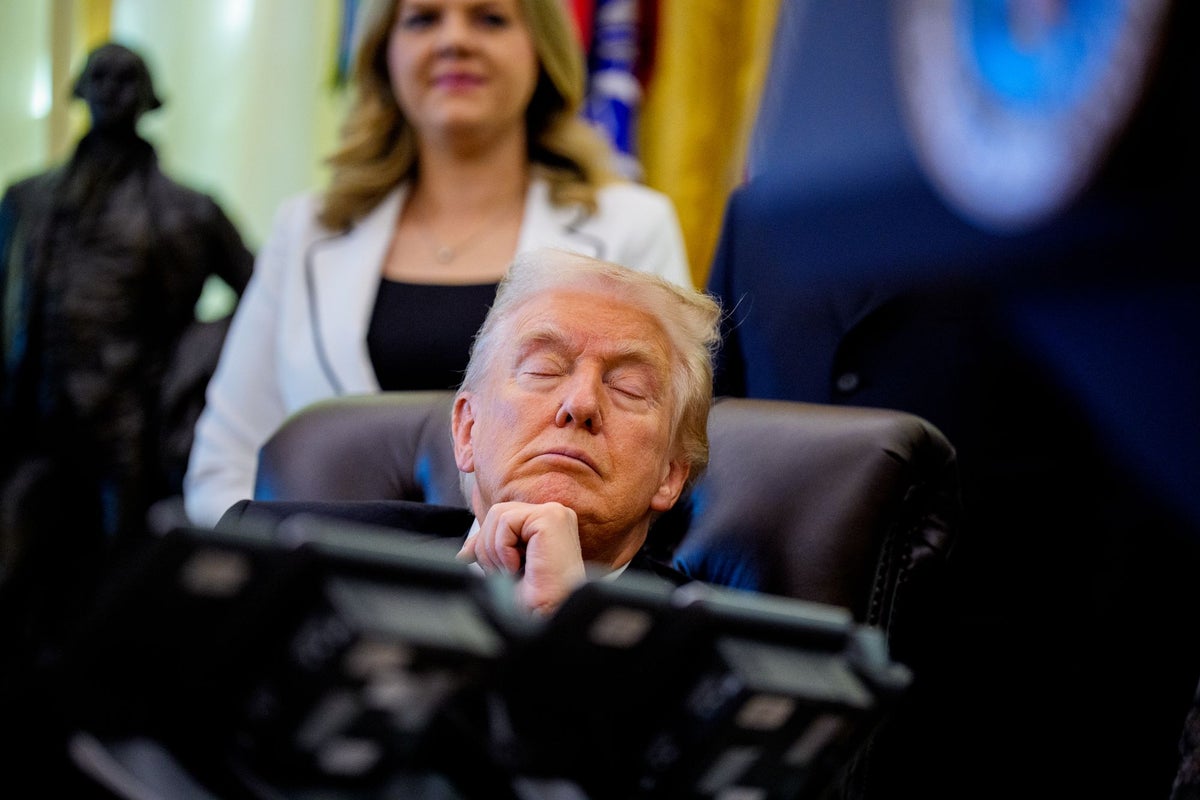
The room is always freezing. Anyone who has ever sat in a high-stakes government briefing, a courtroom, or a congressional hearing knows about the temperature. They keep the air conditioning blasting, a brutal, artificial winter designed for one specific purpose: to keep people awake. When the stakes are global, drowsiness is an enemy.
Yet, there are moments when the cold fails.
Picture a courtroom. The lighting is harsh, humming with a low fluorescent buzz. Lawyers are droning on over piles of legal briefs, debating the minutiae of hush money and campaign finance. In the center of the storm sits a man who once held the nuclear codes. His chin drops. His eyelids flutter, then shut. For a few seconds, then a few minutes, Donald Trump drifts away.
To his critics, it is a moment of pure political comedy. The internet fills with memes. Late-night hosts sharpen their monologues. "Sleepy Don" becomes the counter-punch to "Sleepy Joe." We laugh because it is easier than acknowledging the cold shiver of vulnerability that such an image sends through the machinery of national security.
This is not a story about partisan mockery. It is about the terrifyingly fragile nature of modern deterrence, where the perception of a leader's awareness is just as vital as the weapons they command.
The Theater of Perpetual Alertness
Power is a performance.
We pretend it is about policy papers and grand strategies, but global stability relies heavily on optics. The rest of the world—both allies and adversaries—is constantly watching America’s leadership for signs of fracture. They watch the posture. They watch the eyes.
When Representative Ted Lieu publicly labeled Trump’s courtroom nodding-off as a national security risk, he was not just taking a cheap shot at an opponent. He was pointing out a fundamental flaw in the armor of deterrence.
Think about the presidency. It is an office stripped of humanity. The individual holding it is expected to be a machine, an entity capable of operating on three hours of sleep, digesting vast quantities of classified data, and making life-or-death decisions in the span of a heartbeat. The world moves too fast for naps.
Consider what happens next when that illusion of machine-like alertness breaks.
An adversary sitting in a command bunker across the globe does not see a tired elderly man enduring a tedious legal proceeding. They see a gap. They see a lapse in focus. In the brutal logic of geopolitics, a leader who cannot stay awake during his own criminal trial is a leader who might miss the subtle shift in troop movements along a contested border, or the quiet cyber-offensive launched in the dead of night.
The Hidden Stakes of the Unresponsive Mind
To understand why a closed eye matters so much, we have to look at how decisions are made during a crisis. The American nuclear command structure is built on a terrifying premise: the President has mere minutes to respond to an incoming threat.
During the Cold War, the concept of "launch under attack" meant that if early-warning satellites detected missiles heading toward the United States, the Commander-in-Chief had less than fifteen minutes to verify the information, weigh the options, and make a decision that could end human civilization.
That system has not changed. The timelines have only shrunk with the advent of hypersonic weapons.
The decision-making process requires total, agonizing presence. It demands a mind sharp enough to cut through the fog of war, to question intelligence briefings, and to spot the anomalies that separate a false alarm from a genuine strike.
What happens if that mind is prone to slipping into unconsciousness during moments of stress or boredom?
The human brain under the influence of sleep deprivation or age does not just shut down; it experiences micro-sleeps. These are brief lapses of attention lasting anywhere from a fraction of a second to thirty seconds. During a micro-sleep, the brain fails to process sensory input. You are effectively blind and deaf to the world around you.
In a courtroom, a micro-sleep means you miss a piece of testimony. In the Situation Room, it means you miss the crucial context that prevents a localized conflict from spiraling into a global catastrophe.
The Burden of the Long Watch
It is easy to forget the sheer physical toll of leadership. The presidency ages every person who takes the oath. Hair turns silver; lines deepen into trenches. The pressure is a physical weight, pressing down on the chest every hour of every day.
We are currently watching an era where the leaders vying for this immense power are older than at any point in American history. This is uncharted territory. The human body at eighty years old simply does not recover from exhaustion the way it does at forty or fifty. The circadian rhythms are brittle. The reserve tank is shallow.
Admitting this is not a betrayal of a political party; it is an admission of biology.
Every citizen feels a quiet, unspoken anxiety about this. We watch the stumbles. We note the slurred words. We track the heavy eyelids. We do this because we know, intuitively, that the world is a dangerous place managed by fragile flesh and blood. We want our leaders to be gods, and it terrifies us when they remind us they are merely mortal.
The Language of Adversaries
Beijing watches. Moscow watches. Tehran watches.
They do not read American political news the way voters do. They do not care about the legal arguments or the political polling. They view leadership through the lens of capability and resolve.
Historically, when a superpower appears distracted or physically diminished, its adversaries test the boundaries. They push a little further into disputed waters. They escalate gray-zone warfare. They conduct missile tests. They gamble, betting that the leadership on the other side is too tired, too slow, or too consumed by internal crises to mount a swift, decisive response.
The danger of a sleeping leader is not just what they might miss while their eyes are closed. It is what their enemies are emboldened to attempt because those eyes are not watching.
Deterrence relies on the absolute certainty that the adversary is awake, aware, and ready to strike back instantly. The moment that certainty wavers, the world becomes infinitely more dangerous. A blink is an invitation.
The trial will eventually end. The court reporters will pack up their machines. The lawyers will file their final appeals. The public will move on to the next scandal, the next headline, the next piece of political theater.
But the image of the closed eyes remains, a quiet ghost haunting the halls of power, reminding us that the line between order and chaos is held together by nothing more than the fragile, fleeting attention of exhausted men.