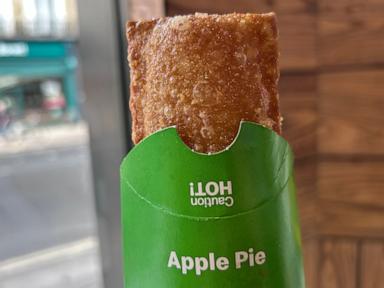
The blistered skin of a perfect fast-food apple pie is something you feel before you taste it. It is a texture engineered by destiny and a searing vat of vegetable oil. If you grew up before the closing decade of the twentieth century, your tongue likely carries the faint, ghostly scar of molten cinnamon-apple filling. It was a beautiful hazard. You waited in the vinyl booth, staring at that little cardboard sleeve, knowing the first bite was a high-stakes gamble between pure bliss and a third-degree burn.
Then, the world changed. If you liked this article, you might want to look at: this related article.
In 1992, without a national day of mourning, McDonald’s pulled the plug. The deep fryers were drained of the oil reserved for dessert. In came the convection ovens. Out came a baked version of the apple pie, marketed as a healthier, more sensible alternative for a society suddenly obsessed with dietary fat grams. The crust became pale, doughy, and cross-hatched. It was safe. It was neat. It was, undeniably, a betrayal. For thirty-four years, a generation of diners has carried a quiet, nostalgic grief for the crunch that used to be.
But history has a strange way of looping back on itself when we need comfort the most. For another perspective on this story, check out the recent coverage from ELLE.
To mark the seminal occasion of America’s 250th birthday, the golden arches are turning back the clock. The fryers are being refilled. The blisters are coming back. In a massive national rollout designed to coincide with the Semiquincentennial celebrations, the original fried apple pie is making its triumphant return to menus across the United States.
This is not just a corporate promotion. It is a time machine disguised as a dessert.
Consider a hypothetical diner named Sarah. In 1988, she was ten years old, sitting in the backseat of a wood-paneled station wagon, her fingers stained with grease from a paper bag. Her grandmother would pass back a fried apple pie, still radiating heat like a freshly mined coal. That pie represented a specific kind of American weekend—unstructured, indulgent, and entirely unbothered by the anxieties of modern life. When Sarah walks into a franchise today, she isn't just looking for a sugar rush. She is looking for that station wagon. She is looking for her grandmother.
McDonald's executives know this. They understand that food is the most direct pipeline to human emotion.
The decision to swap frying for baking in the nineties was driven by a massive corporate pivot toward nutrition, spearheaded by consumer advocacy groups. The baked pie was objectively lower in fat, but it lacked a soul. It lacked the shattering acoustic crunch that occurred when teeth met fried dough. Over the decades, the brand kept the fried pie alive only in select, rogue pockets of the country—most notably in Hawaii and a few legacy locations in Southern California. For the rest of mainland America, the fried pie became a myth, a legend whispered about on internet forums by disgruntled Millennials and Baby Boomers.
To understand why this return matters, you have to look at the mechanics of the pie itself.
A baked pie relies on a traditional shortcrust pastry. It mimics the homemade style of a Sunday kitchen, but under heat lamps, it often turns dense and chewy. The fried pie is a entirely different beast. It uses a specialized dough that expands rapidly when submerged in boiling oil, creating pockets of air that trap steam. This process creates a micro-thin, crispy shell that protects the molten interior. It is an industrial masterpiece.
The rollout for the 250th birthday celebration is a logistical gauntlet. Kitchens across the country have had to reconfigure their dessert stations, ensuring that the oil temperature stays at an exact, punishing metric to achieve that perfect bubbling without burning the delicate apple filling. It requires precision. It requires patience.
There is a vulnerability in this corporate nostalgia. By bringing back a product from 1992, the company is openly admitting that sometimes, the old ways were better. It is an acknowledgment that the march of progress often leaves behind the very things that made us feel secure. In an era defined by digital screens, shifting social landscapes, and economic uncertainty, a hot, crispy pie for a couple of dollars is a democratic luxury. It is something everyone can agree on.
Step up to the counter. Order the pie. Hold the cardboard box and feel the heat radiating through the paper, just like it did decades ago. Take a bite. Listen to the crunch.
The molten filling still burns a little bit, but this time, you won’t mind at all.