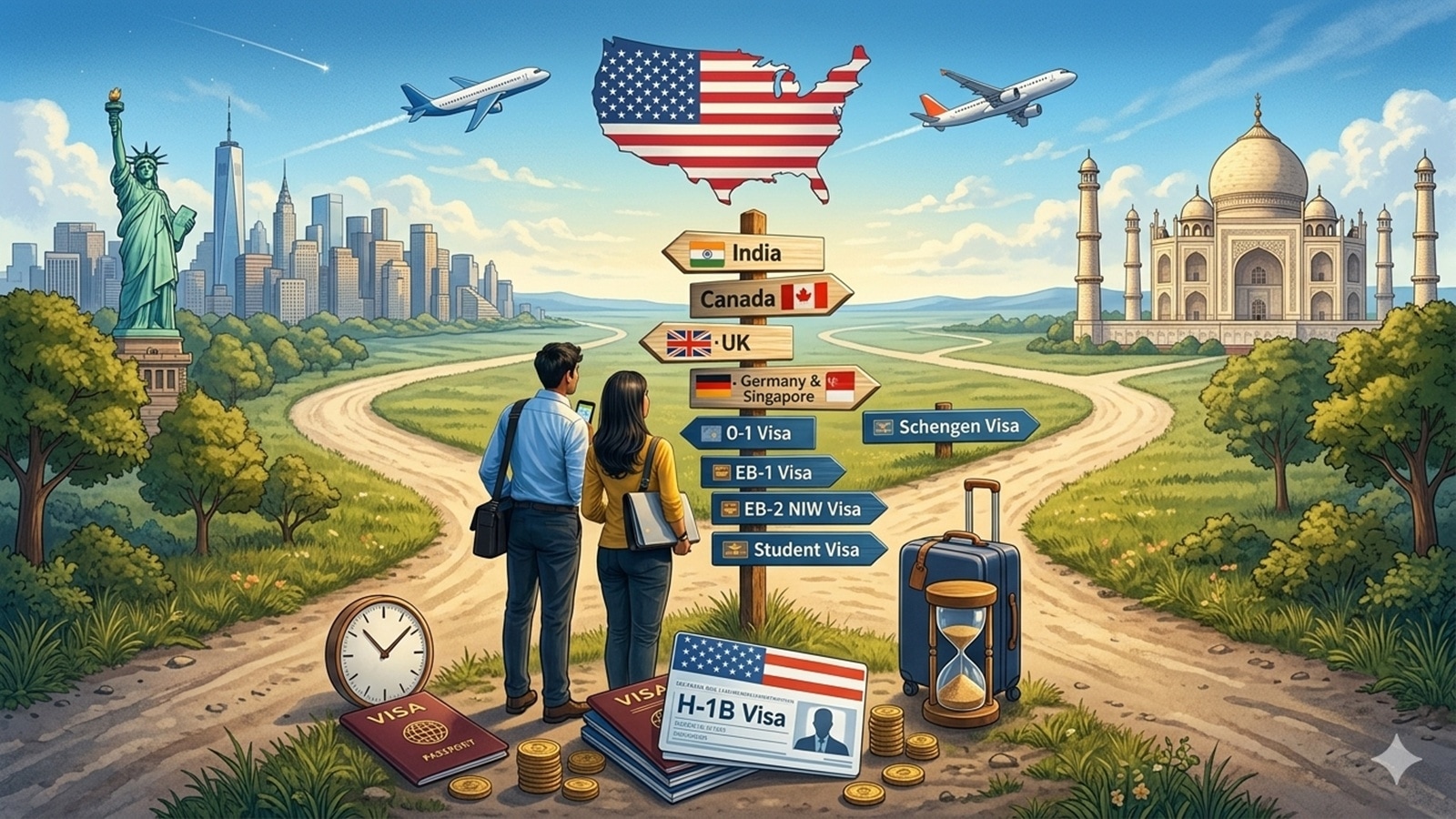
The notification arrives at 3:00 AM. It is a sterile, automated email from a government portal, but to the person staring at the blue light of a smartphone in a dark bedroom, it feels like a physical blow to the chest.
Arjun is an AI researcher in San Francisco. He has spent the last four years building neural networks that can detect early-stage lung cancer with a precision that defies human capability. He pays his taxes. He shops at the local bodega. He has a favorite park bench. But in the eyes of the United States immigration system, Arjun is currently a lottery ticket that didn't get picked.
For decades, the H-1B visa has been the primary bridge for global talent to cross into the American economy. It was designed as a pathway for "specialty occupations," a way for companies to fill gaps in highly technical fields. But today, that bridge is crumbling under the weight of its own bureaucracy. The system relies on a literal random selection process. It does not matter if you are a junior coder at a legacy bank or a visionary scientist on the verge of a medical breakthrough; if the computer doesn't spit out your number, your life in America has an expiration date.
The math is brutal. In recent years, hundreds of thousands of applicants have vied for a static cap of 85,000 visas. It is a game of musical chairs played with the lives of the people who build our operating systems and secure our power grids.
When the music stops and there is no chair for someone like Arjun, the panic sets in. It isn't just about a job. It is about the lease on the apartment, the car in the driveway, and the terrifying prospect of dismantling a life in sixty days. But a quiet, high-stakes migration is happening beneath the surface of this crisis. The brightest minds are no longer waiting for the luck of the draw. They are moving toward the "extraordinary."
The Pivot to Excellence
The O-1 visa used to be the "Einstein Visa." It was a niche category reserved for Nobel laureates, Oscar winners, and athletes with gold medals around their necks. It was the velvet rope of immigration.
But as the H-1B becomes a statistical impossibility, the definition of "extraordinary ability" is being tested and expanded by the tech elite. To qualify for an O-1, you don't necessarily need a trophy on your mantle, but you do need a paper trail of brilliance. You need peer-reviewed journals, high salaries that prove your market value, and evidence that you have played a critical role in an organization with a distinguished reputation.
Consider Sarah, a hypothetical but representative founder of a fintech startup. She realized early on that her H-1B was a ticking time bomb. Instead of praying for the lottery, she spent eighteen months meticulously documenting her worth. She spoke at international conferences. She judged industry hackathons. She secured venture capital from firms that the government recognizes as "distinguished."
Sarah shifted the narrative from I hope you want me to You cannot afford to lose me.
This shift is not merely a change in paperwork; it is a change in the power dynamic of global labor. The O-1 and its permanent-resident cousin, the EB-1, are becoming the preferred lifeboats for the world’s most talented individuals. Unlike the H-1B, which ties an employee to a specific boss in a form of modern indentured servitude, these "extraordinary" pathways offer a level of prestige and, eventually, a much faster track to a Green Card.
The cost, however, is an invisible barrier to entry. The legal fees for an O-1 petition can run into the tens of thousands of dollars. The emotional toll of proving you are "extraordinary" to a government adjudicator who may not understand the nuances of large language models or quantum cryptography is immense. It requires a level of self-documentation that feels almost clinical. You have to dissect your career and present it as a specimen.
The National Interest Loophole
There is another path, one that feels more like a quiet conversation in a back room than a public auction. It is the EB-2 National Interest Waiver (NIW).
Under normal circumstances, an EB-2 visa requires a "Labor Certification." This is a grueling process where a company must prove to the Department of Labor that there are no qualified Americans willing to take the job. It is a protectionist hurdle designed to ensure that foreign labor doesn't undercut local wages.
But the NIW allows an applicant to skip that entire process. To win this, you must prove that your work has "substantial merit and national importance." You are essentially telling the United States government: My presence here is a matter of national progress.
This was once a narrow gate. But as the "Great Tech Race" with global superpowers intensifies, the definition of national importance is widening. If you are working on semiconductors, cybersecurity, or green energy, the government is increasingly likely to agree that your contribution outweighs the need for a labor market test.
This creates a two-tiered system. On one side, you have the "lottery class"—thousands of essential workers trapped in a cycle of renewals and anxiety. On the other, you have the "talent class"—individuals who have the resources or the specific technical niche to bypass the queue.
The tightening of H-1B norms—the increased scrutiny on "third-party worksites," the higher rejection rates for "specialty occupation" status, and the sheer volume of applicants—is forcing a Darwinian evolution in immigration. The middle ground is disappearing. You are either lucky, or you are exceptional.
The Cost of the Wait
We often talk about immigration in terms of policy and percentages. We forget the sensory reality of the "Permit Pending" life. It is the inability to buy a house because your status is tied to a three-year stamp. It is the mid-year trip back home to see a dying relative that turns into a nightmare because a visa "administrative processing" delay keeps you stuck in a foreign consulate for four months while your life in America continues without you.
There is a specific kind of exhaustion that comes from being an "alien."
The surge in O-1 and EB pathways is a symptom of a deeper fever. The United States is currently the world’s greatest magnet for talent, but the magnet is losing its charge. Other countries—Canada, the UK, Australia—have watched our bureaucratic gridlock and sensed an opportunity. They are launching "High Potential Individual" visas and "Global Talent" streams that don't involve lotteries or decades-long waitlists.
They are offering something the US currently cannot: certainty.
Arjun, the researcher from the 3:00 AM email, eventually found a way. He didn't win the lottery. Instead, his company hired a top-tier law firm to pivot his application to an O-1. They spent months gathering recommendation letters from the world's leading oncologists. They proved that his algorithm wasn't just a piece of code, but a national asset.
He stayed. But many of his colleagues did not. They took their degrees, their patents, and their tax brackets to Toronto and London. They tired of the feeling that their worth was being decided by a random number generator.
The shift toward O-1 and EB pathways isn't just a trend in immigration law. It is a survival strategy for the American innovation engine. We are moving toward a world where the only way to stay in the room is to prove you are the most important person in it.
But a room that only welcomes the extraordinary eventually becomes a very lonely place. We are built on the backs of people who came here to become extraordinary, not just those who arrived that way.
The blue light of the smartphone continues to flicker in bedrooms across the country. Every year, the lottery runs. Every year, the numbers get worse. And every year, the most talented people we have are forced to decide if the American Dream is worth the American Bureaucracy.
A scientist stands at a window in a lab in Palo Alto. She is holding a breakthrough in her hands. She is also holding a one-way ticket to a country that won't make her prove she is a genius every three years. She looks at the ticket. She looks at the lab. She wonders which one holds her future.