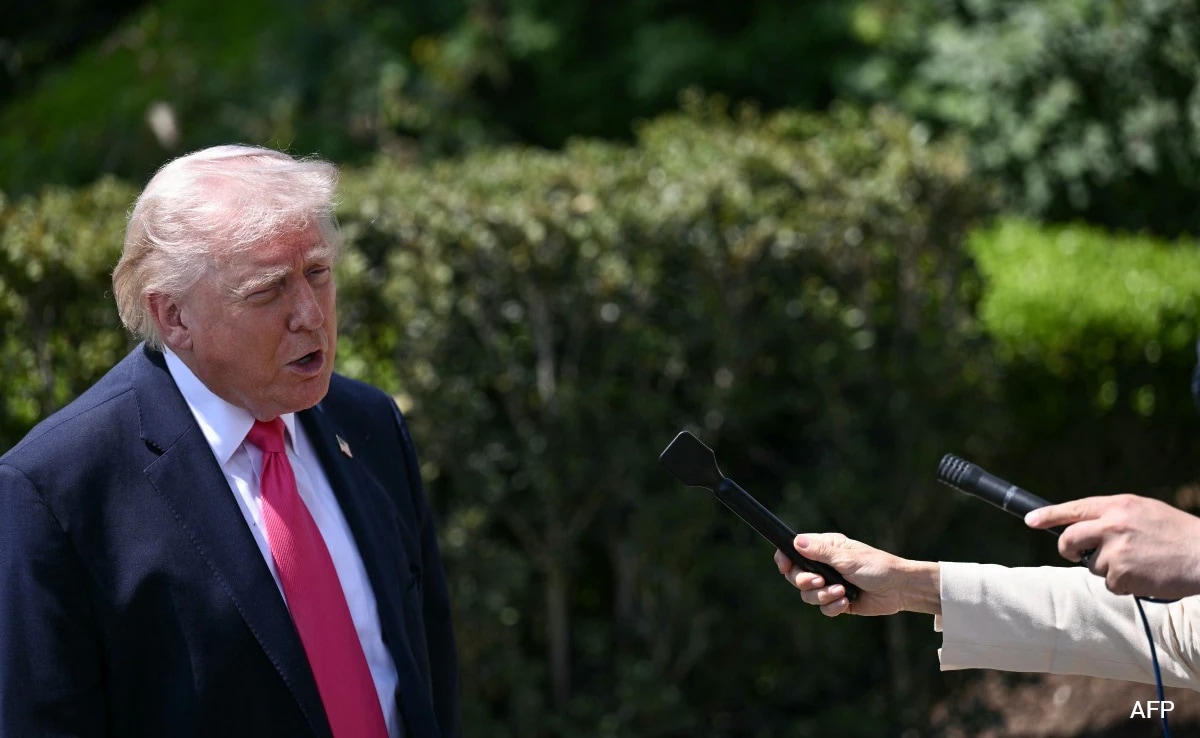
The air inside a private jet is different. It’s recycled, pressurized, and carries the faint, sterile scent of leather cleaner and expensive cologne. Thousands of feet below, the world is a patchwork of borders and ancient cities, but from the cabin of a Boeing 757, those borders look like lines on a map rather than scars on the earth. This is the vantage point of Donald Trump, a man whose life has been defined by the verticality of skylines and the sharp edges of the deal.
Across the Atlantic, a man in a white cassock walks through the dust of a refugee camp or sits in a wooden chair in a drafty Vatican hall. Pope Francis views the world from the ground up. To him, the world isn't a series of assets to be managed or threats to be neutralized; it’s a shivering flock in need of a shepherd.
When these two worldviews collided during a 2016 exchange that crackled through the international news cycle, it wasn't just a political spat. It was a friction between two entirely different philosophies of survival.
The Wall and the Bridge
Think of a home. For some, a home is only safe if it has a reinforced door, a security system, and a clear boundary that says mine and not yours. For others, a home is defined by the warmth of its hearth and how many people can fit around the table.
Donald Trump looked at the shifting demographics of the West and saw a breach. He saw a world that was, in his own words, "nasty." He spoke of it with the grit of a New York developer who knows that if you don't secure the perimeter, you lose the building. When Pope Francis suggested that anyone who thinks only about building walls and not building bridges is "not Christian," the reaction from the Trump camp was instantaneous. It wasn't just a rebuttal. It was a lecture on the reality of the street.
Trump’s response was a masterpiece of his signature style: a blend of personal defense and a grim warning. He didn't attack the Pope's character—not directly. He even called him a "wonderful guy." But he framed the Pontiff as a man insulated by the very walls he criticized. The Vatican, after all, is a city-state surrounded by massive stone fortifications. To Trump, the Pope was a visionary living in a dream, unaware that the wolves were at the gate.
The Invisible Stakes of a Holy War
We often treat these headlines as fleeting moments of high-stakes drama, but the underlying tension is something we all feel in our own lives. It’s the tension between idealism and pragmatism.
Imagine you are walking down a dark alley. You see a stranger approaching. Your heart rate spikes. The "Trump" part of your brain tells you to tighten your grip on your keys, to look for an exit, to prepare for the worst because the world is a dangerous place. The "Francis" part of your brain reminds you that this stranger might be lost, hungry, or simply a fellow traveler in the dark.
Which voice do you listen to?
Trump bet his entire political identity on the idea that the "nasty world" is the only world that exists. He argued that if and when the Islamic State attacked the Vatican—which he called the "ultimate trophy"—the Pope would have wished and prayed that Donald Trump were President. It was a bold, almost cinematic assertion. He was positioning himself as the rough man standing ready to do violence so the holy man could sleep in peace.
But there is a cost to that kind of protection.
The Currency of Fear
When we start to view every outsider as a potential invader, the texture of our society changes. We become more efficient, perhaps. We certainly become more guarded. But the "nasty world" Trump described becomes a self-fulfilling prophecy. If you treat everyone like a combatant, you eventually find yourself in a war.
The Pope’s perspective is rooted in a history that stretches back two millennia, a history that has seen empires rise and fall, walls crumble, and borders vanish. He isn't naive to the existence of evil; he simply believes that meeting evil with its own tools—exclusion and suspicion—is a losing game for the soul.
The facts of the matter in 2016 were straightforward: the Pope made a comment on a plane, and a candidate responded at a rally. But the human element was the sudden, jarring realization that we were being asked to choose between two different kinds of safety. One is the safety of the fortress. The other is the safety of the community.
When the Secular Meets the Sacred
It is rare to see a secular leader tell a religious leader that they are wrong about the nature of reality. Usually, politicians court the favor of the clergy with practiced ease. But Trump didn't see a reason to defer. In his mind, he was the expert on "nasty." He had navigated the shark-infested waters of Manhattan real estate, weathered bankruptcies, and fought his way to the top of the cultural heap.
He looked at the Pope and saw a man who had the luxury of being kind because people like Trump were the ones holding the line.
Consider the logistics of the Vatican. It is one of the most secure places on earth. It has its own police force, the Swiss Guard, and rigorous screening processes for those who enter. Trump’s argument was that the Pope was a hypocrite, or at the very least, woefully disconnected from the struggle of the average citizen who doesn't have a Swiss Guard.
The Pope, however, wasn't talking about the literal bricks of the Vatican. He was talking about the architecture of the human heart.
The Echo in the Modern Mind
We live in a time where these two figures represent the poles of our global conversation. On one side, we have the rise of the sovereign, the protector, the person who promises to put "us" first and "them" last. On the other, we have the call for universal brotherhood, the insistence that there is no "them," only "us."
The friction between Trump and the Pope wasn't a misunderstanding. It was a perfect understanding of a fundamental disagreement.
Trump believed that the world is a zero-sum game. For one person to win, another must lose. For a country to be safe, its borders must be hard. The Pope believes that the world is a common home. For one person to truly win, the dignity of all must be upheld.
This isn't just about politics or religion. It’s about how we choose to see the person standing next to us at the grocery store or the family we see on the evening news fleeing a conflict halfway across the globe.
The Weight of the Crown and the Cross
Power is a heavy thing, but it weighs differently depending on how you carry it.
For Trump, power is a shield and a sword. It is something to be wielded to ensure that your side is the one that survives the "nasty" world. It’s the power of the deal, the power of the wall, the power of the brand. It is effective, visible, and terrifyingly fragile if the wall ever cracks.
For Francis, power is a burden of service. It’s the power of the gesture, the power of the prayer, the power of the open door. It is often quiet, frequently ignored, and remarkably resilient because it doesn't depend on physical strength.
The world watched as these two men traded barbs across an ocean. It was a spectacle, yes. It was a headline. But it was also a mirror.
We look at Trump and we see our own fears—our desire to be protected, our anxiety about the future, our need to know that someone is standing guard. We look at Francis and we see our own aspirations—our hope for a better version of ourselves, our desire for peace, our belief that maybe, just maybe, we don't have to be afraid of each other.
The "nasty world" is real. There is no denying the grit, the violence, and the cold reality of geopolitics. But the question that remained after the dust settled on that 2016 exchange wasn't about who won the argument. It was about which world we wanted to build.
One man pointed to the stones of the wall. The other pointed to the people standing on either side of it.
The plane lands. The motorcade moves. The bells of the basilica ring out over the square. The world remains as complicated and as beautiful as it has ever been, caught between the need for a roof and the need for a horizon.