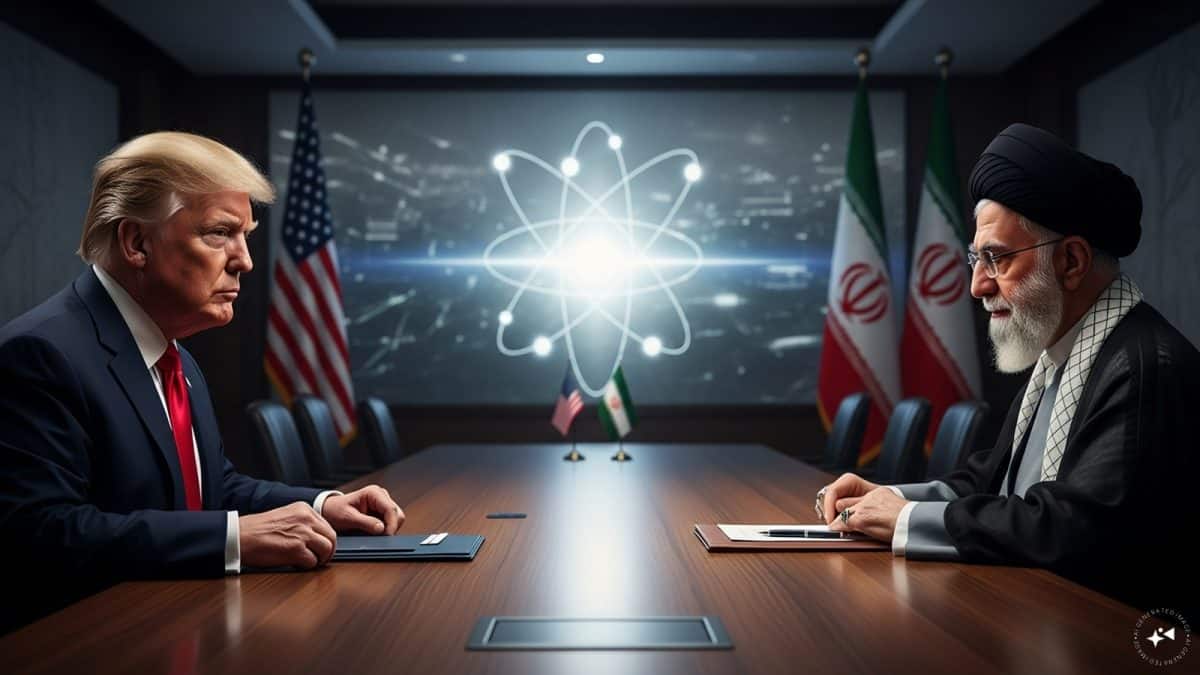
The heavy oak doors of the Palais des Nations in Geneva do not just swing; they seal. Behind them, the air always smells faintly of old paper and expensive floor wax, a scent that masks the metallic tang of anxiety. Today, that anxiety is thick enough to taste.
In this room, the world’s most dangerous math problem is being solved by men in tailored suits who haven't slept in thirty-six hours. On one side, the American delegation, clutching briefings that detail the terrifyingly short "breakout time"—the handful of weeks it would take for Iranian centrifuges to spin enough uranium into a weapon. On the other, the Iranians, focused on the crushing weight of sanctions that have turned their once-vibrant economy into a ghost of its former self.
Between them lies a table. It is wide, polished, and represents a chasm that hasn't been truly crossed in decades.
This is not a dry diplomatic briefing. It is a desperate scramble to stop a clock that is ticking toward midnight. If these talks fail, we aren't just looking at another failed treaty. We are looking at a shadow war that could spill out of the dark and into the streets of every capital in the Middle East.
The Physics of Fear
To understand why a room in Switzerland matters to a baker in Tehran or a software engineer in Virginia, you have to understand the invisible machinery of nuclear enrichment. Imagine a playground carousel. Now imagine spinning it so fast that it begins to hum, then scream, then vibrate at a frequency that threatens to tear the metal apart.
Inside a centrifuge, uranium hexafluoride gas is spun at supersonic speeds. The goal is to separate the heavy isotopes from the light ones. For a civilian power plant, you only need about 4% or 5% purity. It’s a slow, steady burn to keep the lights on. But once you hit 60%—which is where Iran stands today—the physics changes. You’ve done the hard part. The climb from 60% to 90%, the grade needed for a warhead, is a short, steep sprint.
For the Americans, that 60% is a red line written in fire. For the Iranians, it is their only leverage.
Consider a hypothetical student in Isfahan named Amin. Amin is brilliant. He studies nuclear physics not because he wants to build a bomb, but because he wants his country to be a leader in high-tech medicine and energy. But Amin lives in a world where his bank account is frozen, his mother can't find imported heart medication, and his research is viewed by the West as a prelude to Armageddon.
When the negotiators argue over "Advanced IR-6 Centrifuges," they aren't just talking about hardware. They are talking about the limits of Amin’s future and the safety of his counterparts in Tel Aviv or Washington.
The Ghost at the Table
There is a third party in the room, though they aren't listed on any official delegate roster: the ghost of 2018.
That was the year the previous agreement was torn up. Trust is a fragile thing, easily shattered and nearly impossible to glue back together. The Iranians remember the promises made and broken. The Americans remember the decades of "Death to America" rhetoric and the shadow of proxy conflicts.
Because of this, the conversation in Geneva isn't about friendship. It’s about verification.
"Trust, but verify" is an old cliché, but here, it’s a matter of cameras and seals. The International Atomic Energy Agency (IAEA) wants eyes everywhere. They want sensors that can detect a single stray atom of enriched material. The Iranians see these cameras as an intrusion, a violation of their sovereignty.
The tension in the room is a physical weight. Every time a negotiator sighs, every time a chair scrapes against the floor, it echoes. They are debating "snapback" mechanisms—the ability to instantly re-impose sanctions if Iran cheats. They are debating the "sunset clauses"—the dates when restrictions on Iran's program would naturally expire.
But they are really debating whether they can live in a world where the other side exists.
The Economics of Despair
Outside the Palais, the jet-setters of Geneva move between high-end watch boutiques and lakeside cafes. Inside, the talk turns to oil and gold.
Sanctions are often described as "surgical," but that is a lie. Sanctions are a blunt instrument. They are a siege. When the U.S. cuts off Iran from the global banking system, it doesn't just hurt the generals in the Revolutionary Guard. It hurts the shopkeeper who can no longer afford to stock his shelves. It hurts the father who watches the value of his life savings evaporate in a single afternoon.
The Iranian negotiators are under immense pressure from home. They need a win. They need the "oil for peace" trade-off to be real and immediate. They need to go back to Tehran and say that the siege is over.
The Americans have their own pressure. The political climate in D.C. is a tinderbox. Any deal that looks "soft" will be shredded by a Congress that is increasingly skeptical of diplomacy. The specter of an Israeli strike on Iranian facilities looms over every sentence. If the talks stall, the jets might move.
The stakes aren't just about a treaty. They are about preventing a regional wildfire that would send oil prices to $200 a barrel and drag the world back into a conflict it cannot afford.
The Art of the "Last Ditch"
We call these "last-ditch efforts" because that's exactly what they are. A ditch is where you go when you have nowhere else to hide.
The negotiators in Geneva are currently trading words like "sequencing" and "compliance."
"You lift the sanctions first."
"No, you dismantle the centrifuges first."
It’s a high-stakes game of chicken where both drivers are blindfolded.
The reality is that neither side can get everything they want. A "good" deal in this room is one that makes everyone equally unhappy. It is a compromise born of exhaustion rather than enthusiasm.
Think of a bridge that has been bombed out. To fix it, you have to start by throwing a single, thin rope across the gap. You can't drive a truck over it yet. You can't even walk across it. But that rope allows you to pull a thicker cable, and then another, and another.
Geneva is that first, thin rope.
The Silence After the Storm
If the talks end today with a joint statement, the world will breathe a collective, if temporary, sigh of relief. The markets will stabilize. The headlines will move on to the next crisis.
But if the doors open and the delegates walk out in silence, with their heads down and their motorcades idling, the silence will be deafening. It will be the silence that precedes a storm.
It’s easy to look at these men in Geneva and see them as cogs in a geopolitical machine. But look closer. Look at the way they rub their eyes. Look at the way they stare at their phones, waiting for a call from a capital thousands of miles away. They are human beings trying to contain a force—nuclear energy—that we were perhaps never meant to master.
They are trying to negotiate with the laws of physics and the scars of history simultaneously.
As the sun sets over Lake Geneva, hitting the snow-capped peaks of the Alps, the lights in the meeting rooms stay on. The translators are on their fifth pot of coffee. The security guards stand at attention, watching the clock.
Everyone is waiting.
The world is a collection of billions of stories, most of them small and quiet. A mother tucking her child into bed in Chicago. A farmer tending his wheat in the Iranian countryside. A nurse starting her shift in London. None of them are in that room in Geneva. Yet, the outcome of the whispers behind those oak doors will dictate the rhythm of their lives for the next decade.
We live in an age of noise, but the most important things often happen in total stillness.
The pen is hovering over the paper. The ink is dry. The clock is ticking.
The only question left is whether anyone has the courage to blink first.