Dr. Elena Rossi spent most of her career staring at a ghost. For twenty years, she pointed her instruments toward a galaxy named NGC 1275, located in the heart of the Perseus cluster. To the untrained eye, it was a smudge of light 230 million light-years away. To a radio astronomer, it was a tomb. At its center sat a supermassive black hole—a monster with the mass of billions of suns—that had been effectively dormant for 100 million years.
It was silent. It was cold. It was, for all intents and purposes, dead.
Then, the needles moved.
We tend to think of the universe as a slow-motion clock, a place where change happens over billions of years, far beyond the reach of a human lifespan. We find comfort in that scale. It makes the chaos of our own world feel small. But space is not a museum. It is a pressure cooker. When the black hole in NGC 1275 "woke up," it didn't just flicker. It erupted with the force of a billion volcanic blasts, sending ripples through the fabric of the cosmos that we are only now beginning to comprehend.
The Long Sleep of a Predator
Imagine a city that hasn't seen a single person walk its streets since the middle of the Cretaceous period. When this black hole last ate, dinosaurs were still the undisputed masters of Earth. The galaxy around it had settled into a fragile peace. Gas clouds drifted lazily. Stars burned through their fuel in predictable cycles. The central engine, the gravitational heart of the galaxy, had run out of "food"—the gas and dust required to power its terrifying luminosity.
Astronomers call this a "quiescent" state. It’s a polite way of saying the monster is napping.
During this 100-million-year slumber, the space surrounding the black hole became cluttered. Cold gas began to pool, settling into the gravity well like autumn leaves clogging a storm drain. In the vacuum of space, "cold" is a relative term, usually hovering just a few degrees above absolute zero. This gas is the lifeblood of a galaxy; it is the raw material from which stars are born. But when too much of it gathers near a supermassive black hole, the peace is destined to end.
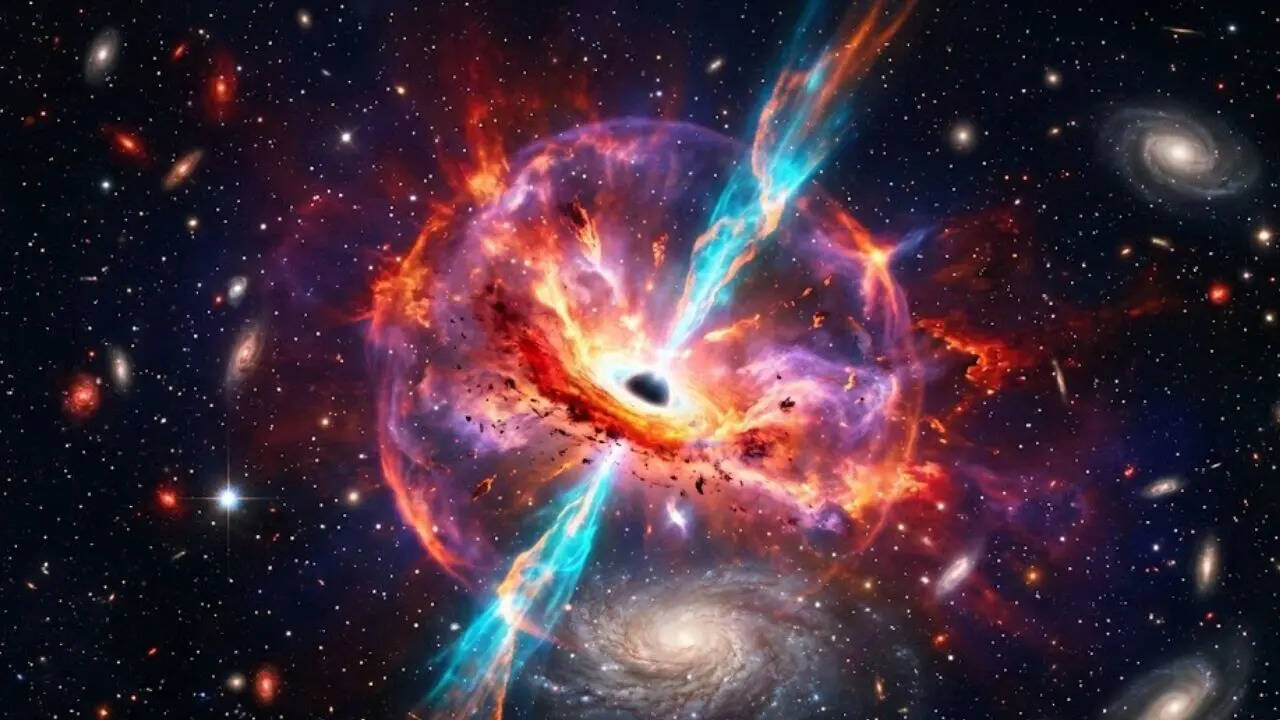
The shift happened with startling speed. Gravity, that patient and relentless sculptor, finally pulled the accumulated gas past the point of no return. As the matter spiraled inward, it began to rub against itself. Friction at cosmic scales creates heat that defies imagination. The gas didn't just warm up; it turned into a raging plasma, screaming as it was accelerated to nearly the speed of light.
The Cosmic Pressure Valve
When a volcano erupts on Earth, we see the release of internal pressure. Magma finds a weak point in the crust and explodes upward. A black hole eruption follows a similar, albeit more violent, logic. As the "food" falls in, not all of it is swallowed. The magnetic fields around the black hole become so tightly wound—like a spring coiled past its breaking point—that they funnel some of the incoming plasma into two Narrow, incredibly powerful jets.
These jets are the "eruption."
They blasted out of the galactic center like twin blowtorches, punching through the surrounding gas and carving out enormous cavities in the intergalactic medium. These aren't just small pockets. Each cavity is large enough to swallow our entire Milky Way galaxy whole.
Consider the energy required to do that. If you took every nuclear weapon ever built on Earth and detonated them all at once, you wouldn't even produce a trillionth of the energy released in a single second of this eruption. It is a display of power that renders our vocabulary useless.
But why does this matter to us? Why should a person sitting in a coffee shop in 2026 care about a galactic belch that happened millions of years ago in a neighborhood we will never visit?
The answer lies in the "Thermostat Problem."
The Invisible Stakes of Galactic Weather
Galaxies are delicate ecosystems. If they get too cold, they collapse. If they get too hot, they can’t form stars, and they become "red and dead"—cemeteries of aging suns with no new generations to take their place. For a long time, astronomers couldn't figure out why large galaxies didn't just keep growing forever. There seemed to be an invisible hand keeping them in check.
We now know that black holes are the cosmic thermostats.
When the black hole in NGC 1275 erupted, the shockwaves it sent out acted like a heater for the entire Perseus cluster. The ripples—sound waves, essentially, though at a frequency 57 octaves below middle C—vibrated through the surrounding gas. This vibration prevented the gas from cooling down and falling back into the galaxy to form new stars.
The eruption is an act of preservation through destruction. By "waking up" and screaming into the void, the black hole stops the galaxy from choking on its own growth. It regulates the birth rate of stars. It maintains the status quo.
This realization changed everything for people like Rossi. We used to view black holes as pure villains—the vacuum cleaners of the universe that destroy everything they touch. Now, we see them as the master gardeners. They prune the hedges. They clear the brush. They ensure the forest doesn't burn itself out.
The Human Perspective on Infinite Time
There is a profound loneliness in studying these events. You are looking at a "now" that actually happened when the first flowers were just beginning to evolve on Earth. The light hitting the telescope is a postcard from a dead era.
When the data first came across the screens, showing the sudden spike in X-ray emissions and the reshaping of the radio lobes, the atmosphere in the lab wasn't one of clinical detachment. It was one of awe. There is a specific kind of vertigo that comes from realizing you are witnessing a 100-million-year-old silence being broken.
"It felt like someone had finally turned the engine back on," one researcher remarked. "You spend your whole life looking at a parked car, and suddenly, the exhaust starts spitting fire."
The technology we use to track these eruptions is, itself, a marvel of human stubbornness. We use arrays of telescopes scattered across continents, synced to the nanosecond, to create a virtual lens the size of the Earth. We are a species that lives for eighty years, using bits of glass and silicon to eavesdrop on the conversations of giants that live for trillions.
It is a lopsided relationship. The black hole doesn't know we exist. It doesn't care that we've mapped its jets or measured the temperature of its plasma. It is simply a physical inevitability, a knot in the rug of spacetime.
The Weight of the Void
The real impact of the NGC 1275 eruption isn't found in the data tables or the peer-reviewed journals. It’s found in the way it forces us to recalibrate our sense of importance.
We live in a world of immediate crises. We worry about the next quarter, the next election, the next notification on our phones. Our horizon is often no further than the end of the week. Then, a ghost in the deep sky wakes up and reminds us that there are processes in motion that make our entire history look like a heartbeat.
The eruption is still happening. As you read this sentence, those jets are still screaming across the light-years, pushing away the cold dark, and shaping the future of a hundred billion stars. The sound waves are still traveling, a low, tectonic thrumming that defines the rhythm of the cosmos.
We are small. We are fleeting. We are observers of a drama so vast that we can only see the tiniest fraction of the stage.
But there is beauty in that smallness. The fact that a collection of carbon and water—us—can stand on a spinning rock and look up, calculate the speed of a jet, and feel the weight of a 100-million-year sleep, is perhaps the most unlikely thing in the universe. We are the way the universe looks at itself in the mirror. And right now, the mirror is reflecting a volcano made of gravity and light, erupting in the dark, keeping the fires of a galaxy burning just long enough for someone to notice.
The giant is awake. And the silence it broke was only ever a pause between breaths.