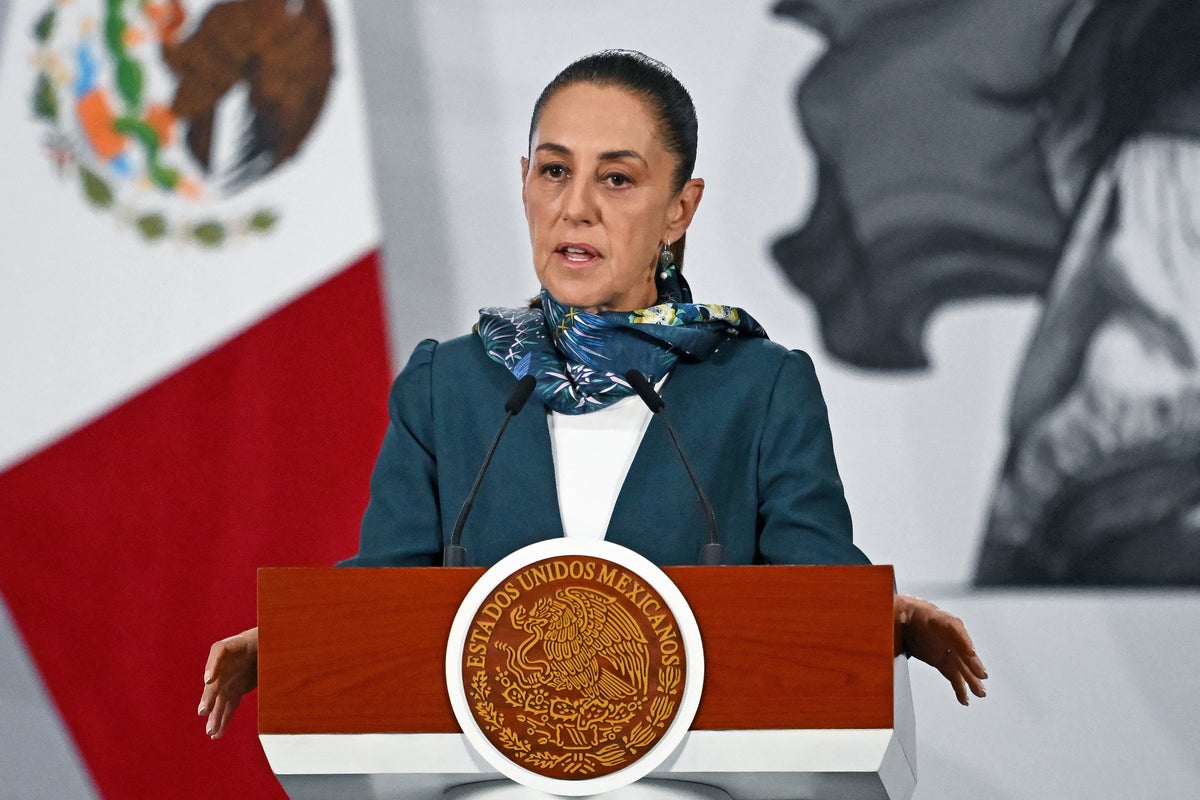
The air in the National Palace is heavy, thick with the scent of centuries-old stone and the quiet weight of a nation’s secrets. When the President of Mexico stands behind the podium, he isn't just speaking to a room of journalists. He is speaking to a history of shadows.
Recently, a report surfaced—a whisper that grew into a roar—suggesting that the CIA had been authorized to conduct lethal operations against Mexican cartels. Not just intelligence gathering. Not just tracking. But the kind of kinetic, terminal intervention usually reserved for war zones in the Middle East.
The President’s denial was swift. It was firm. It was also, in the eyes of many who have watched the border for decades, an inevitable piece of political theater.
To understand why this denial matters, you have to look past the ink on the page and into the dusty streets of Culiacán or the high-tech hallways of Langley. Imagine a young officer in an unmarked van, monitors glowing with thermal feeds of a mountain compound. They see a target. They have the capability to end a threat that has claimed thousands of lives. But between that finger and the trigger lies the most volatile thing in North American politics: sovereignty.
The Friction of Two Truths
Mexico and the United States share more than a three-thousand-kilometer border; they share a blood-soaked history of "cooperation" that often looks like intrusion.
The report in question suggests a fundamental shift. It claims that during a previous administration, the rules of engagement changed. It hints at a world where the lines between law enforcement and assassination blurred until they vanished. When the current administration denies these reports, they aren't necessarily saying the events didn't happen in the dark. They are saying that, officially, the Mexican state remains the sole master of its house.
Sovereignty isn't just a word found in dusty legal textbooks. It is the pride of a father who wants to know that his country’s laws apply to everyone. It is the shield that protected Mexico from centuries of northern expansionism. To admit that a foreign agency is conducting "lethal operations" on your soil is to admit that you have lost control.
But control is a ghost in the sierras.
The Architecture of a Secret
If you were to design a perfect secret, it would look exactly like the drug war. It is a conflict defined by shifting alliances, where the "bad guys" sometimes work for the "good guys," and the lines of authority are as tangled as a knot of desert vipers.
Consider a hypothetical scenario—let's call it the "Midnight Decree." In this scenario, a high-ranking cartel leader is neutralized in a remote village. The official report says it was a Mexican Navy operation. The locals, however, describe drones that didn't sound like anything in the Mexican inventory. They talk about men who spoke Spanish with the flat, rehearsed cadence of a foreign intelligence school.
The truth stays buried because it serves everyone. The U.S. gets its target. The Mexican government gets the credit for a "win" against the cartels. The public gets a sense of security, however fleeting.
This is the "invisible stake" of the current controversy. Every time a report like this emerges, it threatens to pull the curtain back on a machine that relies on total darkness to function. If the public truly understood the level of foreign involvement in domestic security, the political fallout would be a seismic event. It would trigger protests, diplomatic freezes, and a surge in the very nationalism that makes cooperation so difficult in the first place.
The Weight of the Body Count
While politicians trade denials and journalists hunt for leaks, the human cost continues to accumulate with a terrifying, rhythmic consistency.
For a mother in Michoacán, it doesn't matter if the bullet that killed the man who terrorized her village came from a Mexican rifle or a CIA-contracted drone. What matters is the vacuum left behind. The drug war is a hydra. You cut off one head, and three more grow, hungrier and more desperate than the last.
The reports of "lethal operations" suggest a strategy of decapitation. Target the bosses. Take out the capos. But history shows us that this rarely brings peace. Instead, it triggers a "democratization of violence." When a major cartel leader is removed, the organization fractures into dozens of smaller, more violent cells. They no longer just move drugs; they kidnap, they extort, they burn.
The CIA’s reported involvement isn't just about tactical success; it’s about a desperate search for a shortcut. The U.S. is tired of the flow of fentanyl. Mexico is tired of the flow of blood. In that exhaustion, the idea of a "clean" lethal operation becomes seductive.
It is a lie, of course. There is no such thing as a clean operation in a land where the infrastructure of the state and the infrastructure of the cartels are often the same building.
The Language of Denial
Listen closely to the words used in the National Palace. The denial isn't just a "no." It is a carefully constructed defense of the national psyche.
"We do not allow foreign intervention," the President says.
This phrase is a lightning rod. It connects back to the Mexican-American War, to the occupation of Veracruz, to every time a neighbor to the north decided they knew what was best for Mexico. For the Mexican voter, the idea of the CIA running wild in the countryside is a nightmare that eclipses even the violence of the cartels. It represents a loss of identity.
The reality of modern intelligence is that "intervention" is a spectrum. Is sharing real-time satellite data intervention? Is providing encrypted radios intervention? Is sitting in a command center and "advising" on a hit intervention?
The report alleges we moved past advice and into execution.
The denial is necessary because the alternative is a crisis of legitimacy. If the Mexican government admits that they need American assassins to do what their own military cannot, they are effectively resigning.
The Silence After the Storm
There is a specific kind of silence that follows these reports. It’s the silence of a town that knows the gunmen are still there, even if the soldiers have moved on.
We live in an era where facts are often treated as matters of opinion, but the logistics of a lethal operation are stubbornly physical. They require fuel, landing strips, local lookouts, and a way to disappear. You cannot hide a war forever.
The denial from the Palace serves as a temporary dam against a rising tide of questions. But beneath the surface, the machine continues to grind. The drones still hum in the high altitudes, invisible to the naked eye but felt in the sudden, violent shifts of the criminal underworld.
The human element of this story isn't found in the press releases. It’s found in the eyes of the soldiers who wonder who is really giving the orders. It’s found in the hearts of the citizens who have learned that the truth is something you only find in the graves.
We want to believe in a world of clear borders and honest leaders. We want to believe that "cooperation" means a handshake between equals. But the shadow of the CIA in Mexico suggests a much more complicated, much more intimate, and much more dangerous reality. It is a marriage of convenience where neither partner trusts the other, and the children—the people caught in the crossfire—are the ones who pay the price for the secrets kept in the dark.
The sun sets over the Zócalo, casting long, distorted shadows across the pavement. The tourists take their photos, the vendors sell their sweets, and the President retires to his quarters. The denial stands. The report lingers. And somewhere in the mountains, a red dot finds its mark on a man who never heard the engine coming.
Justice, vengeance, or intervention? The name depends entirely on which side of the border you are standing on, and how much of the truth you can afford to hear.