The air at seventeen thousand feet does not sustain life; it merely tolerates it. Up here, where the oxygen thins to a ghostly whisper and the wind strips the skin from an exposed cheek in seconds, the border between India and China is less a line on a map and more a scar carved into the roof of the world.
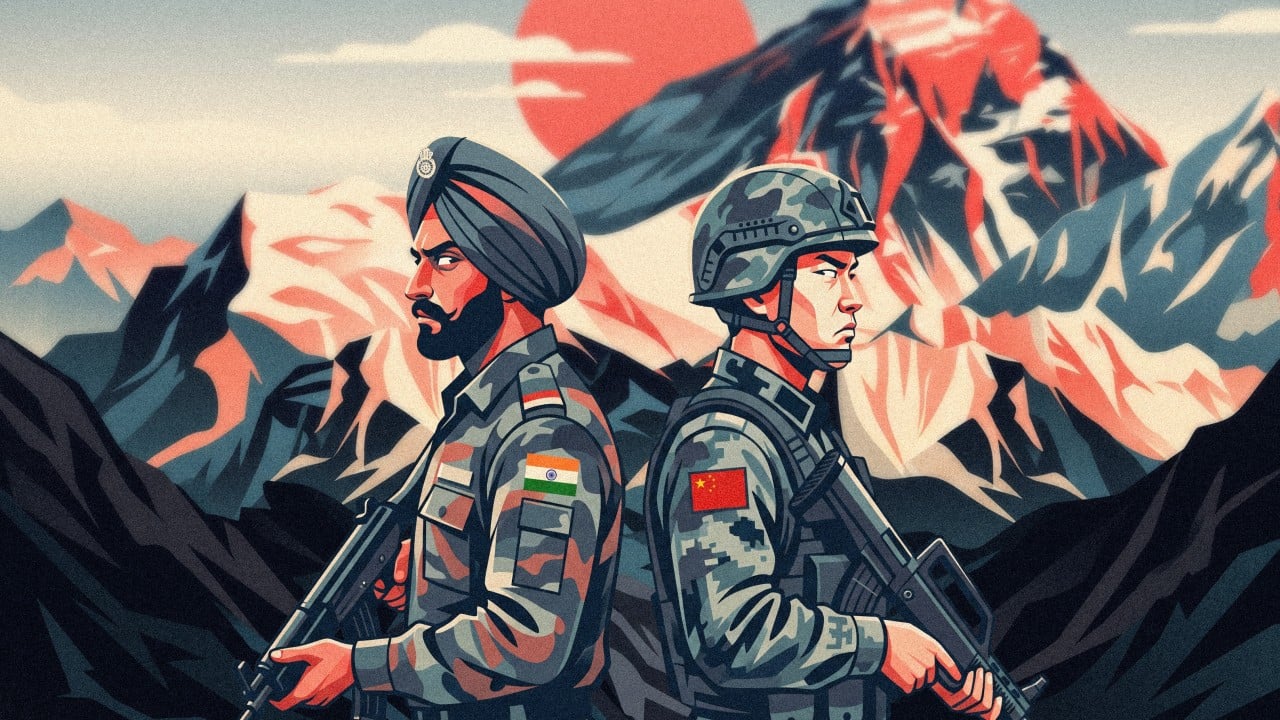
Consider a hypothetical young lieutenant named Manoj, stationed in the biting sub-zero gloom of the Eastern Ladakh sector. He pulls his woolen balaclava higher over his nose, his breath instantly freezing into a crust of white crystals against the fabric. Through his binoculars, across a jagged chasm of gray shale and blinding white snow, a People's Liberation Army soldier stares back through similar glass. They are separated by barely a mile of dead ground, yet the distance between them is measured in decades of distrust.
On paper, diplomats in Beijing and New Delhi have clapped hands. They have signed agreements, posed for flashing camera lenses against crimson carpets, and spoken grandly of a thaw. Patrol rights have been negotiated. Disengagement zones have been drawn with neat, ink-stained precision. But back down in the dirt, where the frostbite bites deep and the memory of the bloody summer of 2020 still stains the stones, the military relations between these two nuclear-armed giants are completely frozen in time.
Why? Because trust is heavy, and steel is cheap.
To understand why a diplomatic handshake in a lowland capital evaporates the moment it reaches the mountains, you have to look at the anatomy of the border itself. It is a maze of sheer cliffs, glacial valleys, and windswept plateaus known as the Line of Actual Control, or LAC. Unlike a traditional border marked by fences and customs booths, the LAC is a shifting ghost. Both nations claim overlapping slices of sovereignty. Both nations patrol aggressively to establish presence.
And presence, in military terms, is everything.
In October 2020, that presence turned lethal in the Galwan Valley. Crude weapons—studded clubs, iron rods, and barbed wire—shattered decades of relative quiet. Twenty Indian soldiers and an undisclosed number of Chinese troops perished not from long-range artillery, but in brutal, hand-to-hand desperation in the dark. That night etched a psychological scar so deep that bureaucratic announcements from distant capitals cannot simply scrub it clean.
Today, the diplomats point to autumn agreements that supposedly restored patrolling rights to disputed friction points like Depsang and Demchok. They talk about returning to the status quo of April 2020. But walk the ridges with the men who actually hold the line, and you hear a different story.
The physical infrastructure has only grown denser. During the years of diplomatic wrangling, both sides did not idle. They built.
On the Indian side, massive engineering feats carved all-weather tunnels through solid granite, allowing tanks and heavy artillery to move swiftly toward the front lines where pack mules once labored. Bridges were thrown across roaring glacial rivers. Helipads clawed their way into the rock. Across the valley, the other side matched every inch of concrete with their own asphalt ribbons, reinforced bunkers, and sprawling fiber-optic communication networks buried deep beneath the permafrost.
It is an arms race written in cement and steel.
When two armies spend four years preparing for a war that nobody officially wants, they do not unprepare just because a minister signs a communiqué. They look across the valley and see new barracks. They see upgraded radar installations. They see the other side's readiness score ticking upward every single morning.
Stuck. That is the only word for it.
The patrols still venture out into the glacial wasteland. They march in heavy boots over terrain that breaks the heart and the lungs. They carry weapons hot with readiness. When patrols meet—as they inevitably do in disputed pockets where the maps disagree—they do not share tea. They stare. They hold banners. They communicate through megaphone broadcasts in languages neither side fully understands, demanding that the other retreat.
The rules of engagement are ironclad, designed precisely to prevent another iron rod from sparking a war. Yet the tension remains so electric that a single stumble, a misread signal, or a nervous finger on a trigger could flip the switch.
This is the hidden cost of geopolitical posturing. Peace is easy to declare on television; it is agonizingly difficult to enforce in the dirt.
Manoj lowers his binoculars. The wind howls through the pass, carrying a flurry of fine, stinging ice. Across the chasm, the opposing watcher lowers his glass as well. Neither man smiles. Neither man relaxes. They turn back toward their respective bunkers, leaving the silent peaks to the wind, waiting for a spring thaw that may never truly reach the high frontier.