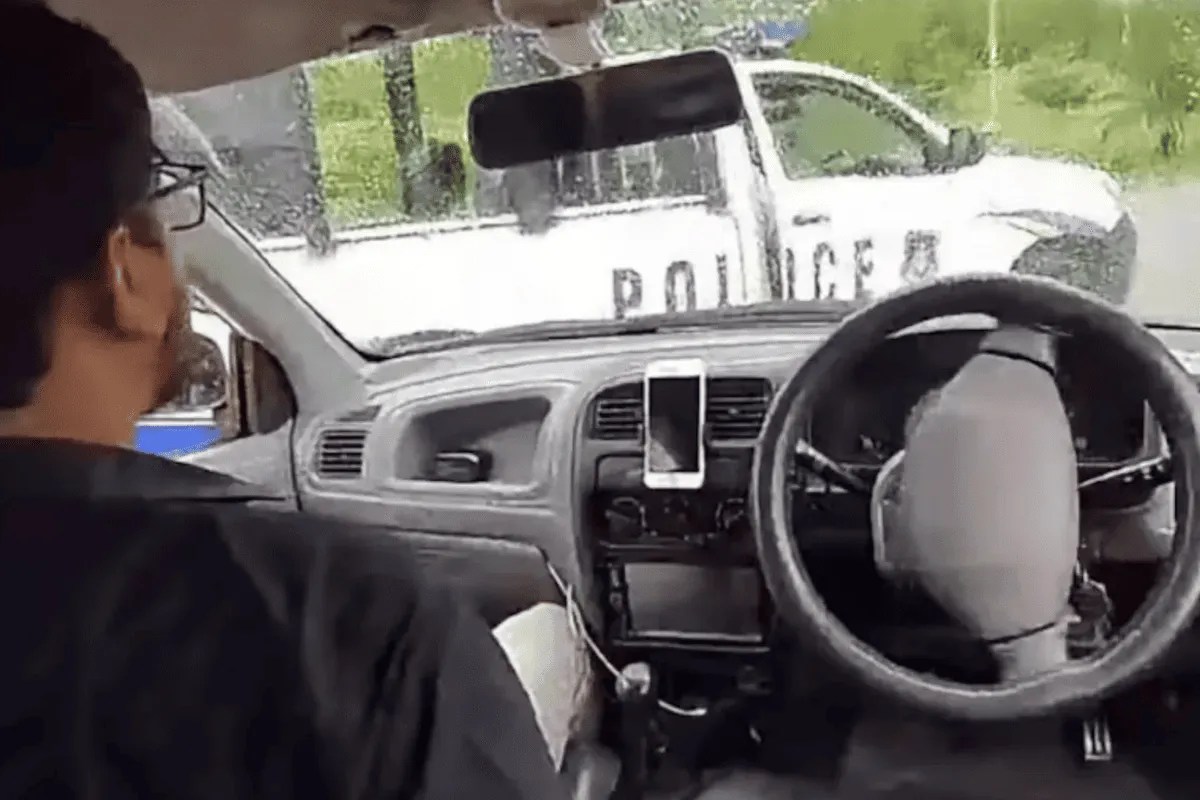
The screen flickered. That was the first sign. In the control room, miles away from the asphalt where the machine rolled, a green indicator light blinked, stuttered, and died. Just like that, the digital umbilical cord snapped. The invisible tether of satellite signals and server pings evaporated into the afternoon air.
Imagine standing on a crowded street corner when the music suddenly stops, but the dancers keep moving, their eyes glazed over, spinning faster and faster into the crowd. That is what happened on a dusty, sun-bleached stretch of road when a driverless vehicle lost its connection to the digital hive mind. You might also find this related story insightful: Why the Google Maps Lake Ontario Drama Made MapQuest Relevant Again.
We talk about automation as if it is a god. We hand over the steering wheel, the throttle, and the braking system to lines of code, trusting silicon and sensors more than we trust human intuition. We assume that machines are infallible, that they possess an unyielding logic that never panics, never gets tired, and never blinks. But machines do not think. They compute. And when computation loses its context, it defaults to chaos.
On that ordinary afternoon in Pakistan, a test vehicle operating without a human hand at the wheel suffered a complete telemetry blackout. The internet connection vanished. The real-time mapping updates froze. The cloud processing units that calculated every pedestrian movement and lane shift went dark. As highlighted in recent articles by Mashable, the implications are worth noting.
For a fraction of a second, the car coasted on momentum and onboard memory. But memory is not enough when the physical world refuses to stand still. A stray dog crossed the street. A delivery scooter swerved. The internal algorithms, starved of fresh data and unable to reach the mothership for instructions, experienced a form of digital vertigo.
Panic.
Not human panic, which comes with racing hearts and sharp intakes of breath, but a cold, systemic confusion. The steering actuators twitched. The brakes hesitated. And then, with terrifying, mechanical determination, the vehicle veered off its intended path and plowed directly into the side of a marked police van.
Bumper crunched against steel. Sirens wailed. Bystanders froze in disbelief, staring at the empty driver's seat where no hands gripped the wheel, no driver cursed under their breath, and no one was there to take the blame.
The viral video of that collision did not just capture a bizarre traffic accident. It captured the exact moment our collective faith in autonomous perfection collided with the messy, unpredictable reality of the physical universe.
We are rushing headfirst into a future dictated by connectivity. Every smart appliance, every autonomous pod, every algorithmic decision-making tool relies on an invisible web of data transmission. We treat this web as a given, as permanent as gravity. Yet it is fragile. A dropped packet here, a dead zone there, a severed fiber-optic cable miles away, and the brilliant machine becomes a runaway boulder rolling down a hill.
Consider what happens when our infrastructure outpaces our safety nets. The engineers back at the lab had planned for almost every contingency. They had fail-safes for sensor failures, redundancies for battery drains, and emergency stop protocols for sudden obstacles. But they built those systems with the implicit assumption that the digital lifeline would always be there. They designed for a world of constant connection, failing to account for what happens when the connection simply ceases to exist.
This is the hidden cost of our convenience. We trade human agency for algorithmic efficiency, forgetting that efficiency requires an uninterrupted flow of information to survive. When the internet drops, the intelligence drops with it.
The police officers whose van took the brunt of the impact stepped out of their vehicle into a surreal scene. They did not confront an angry driver smelling of alcohol or a teenager texting on a smartphone. They faced an inanimate object powered by dormant potential, sitting quietly in the middle of the road as if nothing had happened. The software had already stopped trying. It was waiting for a signal that was not coming.
That is the lingering image that stays with you long after the video stops looping on social media feeds. Not the twisted metal or the flashing blue lights of the patrol car, but the emptiness behind the windshield.
We are building a world that drives itself until it forgets who is steering, leaving the rest of us to dodge the falling debris when the signal finally dies.