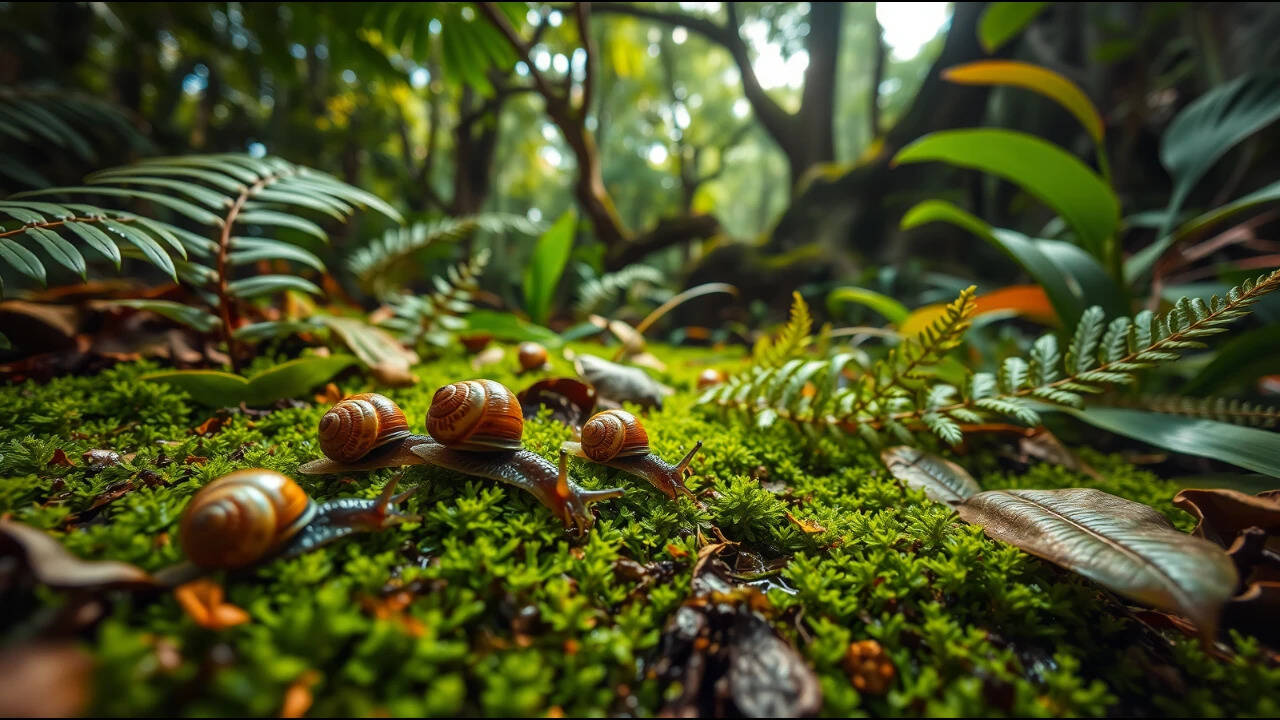
You can walk past a ghost and never know it is breathing.
It happens in the quiet places, the damp crevices where limestone weeps water and moss smells like iron. For years, scientists walked right past the final stronghold of Partula hebe without realizing they were looking at an empty stage. The curtain had already fallen. Or so they thought. Don't miss our recent post on this related article.
Extinction is usually depicted as a loud event. A falling asteroid, a smoking forest, a desperate final photograph of a solitary rhino dying in the Sudanese sun. But the quiet extinctions are the ones that haunt the imagination. They happen in millimeters. They happen in silence.
Consider what it takes to wipe an entire lineage from the Earth. You do not need an executioner with an axe. You only need an introduction. If you want more about the history of this, USA Today offers an informative breakdown.
Decades ago, someone brought a tiny, voracious predator to the islands of French Polynesia to solve a human problem. The rosy wolfsnail (Euglandina rosea) was meant to be a biological weapon, a neat little fix for an agricultural nuisance. Instead, it became an engine of annihilation. The wolfsnail did not hunt with claws or teeth; it slid through the leaf litter like a glacier of appetite, tracking the slime trails of native snails with algorithmic precision.
It was a slow-motion massacre.
Species that had spent millions of years shaping the volcanic soils of Moorea and Tahiti vanished in a blink of geological time. Entire families of snails—creatures with shells like porcelain scrolls and intricate histories written in spirals—simply blinked out of existence. By the late twentieth century, conservation biologists were writing eulogies. They gathered the few remaining individuals they could find, placed them in sterile plastic boxes, and prayed to a God of small things.
They called it captive breeding. We call it an ark.
The trouble with an ark is that it changes the animals inside it. Generations in a terrarium, fed on carefully measured slurries of crushed calcium and lettuce, protected from predators, and shielded from the brutal, stochastic cruelty of the wild, tend to forget how to be wild. Evolution is not a museum piece; it is a muscle. If you stop using it, it atrophies.
Imagine being born into a glass box. Your grandparents never knew the taste of volcanic rain. Your parents never had to climb a slippery stalk of wild ginger to escape the morning sun. You are safe. You are fed. And you are, in every meaningful sense, becoming a ghost of your former self.
This is the central paradox of modern conservation. To save a creature from extinction, you often have to remove it from the very forces that made it what it is. You preserve the DNA while losing the soul of the adaptation.
Yet, miracles are stubborn things. They do not care about statistical probabilities.
In recent years, behind the climate-controlled doors of European and British zoos, something shifted. Biologists working with the tiny, fragile survivors of the Partula genus noticed that the populations were not just holding steady—they were multiplying. The numbers ticked upward. Ten became a hundred. A hundred became thousands.
Then came the hard part.
Keeping a snail alive in a London zoo is an exercise in meticulous engineering. Returning that same snail to the dripping, unpredictable canopy of a Tahitian valley is an act of faith.
Picture the moment of release.
A conservationist—call her Sarah, because science is always carried out by people with mud on their boots and coffee stains on their sleeves—kneels in the damp undergrowth. Her knees are sinking into volcanic loam. The air is thick enough to drink, heavy with the scent of rotting wood and ferns. In her hand, she holds a plastic vial.
Inside that vial are half a dozen snails no larger than a grain of rice. Their shells are translucent, amber-tinted, delicate as an autumn leaf.
She unscrews the cap.
She does not tip them out. She waits, her hand steady, until the first tiny pair of horns emerges from the shell. The snail tests the air. It tastes the chemistry of a world its ancestors left behind decades ago. It glides over her thumb, cool and deliberate, and makes contact with the bark of a native tree.
That is the exact second when hope becomes a physical weight.
What happens next is not a Hollywood ending. There is no triumphant orchestral swell. There is only the rain. There is only the constant, grinding pressure of survival. The invasive wolfsnails are still out there, hiding in the shadows. The habitat is still fragile, bruised by climate change and human encroachment.
Every reintroduction is a roll of loaded dice.
Biologists monitoring these returned populations use tiny, non-toxic dots of paint on shells—so small they require a magnifying glass to see—to track individuals through the gloom. They count the living. They search for empty shells, reading the forensics of death in the forest. Was it disease? Was it a predator? Was it old age?
Each empty shell is a heartbreak. Each living, moving snail is a rebellion against finality.
We are living through an era often described as the Sixth Extinction. It is easy to look at the headlines—the warming oceans, the burning forests, the sliding baseline of biodiversity—and feel a paralyzing numbness. The scale of the loss is too vast for the human heart to comfortably hold.
That is why the snail matters.
It is easy to care for a panda. It has big eyes, a face that triggers our parental instincts, and a PR department the size of a continent. But a snail? A microscopic, amber-shelled survivor of a forgotten archipelago?
If we can care enough to save a snail, we can care about anything.
The captive breeding programs that brought these creatures back from the brink did not rely on massive technological breakthroughs or billions of dollars in venture capital. They relied on patience. They relied on decades of mundane, unglamorous labor—people checking humidity gauges at three in the morning, scrubbing algae from glass tanks, meticulously recording lineage charts like Victorian genealogists.
It is the uncelebrated heroism of the micro-scale.
When you look closely at a reintroduced Partula shell under a microscope, you can see the growth rings. There is a distinct line where the captive-grown shell meets the wild-grown shell. The captive part is smooth, pale, uniform—the product of a controlled, sheltered existence. The wild part is darker, rugged, notched with the scars of real weather and the rich chemistry of native soil.
That line tells a story. It is the scar of a resurrection.
The ghost has learned to stay. It has crawled back onto the branch, not as a museum specimen, but as a living, breathing participant in an ancient ecological drama.
The forest is listening. The rain is falling. And somewhere in the dark, a tiny horn rises to test the wind, asking the oldest question on Earth: Is it safe to come out now?


