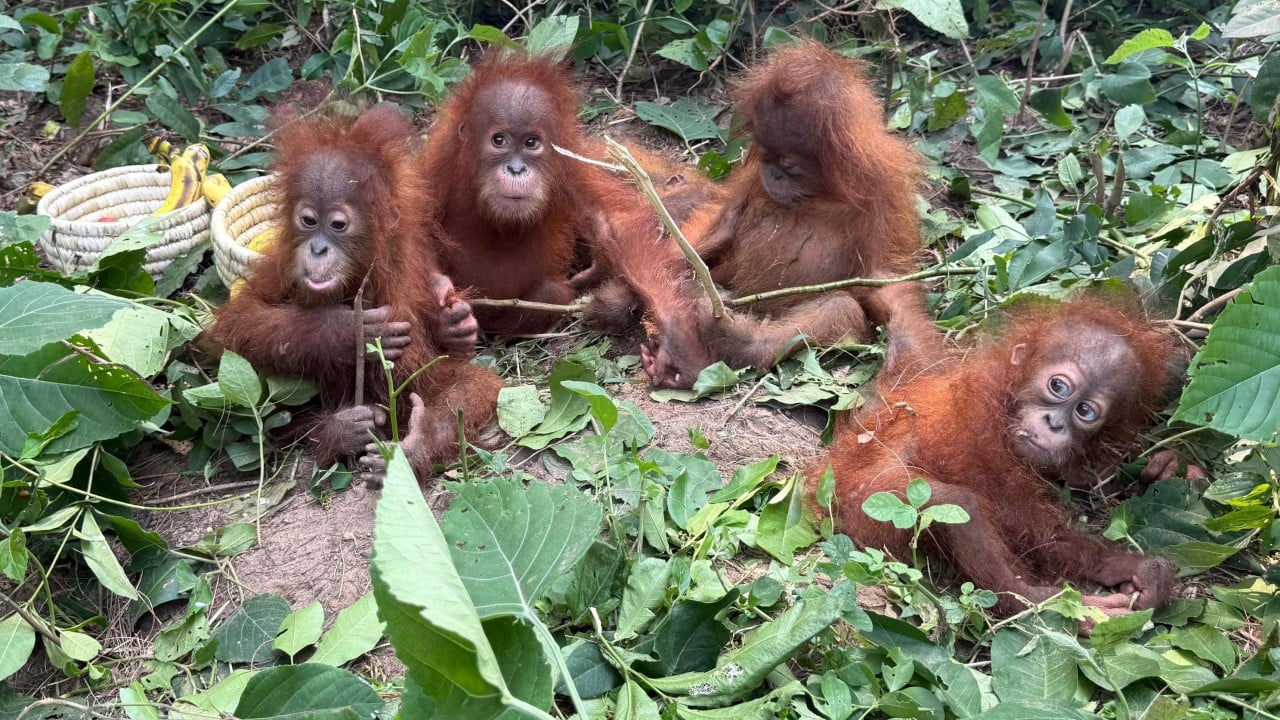
They do not cry the way human babies cry. They whimper, a high, thin sound that catches in the back of the throat, followed by a desperate, wide-eyed silence when a stranger walks into the room.
Picture a cardboard box, punched with a dozen ragged holes using the tip of a cheap pocketknife, sitting on the stained floor of a cargo van somewhere along the porous border of Northeast India. Inside that box is a creature weighing barely four pounds. His hair is a shock of burnt copper, matted with his own waste and the sticky residue of sweetened condensed milk fed to him through a syringe. His fingers, long and impossibly human, are curled tight around a scrap of dirty burlap. Also making news in this space: Why the Unity Versus Security Debate in Israeli Politics Misses the Point.
He is an orangutan. He belongs in the ancient, dripping peat swamps of Borneo or Sumatra, clinging to the chest of a mother who would have carried him for seven years, teaching him which leaves cure stomachaches and which branches will hold his weight eighty feet above the forest floor.
Instead, he is in a van headed toward a sprawling, gated farmhouse on the outskirts of Delhi or Mumbai, destined to become a living status symbol for someone who has run out of expensive cars to buy. More insights into this topic are covered by USA Today.
When customs officials and wildlife investigators began intercepting shipments of baby orangutans across India over the past few years—most notably in raids stretching from Assam and Mizoram down to Chennai and Bengaluru—the headlines treated it like an anomaly. A bizarre smuggling bust. A strange footnote in the daily news cycle.
It is not a footnote. It is a flare shot into a very dark sky.
To understand what is happening in the backrooms of India’s booming exotic pet trade, you have to strip away the sterile language of conservation reports and look at the cold, brutal arithmetic of desire. Over the last decade, a quiet shift has taken place among a certain tier of the newly wealthy across South Asia. Owning a pedigree dog became too common. Installing a saltwater aquarium felt dated. The new currency of exclusivity is the wild, the rare, and the legally untouchable.
The Architecture of a Smuggling Pipeline
Let us trace the path of a single infant, using a composite scenario drawn from verified wildlife crime investigations across the Indo-Myanmar border.
The journey begins thousands of miles away, in the rapidly shrinking lowland forests of Kalimantan or Sumatra. Here, palm oil plantations and illegal logging roads carve deep scars into the jungle. For a poacher, an adult female orangutan is useless—she is too strong, too dangerous, and entirely untamable. She is also fiercely protective. To take her infant, the poacher must first kill her.
Stop and let that register.
Every single baby orangutan found in a smugglers' crate represents a murdered mother. Because orangutans have the slowest reproductive rate of any land mammal—giving birth only once every seven to nine years—losing even a handful of breeding females pushes a local population toward mathematical collapse.
Once the infant is pried from its dead mother’s arms, the clock starts ticking. Out of every five infants captured in the wild, conservationists estimate that three or four die before ever reaching a buyer. They die of pneumonia in freezing cargo holds. They die of dehydration. They die of sheer, crushing psychological shock, a condition primate researchers recognize as the literal breaking of a young mind deprived of maternal contact.
The survivor is moved through a shadow network that mirrors the narcotics trade, often using the exact same routes. From Indonesia, the animal is ferried by boat to Malaysia or Thailand, tucked inside false-bottomed crates or drugged with human sedatives so it won't make a sound during port inspections. From there, it enters Myanmar, crossing into India through the rugged, forested hills of Mizoram or Manipur.
Why India? Because for years, a legal loophole created a gray market that traffickers exploited with ruthless efficiency.
Under India’s Wildlife Protection Act of 1972, native species—tigers, leopards, star tortoises, parakeets—were strictly protected. Penalties for trafficking them were severe. Yet, for decades, exotic species not native to India existed in a regulatory blind spot. Once an animal was smuggled across the international border, if a trafficker could avoid customs at the entry point, possessing a marmoset, an iguana, or even a great ape inside the country was remarkably difficult for local police to prosecute.
When the Indian government introduced the voluntary disclosure scheme in 2020 to create an inventory of exotic animals held across the country, more than thirty thousand people came forward, declaring everything from macaws to wallabies. The law has since been tightened, bringing species listed under CITES—the Convention on International Trade in Endangered Species—directly under the teeth of Indian wildlife law.
Yet the demand had already been awakened. And you cannot legislate away a status symbol overnight.
Inside the Digital Bazaar
If you think this trade happens in smoky, cinematic underground lairs, you are looking in the wrong place. It happens on your phone.
I have spent years tracking the digital footprints of wildlife traffickers, and the most unsettling thing about them is how ordinary their storefronts look. Scroll through private Telegram channels, encrypted WhatsApp groups, or even thinly veiled Instagram pages, and you will see videos of baby primates dressed in toddler clothes. They are shown drinking from plastic baby bottles, sitting on leather sofas, or blinking nervously under fluorescent lights while pop music plays in the background.
To the untrained eye, these clips look adorable. Cute. Viral-ready.
Look closer at the body language. Watch the way the infant rocks back and forth endlessly—a classic sign of severe trauma and neurological distress in captive primates. Notice the missing hair around the wrists where a cord was tied too tight. Look at the dull, sunken eyes of an animal suffering from severe vitamin D deficiency because it has never felt real sunlight on its skin.
The sellers use coded language to bypass automated moderation. A baby orangutan might be listed as a "red doll," a "forest baby," or simply offered via direct message to vetted buyers who have already purchased high-end reptiles or exotic birds. Prices range anywhere from fifteen lakh to over forty lakh rupees—roughly twenty thousand to fifty thousand dollars—depending on the age and health of the animal.
Think about that sum. For the price of a luxury sedan, a buyer can have a critically endangered great ape delivered to their doorstep in a discreet, unmarked SUV.
The Illusion of Care
Ask the buyers why they do it, and you will rarely hear malice. You will hear delusion.
I remember speaking with an investigator who had just rescued a juvenile primate from a private residence in southern India. The owner, a prominent businessman, was genuinely outraged that his pet was being confiscated. He pointed to the air-conditioned room he had built for the animal. He showed off the imported fruits, the plush toys, the custom-made blankets. He insisted he loved the creature like a child.
This is the psychological trap at the heart of the exotic pet trade. Humans are wired to project our own needs onto animals with flat faces, forward-facing eyes, and grasping hands. When a baby orangutan clings desperately to a human owner’s shirt, the owner feels chosen. They feel loved.
They do not realize the animal is clinging to them out of pure, existential terror—the same instinct that makes a drowning person grab onto a piece of driftwood.
An orangutan is not a furry human toddler. By the time a male reaches adolescence, around eight to ten years old, he will develop massive cheek pads, throat sacs that boom across miles of jungle, and the upper-body strength of five grown men. He will no longer fit in a designer onesie. He will no longer sit quietly on a velvet couch. He will become frustrated, territorial, and immensely dangerous.
What happens to the "beloved pet" then?
The lucky ones are quietly surrendered to state zoos or rescue centers, where they spend the next forty years behind steel mesh, unable to ever return to the wild because they never learned how to climb, forage, or fear predators. The unlucky ones are locked in backyard cages, abandoned on the edges of highways, or killed when they inevitably bite someone.
The Cost We Cannot See
It is easy to view the smuggling of a few dozen orangutans as a tragedy confined to those specific animals. That perspective misses the larger, terrifying picture.
The illegal wildlife trade is no longer run by lone poachers looking to feed their families. According to global intelligence agencies, it is the fourth-largest transnational organized crime sector in the world, trailing only narcotics, human trafficking, and counterfeiting. The same syndicates moving baby apes through Southeast Asia and into India are often moving arms, laundered cash, and synthetic drugs.
There is also a biological ticking time bomb wired directly into every smuggled primate.
Orangutans share roughly ninety-seven percent of our DNA. That genetic proximity is precisely why we find them so captivating—and why they pose a catastrophic public health risk when ripped out of their ecosystems and shoved into urban homes. Pathogens do not respect customs borders. Herpesviruses, tuberculosis, respiratory syncytial viruses, and novel zoonotic diseases can leap effortlessly between captive great apes and their human handlers, and vice versa.
We spent the early years of this decade watching the entire global economy grind to a halt because a virus jumped from wildlife to humans through poorly regulated trade networks. Every time a smuggled ape is kept in a suburban living room, someone is rolling those exact same dice all over again.
The Long Road Back to the Trees
What happens to the infants that survive the raids in India?
When customs officers at Chennai airport or forest officials in Assam pry open those cardboard boxes, the immediate relief of the rescue quickly gives way to a logistical nightmare. India has no native orangutan populations. There are no established forest sanctuaries equipped to rehabilitate great apes, no local experts trained in the intricate, multi-year process of teaching an orphaned orangutan how to survive in the canopy.
The rescued infants are transferred to specialized zoological facilities, placed in strict quarantine to prevent disease transmission, and kept alive by veterinarians working around the clock to reverse months of malnutrition and trauma.
Even if diplomatic channels succeed in repatriating these animals back to Indonesia or Malaysia—a process tangled in red tape, genetic testing to determine whether the infant is Bornean or Sumatran, and millions of rupees in transport costs—the damage is largely irreversible.
At rehabilitation centers in Borneo, human surrogate mothers spend years walking orphaned orangutans into the forest every morning, sleeping near them, and patiently demonstrating how to bend branches into sleeping nests. Some orphans eventually graduate back into protected forests. Many never do. They have forgotten what they are.
The Mirror Held Up to Us
The enforcement agencies in India deserve immense credit for the recent spike in seizures. Better intelligence sharing between the Wildlife Crime Control Bureau, customs authorities, and international partners has disrupted several major smuggling rings. Amendments to the Wildlife Protection Act have finally given prosecutors the legal leverage to seek prison time and heavy fines for those trafficking CITES-listed species.
Laws and border patrols, however, are only half the battle. They treat the symptom, not the disease.
A smugglers' pipeline only stays open as long as someone at the far end is willing to pay for what comes out of it. Every click on an exotic pet video, every "like" left on an influencer posing with a baby primate, every quiet inquiry sent in a private chat group feeds the machine. It tells the poacher in Sumatra that the bullet is worth the price. It tells the trafficker in Myanmar that the bribe at the border will pay for itself ten times over.
We like to think of conservation as something that happens far away, fought by rangers in khaki uniforms hacking through distant jungles. It isn't. It is fought in the quiet choices of consumers who decide whether a living, breathing intelligence deserves its own life, or whether it exists merely to decorate theirs.
Somewhere right now, in a dim room miles from the nearest forest, a four-pound infant with copper hair is gripping the bars of a metal cage, waiting for a mother who will never come.


