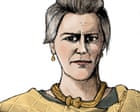
Picture a winter gale off the coast of Gaul in the year 42 AD. The sea is the color of hammered iron, churning against the wooden hulls of Roman merchant vessels while a single figure stands near the prow, salt crusting on a heavy wool cloak, staring backward toward the white cliffs vanishing into the mist.
We know this figure existed. We know they crossed the English Channel in desperation, driven out of their homeland in southern Britain by a rival tribe called the Catuvellauni. We know they stood before the Roman Emperor Claudius—a man mocked by his own court as a stammering, weak-kneed eccentric who desperately needed a military triumph to keep his throne—and whispered the exact words that convinced Rome to launch forty thousand soldiers across the sea in 43 AD.
History calls this exile King Verica.
For nearly two thousand years, textbooks, museum placards, and dusty Latin translations have painted Verica as just another bearded Iron Age warlord begging Rome for muscle. That assumption has sat untouched in the historical record like a heavy stone nobody bothered to flip over.
Until now. Because when you actually flip that stone over, the Latin doesn't quite say what Victorian scholars insisted it said. And the person who triggered the Roman conquest of Britain—the single event that birthed Londinium, reshaped the British Isles, and altered the trajectory of Western Europe—might have been a woman.
A Name Carved in Gold and Misread in Ink
Let us be honest about how ancient history gets made. It is rarely a clean, unbroken video feed from the past. Usually, it is a game of broken telephone played across centuries by monks copying manuscripts by candlelight, followed by nineteenth-century gentlemen scholars projecting their own rigid worldviews onto fragments of broken pottery and corroded bronze.
I spent years walking the mudflats of the Thames and sitting in quiet, cold university archives staring at things people dropped two millennia ago, and if there is one thing that work teaches you, it is humility. You realize quickly how easily a single smudge of ink or a tiny linguistic assumption can erase an entire human being. You start looking at the gaps between the words, wondering who got edited out because a translator couldn't imagine them standing in the room.
To understand the mystery of Verica, you have to look at the only two places where this ruler leaves a fingerprint: Roman text and Iron Age gold.
First, the text. Our primary written source for the invasion of 43 AD is Cassius Dio, a Roman historian writing in Greek nearly two centuries after the fact. In his Roman History, Dio mentions an exiled Briton who fled to Claudius to ask for help after being driven out by civil strife. In the surviving manuscripts, the name is written as Bericus.
Notice that ending. -us.
In Latin and Greek, an -us ending is the standard masculine stamp. When Victorian historians read Bericus and matched it to the British coins stamped with the name VERICA, they didn't pause to think. They simply assumed Verica was the Celtic spelling of a man's name, and Bericus was the Romanized masculine version of it. Case closed. Put a crown on him, give him a beard in the illustrations, and move on to the battles.
Except Celtic linguistics doesn't work like that.
Look closely at the name Verica. In the Brittonic languages spoken across southern Britain before the Romans arrived, names ending in -a were overwhelmingly feminine. Think of Boudica, the red-haired queen of the Iceni who burned London to ash two decades later. Think of Cartimandua, the powerful queen of the Brigantes in the north who ruled her own kingdom and handed rebel leaders over to Rome in chains.
In the linguistic soil of Iron Age Britain, -ica is a classic feminine suffix. If a Roman scribe heard a native Briton pronounce the name Verica, or saw it stamped on a coin, and assumed—just like a Victorian professor would—that any ruler asking an emperor for an army had to be a man, that scribe would automatically slap an -us onto the end of the name to make it fit Roman grammar. Verica becomes Bericus. A woman becomes a man with the stroke of a reed pen.
The Silent Testimony of Metal
Coins are different from books. Books get copied, edited, lost in fires, and rewritten to flatter whoever is currently paying the scribe. Coins are stamped in red-hot metal in the exact moment a ruler holds power, and then they are dropped in the dirt, buried in hoards, and left untouched until a metal detectorist hears a faint beep in a plowed Sussex field.
Verica minted thousands of them.
Across Hampshire, West Sussex, and Surrey—the ancient territory of the Atrebates tribe—archaeologists have uncovered gold staters, silver units, and tiny copper-alloy coins bearing the inscription VERICA or VIRI, often paired with the title COMMI F, meaning "child of Commius."
Commius was a famous Gallic chieftain who once served Julius Caesar before turning against him and fleeing to Britain to establish a dynasty. For generations, historians assumed Verica was one of Commius's three sons—alongside Tincomarus and Eppillus—who carved up southern Britain after their father died.
Here is where the timeline starts to creak under its own weight.
Commius fled to Britain around 50 BC. The Roman invasion happened in 43 AD. If Verica was a direct son of Commius, he would have been pushing ninety or a hundred years old when he crossed the Channel in rough winter seas to negotiate with Claudius. People in the Iron Age rarely lived to see eighty, let alone survive a winter sea crossing in their nineties to orchestrate a geopolitical coup.
It is far more likely that COMMI F functioned like a dynastic brand name—a royal stamp declaring legitimate descent from the founder of the house, much like later Roman emperors all called themselves "Caesar" regardless of bloodline. And if Verica wasn't one of Commius's aging sons, then the assumption that Verica had to be male loses its strongest anchor.
Even more intriguing is what appears on the coins themselves. Unlike neighboring tribes whose coinage screamed with aggressive, hyper-masculine war imagery—charging horsemen, severed heads, bristling spears—Verica's coins feature remarkably distinct, sophisticated motifs. One famous silver coin shows a seated female figure holding a staff or scepter, a design heavily borrowed from classical Roman depictions of goddesses or empresses like Livia. Another features a single, delicate vine leaf.
A vine leaf. Think about what that tiny image meant in 20 AD. Grapes weren't native to Britain; wine was a luxury imported from the Mediterranean, a symbol of Roman diplomacy, trade, and high-level courtly alliances. Whoever minted these coins wasn't a provincial brute swinging an iron broadsword in the mud. They were a savvy, internationally connected monarch who understood Roman soft power down to the smallest visual detail.
Why Iron Age Britain Wouldn't Blink at a Queen
To understand why a female ruler of the Atrebates makes total historical sense, you have to strip away two thousand years of modern assumptions about gender and power.
The Romans were deeply patriarchal. To a Roman senator sitting on the Palatine Hill, the idea of a woman commanding troops, signing treaties, or sitting on a throne was unnatural, borderline monstrous. When the Roman historian Tacitus wrote about Boudica leading a massive British coalition against Roman legions, he expressed sheer shock—not just at the rebellion, but at the fact that Britons made no distinction of sex when choosing their military commanders.
That single observation from Tacitus changes everything.
In Iron Age Celtic society, women could inherit property, divorce their husbands, own vast herds of cattle, and rule tribes in their own right. We don't have to guess about this; the archaeological record is full of high-status female burials—like the Wetwang Slack chariot burial in East Yorkshire—where women were laid to rest with mirrors, fine jewelry, and two-wheeled war chariots, the ultimate status symbols of the Iron Age elite.
Consider Cartimandua, who ruled the Brigantes—the largest tribe in Britain—during the exact same era as Verica. She wasn't a regent warming a seat for a young son. She was the sovereign monarch. When her husband, Venutius, tried to challenge her authority, she didn't step aside; she divorced him, took his armor-bearer as her new consort, and called in Roman troops to crush her ex-husband's rebellion.
If the Brigantes in the north were ruled by a fierce, politically ruthless queen, and the Iceni in the east were ruled by Boudica, why on earth would it be strange for the Atrebates in the south to be ruled by Queen Verica?
It wouldn't. The only reason it sounds radical today is because Roman writers—and the modern historians who trusted them blindly—filtered British history through a lens that couldn't recognize female sovereignty unless it was burning down a Roman city.
The Desperate Gamble at the Edge of the World
Let us step away from the coins and the Latin grammar for a moment and imagine what the winter of 42 AD actually felt like for the person wearing Verica's crown. (To be clear, we have no diary from this voyage, so we are reconstructing the human reality from the political facts we know.)
Imagine watching your kingdom shrink week by week.
To the north, across the Thames, the Catuvellauni tribe—led by the aggressive sons of Cunobelinus, Caratacus and Togodumnus—were swallowing everything in sight. They had already seized your eastern territories. Your allies were defecting out of sheer terror. Every rider arriving at your stronghold in Calleva (modern Silchester) brought news of another burned farmstead, another stolen herd, another noble family switching sides to survive.
You are out of soldiers. You are out of silver. And if you stay in Britain until spring, Caratacus will hunt you down, drag you out of your hall, and execute you to wipe out the last legitimate heir of Commius.
You have only one card left to play, and it is terrifying.
You have to cross the ocean to the court of the most dangerous empire on earth—an empire that had already tried and failed to conquer Britain under Julius Caesar nearly a century earlier—and convince them to finish what Caesar started.
Think about the nerve required for that journey. Whether Verica was a king or a queen, they didn't arrive in Rome as a weeping beggar. You don't persuade a cautious, politically cornered emperor like Claudius to risk four full legions—nearly forty thousand men, plus auxiliary cavalry and a massive naval fleet—by crying at his feet.
Claudius was desperate for legitimacy. He had been dragged out from behind a palace curtain by the Praetorian Guard after the assassination of his nephew Caligula and handed an empire nobody expected him to survive. The Roman Senate despised him. The army barely knew him. He needed a glorious, headline-grabbing foreign conquest—specifically, the conquest of Ocean itself, the mythical edge of the known world that even Julius Caesar hadn't managed to hold.
Verica walked into that imperial court holding the exact key Claudius needed.
They brought intelligence. They knew the river crossings, the tribal rivalries, the supply routes, and the exact political fault lines dividing southern Britain. They offered Rome a legal pretext—restoring a rightful, Roman-allied monarch to a stolen throne—so Claudius could frame an unprovoked invasion as a noble intervention to protect a friend of Rome.
Now picture that meeting again, knowing Verica might have been a woman.
Imagine a British queen standing in the marble halls of Rome, speaking fluent Latin or working through an interpreter, looking a stammering, underestimated Roman emperor dead in the eye and laying out the blueprint for an invasion. Two underestimated rulers—one written off by his own aristocracy as a fool, the other written out of history by later scribes because of her gender—striking a deal that would redraw the map of Europe.
What Changes When We Change a Pronoun?
It is easy to shrug and ask what difference it really makes whether the name on a two-thousand-year-old coin belonged to a man or a woman. Verica dies or disappears from the record shortly after the Romans land in 43 AD; a client king named Togidubnus takes over the southern territories, builds a sprawling Roman palace at Fishbourne, and life moves on.
Except it makes every difference in the world.
When we automatically default to "king" whenever we find an ancient crown, we aren't being neutral or objective. We are actively erasing half the human race from the moments when history pivoted. We train ourselves—and our children—to look at the foundations of civilization and see only men making the hard decisions, cutting the diplomatic deals, and gambling with the fate of nations.
Look at how quickly the story of British history shifts when you restore Verica's possible identity.
For generations, the standard narrative of women in Roman Britain has been a binary trap: either you were a passive Romanized wife hosting dinner parties in a villa, or you were Boudica—a tragic, doomed avenger screaming in a chariot before taking poison. There was no room in the textbook for a calculating, pragmatic female statesman who played superpower politics at the highest possible level and won.
Queen Verica breaks that mold completely. She wasn't a tragic martyr. She was a survivor who looked at an impossible situation in Britain, crossed a winter sea, walked into the heart of the Roman Empire, and bent the world's greatest military machine to her will.
We may never find a pristine marble bust in the Sussex soil with an inscription reading Verica Regina—Queen Verica. History rarely hands us certainty on a silver platter. Most of the time, it leaves us with a worn silver coin bearing a vine leaf, a mismatched Latin ending in a dusty manuscript, and a nagging question that refuses to go away.
Next time you stand in a museum looking down through thick glass at a tiny, corroded piece of Iron Age gold, look past the label printed by a curator a hundred years ago. Look at the name stamped into the metal, and remember the winter sea, the marble halls of Rome, and the quiet, formidable queen who might have started it all.