The smell of burning diesel never really leaves your nostrils. Ask anyone who spent eighteen months patrolling the dusty outskirts of Fallujah or the jagged ridgelines of Korengal Valley, and they will tell you that memory isn't stored in photographs or medals. It lives in the nervous system. It lives in the sudden flinch when a car backfires on an Ohio highway, and in the quiet, kitchen-table arithmetic of families trying to figure out why a son came home in a flag-draped box while the pundits on television moved on to the next news cycle.
For twenty years, that specific ache was a political orphan in Washington. Both parties had their hawks. Both parties had their reasons for sending eighteen-year-olds to fix broken borders half a world away. Also making headlines recently: Why French Student Protests Are Not the Second Coming of May 1968.
Then came the shift.
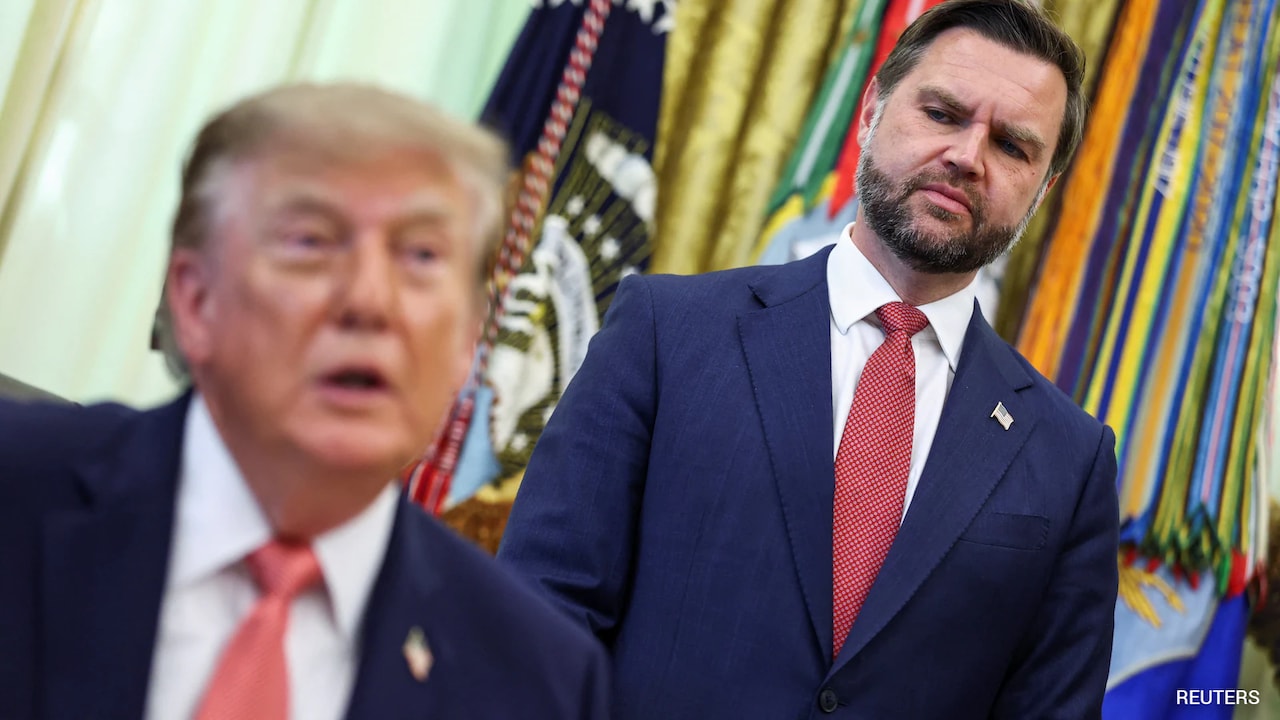
When reports surfaced recently detailing how JD Vance has forcefully called out the push toward a conflict with Iran—simultaneously positioning himself as the standard-bearer for the modern American Right—many political observers treated it as just another piece of beltway palace intrigue. Another headline. Another jockeying for position in the post-Trump era. More information into this topic are detailed by The Washington Post.
They missed the point entirely.
To understand why Vance’s stance on Iran is vibrating through the American electorate like a plucked wire, you have to look past the cable news chyrons. You have to look at the structural realignment of conservative politics, the exhaustion of the American heartland, and a generational divide that has turned foreign policy from an abstract chessboard into a deeply personal fight over survival.
The Architecture of a Breakup
For decades, the Republican Party operated on a three-legged stool. Social conservatism, free-market economics, and a muscular, interventionist foreign policy. If you wanted to lead the GOP, you spoke the language of Ronald Reagan and George W. Bush. You talked about spreading democracy, projecting strength abroad, and confronting adversaries wherever they raised their heads.
That stool is broken.
Vance, a former Marine who served in Iraq, isn't just tweaking the party platform; he is taking a sledgehammer to its old foundation. According to political analysts and recent reporting on his public addresses and behind-the-scenes maneuvering, Vance has made opposition to a new Middle Eastern war—specifically an escalating conflict with Iran—the centerpiece of his ideological identity. By framing restraint not as weakness, but as the ultimate defense of the American homeland, he is staking a claim to the title of the true leader of the American Right.
Consider a hypothetical scenario to see how this plays out away from the cameras. Imagine a small manufacturing town in Pennsylvania—call it New Castle or Erie. Let’s introduce a composite character: Marcus, a forty-two-year-old tool-and-die maker whose younger brother did two tours in Ramadi. Marcus doesn't read foreign policy journals. He doesn't care about the nuances of enrichment percentages in Natanz. What Marcus knows is that the local foundry closed in 2008, the price of groceries jumped forty percent over the last few years, and the bridges in his county are rusting into the river.
When Marcus turns on the television and hears traditional hawks arguing that America must police the Persian Gulf or risk losing global credibility, he doesn't hear strength. He hears a bill coming due that his family will have to pay, in blood and treasure, while the people writing the checks live in gated suburbs outside D.C.
Vance speaks directly to Marcus.
The Mechanics of Political Gravity
Political movements rarely change because someone wins a debate in a think tank. They change because the gravity shifts.
Think of the American Right over the last quarter-century like a massive container ship. Under the Bush administration, the rudder was locked hard toward interventionism. The invasion of Iraq in 2003, the surge, the long slog in Afghanistan—these weren't side projects; they were the defining missions of conservatism. Even as public support cratered, the institutional machinery of the party remained loyal to the doctrine of preemptive action.
Donald Trump cracked the hull in 2016 by calling the Iraq War a "big, fat mistake" on a South Carolina debate stage, an act of heresy that shocked the party elders. Yet during his presidency, Trump’s administration often remained a tug-of-war between his populist instincts and the traditional hawks he hired to staff the National Security Council and the State Department.
What JD Vance is doing now is attempting to turn Trump’s instinct into permanent doctrine.
By openly criticizing the drums of war beating around Tehran, Vance is drawing a bright, unforgiving line in the sand. On one side stand the legacy conservatives—senators, donors, and commentators who view Iran as an existential threat that must be neutralized through overwhelming military pressure, regardless of the cost. On the other side stands the nationalist-populist wing, which argues that the United States has burned through trillions of dollars and thousands of lives trying to remake the Middle East, with nothing to show for it except regional chaos, a ballooning national debt, and a hollowed-out industrial base at home.
It is a fascinating, high-stakes gamble. In Washington, calling for military restraint in the face of Iranian proxies, drone attacks, and nuclear ambitions carries immense political risk. Critics within his own party quickly label such arguments as isolationism or appeasement. They argue, with historical weight behind them, that vacuums of power are always filled by predators, and that ignoring a fire in the neighbor's yard eventually burns down your own house.
I admit, when I look at the sheer volatility of the Middle East today, the choice isn't obvious. Anyone who pretends that foreign policy is a simple binary between "peace" and "war" is selling something. The threats from Tehran are real. The shipping lanes in the Red Sea matter to the price of every good sitting on a Walmart shelf in Ohio. Pretending America can simply pull up the drawbridge and ignore the world is a fantasy.
And yet, the counter-argument carries an undeniable emotional and empirical punch. We tried the alternative. We spent twenty years trying to engineer stability at the point of a bayonet. The result was not a Jeffersonian democracy in Baghdad, but the rise of ISIS, an emboldened Iran, and a generation of American veterans nursing invisible wounds.
Why Iran Is the Ultimate Litmus Test
Why does Iran matter so much right now? Why has it become the specific anvil upon which the future of the Right is being hammered out?
Because Iran is the ultimate temptation for the old guard. Unlike the murky insurgencies of the War on Terror, Iran represents a state actor with clear fingerprints on regional instability. For hawks in Washington, confronting Iran feels like finishing unfinished business—a chance to restore American deterrence and correct decades of perceived weakness.
For Vance and his allies, however, a war with Iran represents the ultimate trap.
Look at the geography. Iran is nearly four times the size of Iraq, with a population approaching ninety million people and mountainous terrain that makes an invasion a logistical nightmare. A military conflict wouldn't be a surgical, weekend operation; it would almost certainly trigger a regional conflagration, choking off the Strait of Hormuz, sending global oil prices past two hundred dollars a barrel, and dragging American troops back into a meat grinder with no exit strategy.
Vance understands that if the Republican Party embraces another Middle Eastern war, the populist revolution dies. You cannot rebuild the American working class while financing a trillion-dollar desert campaign. You cannot secure the southern border while deploying carrier strike groups and infantry divisions to guard the Persian Gulf.
By framing the Iran question in these stark terms, Vance isn't just offering a foreign policy critique; he is auditioning for the throne.
Leadership in any political party isn't bestowed by a committee. It is seized by whoever best articulates the deepest anxieties of the base. Right now, the deepest anxiety on the American Right isn't that the U.S. military isn't fighting enough wars. It is that the people in charge of the country care more about foreign borders than their own, and more about global prestige than the survival of the American middle class.
The Invisible Stakes at Home
To grasp the full weight of this struggle, step back from the geopolitics and look at the economics of empire.
Every dollar has only one life. When a nation decides to spend hundreds of billions of dollars on bunker-busting munitions, overseas bases, and nation-building projects, those dollars are permanently subtracted from somewhere else. They are subtracted from semiconductor fabrication plants in Arizona. They are subtracted from shipyards in Virginia that are struggling to keep pace with foreign naval production. They are subtracted from the paychecks of working families through the silent, corrosive tax of inflation.
This is the core of Vance’s thesis, and it is why his message resonates far beyond traditional anti-war circles. Traditionally, skepticism of American military intervention lived on the political Left—among college professors, activists, and pacifists. Today, that skepticism has migrated to union halls, VFW posts, and suburban kitchen tables across the Rust Belt.
Think of it like a family budget. If a household is drowning in credit card debt, the roof is leaking, and the furnace is failing in the middle of January, the father who insists on taking out a second mortgage to landscape the neighbor's yard isn't being generous. He is being reckless.
For years, working-class voters watched Washington elites act like that reckless father. They watched trillions vanish into the sands of Mesopotamia while opioids flooded their communities and factories moved overseas. They felt the disconnect in their bones, even when they didn't have the political vocabulary to describe it.
Vance is giving them that vocabulary. By calling out the push toward an Iran war, he is telling those voters that their skepticism isn't unpatriotic—it is common sense. He is positioning himself as the protector who stands at the door and says, No more.
The Clash of Two Americas
Of course, this fight is far from over. Inside the Republican Party, the civil war over foreign policy is fierce, personal, and deeply bitter.
The traditionalists have deep pockets, decades of institutional memory, and powerful allies in the defense industry and media. They view Vance’s brand of realism as dangerously naive—a retreat that will invite aggression not just from Iran, but from Russia and China as well. In their eyes, American strength is indivisible; if you blink in Tehran, Beijing takes Taiwan.
There is a cold logic to their warning. History is littered with empires that mistook exhaustion for wisdom, only to discover that their enemies interpreted restraint as surrender. The 1930s remain the permanent ghost haunting every foreign policy debate in Washington, a reminder that ignoring distant storm clouds doesn't stop the rain.
Yet Vance’s faction has something the old guard lacks: momentum, demographic energy, and the scarred memory of the post-9/11 era. The millennials and Gen Z conservatives rising through the ranks of the Right didn't come of age watching the Berlin Wall fall. They came of age watching the towers fall, watching the weapons of mass destruction fail to materialize in Iraq, and watching the chaotic withdrawal from Kabul in 2021.
Their worldview was forged in failure. They do not trust the experts who promise that the next intervention will be quick, clean, and decisive.
When Vance steps to a microphone and challenges the orthodoxy on Iran, he isn't merely speaking for himself. He is acting as a conduit for an entire generation that refuses to be the collateral damage of someone else's grand strategy.
The Quiet Reckoning
Late at night, in towns stretching from Appalachia to the Great Plains, the lights stay on in living rooms where old uniforms hang in the back of closets. The men and women who wore them rarely talk about grand strategy or geopolitical spheres of influence. They talk about buddies who didn't make it back, marriages that frayed under the weight of repeated deployments, and the strange alienation of returning to a country that barely noticed they were gone.
Politics, at its highest level, is supposed to be the art of translating those lived realities into national policy. For too long, a vast chasm separated the people who voted for wars from the people who fought them.
Whether JD Vance ultimately succeeds in remaking the American Right in his image remains an open question. Political coalitions are fragile things, easily shattered by an unexpected crisis, a terrorist attack, or a sudden shift in the global winds. A single spark in the Persian Gulf could test his doctrine in ways no speech ever could.
But the genie is out of the bottle. The era of reflexive, bipartisan consensus for Middle Eastern intervention is dead, buried beneath twenty years of desert sand. And as the smoke clears over the future of conservative politics, one reality stands unmistakable: anyone who wants to lead the American Right will first have to answer to the ghosts of the wars already fought.