Mainstream political reporters love a cheap circus. Show them a politician getting shouted down on a New York sidewalk, and they immediately reach for the same tired trope: the inevitable collapse of the progressive movement, eaten alive by its own base.
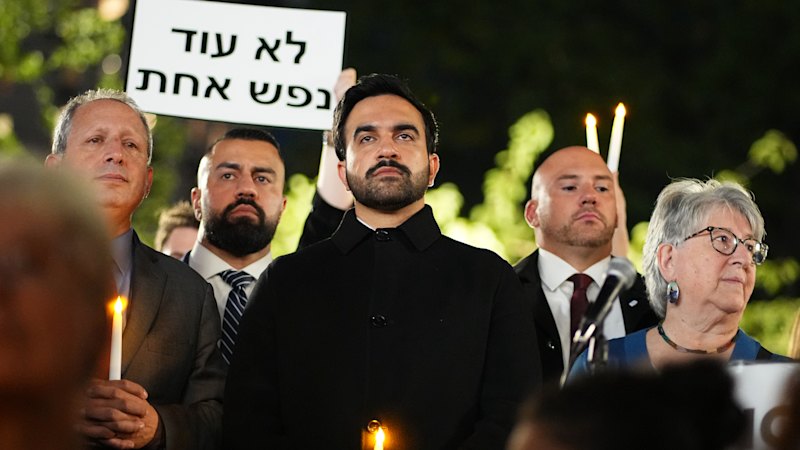
That is the exact lazy consensus driving the coverage around Zohran Mamdani being jeered at an October 7 vigil, where protesters labeled him a traitor to the Palestinian cause. The press wants you to see a fatally wounded candidate losing control of his street-level coalition. They see chaos. They see a political death spiral.
They are completely blind to how actual power is built.
If you want to understand modern urban politics, stop looking at the volume of the megaphones and start looking at the math of the electorate. Getting publicly denounced by the absolutist fringe is not a crisis for an insurgent politician trying to govern a city of eight million people. It is a mandatory rite of passage. More importantly, it is a massive political gift that no campaign consultant could ever buy with donor cash.
The Illusion of the Monolithic Base
I have spent fifteen years inside war rooms watching promising progressive campaigns implode before they ever reach a general election ballot. Every single time, the autopsy reveals the same cause of death: the candidate mistook the loudest ten percent of their activist wing for the actual voting public.
Activists and voters operate on entirely different incentive structures. An activist's currency is moral purity. Their goal is to move the Overton window, hold the line on uncompromising demands, and refuse to yield an inch, regardless of the electoral consequences. A politician's currency, if they actually intend to win executive office and wield state power, is coalition building. You cannot govern New York City from a protest barricade.
When protesters screamed "traitor" at Mamdani—a Democratic Socialist assemblyman from Queens who has built his entire brand on fierce advocacy for Palestinian human rights—the media treated it as a stunning betrayal. Why? Because legacy journalists still view the political left as a single, uniform hive mind. They fail to grasp the basic structural divide between movement politics and electoral politics.
Movement politics demands ideological perfection today. Electoral politics requires assembling a fifty-percent-plus-one majority on Election Day. When Mamdani chose to attend an October 7 memorial vigil to mourn Israeli victims of the Hamas attacks, he was executing a basic, necessary maneuver for anyone seeking citywide legitimacy: acknowledging the shared humanity and grief of a massive constituency in New York.
The protesters calling him a traitor were doing their job as purists. Mamdani was doing his job as a viable leader. The friction between those two roles is not a bug in the system. It is the entire engine of democratic governance.
Why Purity Spirals Are Political Rocket Fuel
Let's strip away the emotional theater and look at the cold mechanics of voter perception.
For any democratic socialist or hard-left insurgent, the single biggest barrier to winning executive office—like the New York City mayoralty—is the "radical" label. Moderate, independent, and older reliable voters do not necessarily hate progressive economic policies like rent freezes, free public transit, or universal childcare. What terrifies them is the idea that the person holding the keys to City Hall is a hostage to unaccountable street agitators.
Think about the infamous "Sister Souljah moment" from the 1992 presidential race, or look at how Harold Washington navigated factional warfare in Chicago during the 1980s. When an insurgent candidate is visibly attacked by the most uncompromising faction of their own ideological camp, it immediately shatters the opposition's primary attack ad.
You cannot credibly paint Zohran Mamdani as a mindless puppet of the radical fringe when the radical fringe is literally on the evening news calling him a traitor.
Imagine a scenario where Mamdani had boycotted the vigil entirely to appease the protesters. The headlines would have written themselves: Socialist Assemblyman Refuses to Mourn Terror Victims. That single decision would have locked him into a permanent ceiling of roughly twenty percent of the primary electorate, rendering him a perennial protest candidate with zero path to Gracie Mansion.
Instead, by showing up, absorbing the abuse, and refusing to retreat, Mamdani accidentally generated millions of dollars in earned media proving his independence. To the average voter in Queens, Brooklyn, or the Bronx who does not spend their days parsing activist manifests on social media, the visual was crystal clear: here is a guy willing to stand in the fire, show basic empathy for grieving neighbors, and take heat from his own side for doing it.
Dismantling the Media's Favorite False Premises
If you look at the questions dominating the discourse around this incident, almost every single one is built on a flawed premise. Let's tear them down one by one.
Does this mean Zohran Mamdani is losing the progressive base?
No. It means he is shedding the non-voting fringe. Political scientists like Eitan Hersh have documented the phenomenon of "political hobbyism" and hyper-engaged activists who dominate public spaces and online discourse while representing a tiny fraction of actual ballot-box turnout. The vast majority of progressive voters in New York City want two things simultaneously: an end to civilian suffering in Gaza, and a local leader who treats Jewish New Yorkers with dignity and respect. The protesters screaming at the vigil do not represent the progressive base; they represent an absolutist subculture that routinely eats its own.
Can a politician survive being labeled a traitor by street activists?
Not only can they survive it, they rarely win high office without it. Look at the history of modern urban mayors, from Fiorello La Guardia to David Dinkins. Every single one faced ferocious blowback from their core ideological allies the moment they stepped outside the echo chamber to build a governing coalition. If you have never been called a sellout by someone holding a megaphone, you have never actually tried to win a broad election.
Why did Mamdani attend the vigil if he knew he would get protested?
Because leadership is not about avoiding friction; it is about choosing which friction you are willing to endure. Mamdani calculated—correctly—that the political cost of alienating mainstream Jewish and moderate voters by ignoring October 7 was infinitely higher than the cost of enduring a ten-minute shouting match on a sidewalk.
The Fatal Flaw in Modern Campaign Strategy
Most political consultants are cowards. When faced with a volatile issue like the Israeli-Palestinian conflict, their default advice is strategic ambiguity. They tell their candidates to issue sterile, focus-grouped statements drafted by lawyers, avoid public appearances where crowds cannot be vetted, and hide behind safe talking points.
That strategy is dead. Voters have developed an acute allergic reaction to scripted cowardice.
I have watched candidates burn through millions in consulting fees trying to craft the "perfect" middle-of-the-road statement that offends nobody, only to end up despised by everybody. When you try to please both the absolutist protest crowd and the mainstream electorate, you look weak, calculative, and untrustworthy.
Mamdani's approach—whether driven by moral conviction or sharp political instinct—did the exact opposite. He maintained his fierce, unapologetic critique of Israeli military policy and American foreign aid, while simultaneously refusing to dehumanize Israeli victims or boycott a community vigil.
That is not contradiction. That is coherence. And in an era of algorithmic polarization where everyone is rewarded for picking a team and ignoring human suffering on the other side, coherence is radical.
The Real Risk Nobody Is Talking About
To be clear, taking heat from the fringe is not a risk-free magic bullet. There is a very real downside to this dynamic, and ignoring it is how smart politicians still manage to lose.
The danger is not that the protesters will vote for Mamdani's opponent. They won't. In a general election or a ranked-choice primary, ideological purists have nowhere else to go, or they simply stay home—which they were likely going to do anyway.
The real danger is volunteer attrition.
In hyper-local New York politics, grassroots campaigns rely on an army of unpaid, obsessive true believers to knock on fifty thousand doors in the freezing rain, staff subway stations at six in the morning, and execute get-out-the-vote operations. Those are often the exact same people who show up to street protests.
If Mamdani alienates too many of his hardcore organizers, he loses his ground game. You cannot replace ten thousand passionate door-knockers with a few favorable op-eds from mainstream columnists praising your moderation. If his field operation collapses because his core volunteers feel betrayed, no amount of moderate goodwill will save him on Election Day.
How Smart Insurgents Actually Play This Hand
If you are managing a campaign, leading an organization, or trying to navigate a hostile faction inside your own camp, stop taking cues from the pundits. Here is how you actually handle a public revolt from your own base:
- Never apologize to a mob. The second you issue a groveling clarification to appease protesters who just called you a traitor, you confirm their framing. You look weak to the mainstream voters you just won over, and the purists still will not forgive you. Stand on your record and move forward.
- Separate the loud from the loyal. Audit your actual field organizers and precinct captains. Are the people screaming at you on the sidewalk actually the ones knocking on doors and raising small-dollar donations, or are they professional agitators who never participate in electoral politics? Treat those two groups completely differently.
- Hold private, unvarnished listening sessions with real stakeholders. You do not negotiate with megaphones on the street. You sit down behind closed doors with respected community leaders, union organizers, and long-time activists who have skin in the game, explain your strategic reality, and listen to their anger without yielding your core principles.
- Weaponize the contrast. Let the opposition try to paint you as an extremist while the clips of extremists attacking you play on loop. You do not even need to point out the hypocrisy; voters will do the math themselves.
The press wants a simple story about a progressive star burning out on the sidewalk. Let them write it. While they are busy counting decibels at a protest, the real race is being won in the quiet living rooms of everyday voters who just watched a politician refuse to be bullied by his own side.