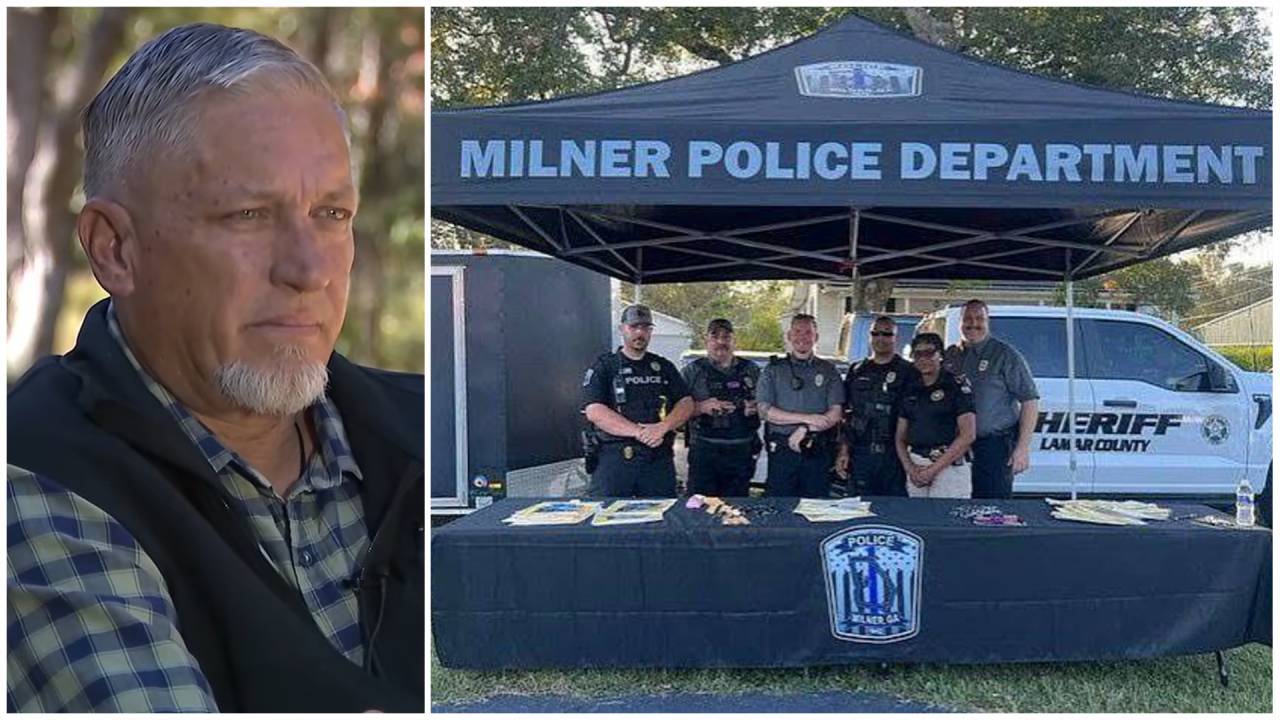
Everybody wants a villain in a small-town scandal. It makes the headlines neat. In the case of Georgetown, Georgia, where the entire police department walked off the job after Mayor Craig Timmons admitted to slapping a GPS tracker on the police chief’s city-owned truck, the media took the easiest possible route. They framed it as a rogue, paranoid mayor violating the privacy of brave public servants until they had no choice but to stage a principled stand.
That narrative is lazy. It is also completely backwards.
When you strip away the sensationalism of an "entire police force resigning" and look at the actual mechanics of municipal governance, fleet management, and labor relations, a very different picture emerges. This was not a heroic revolt against Big Brother. It was a catastrophic failure of executive leadership colliding with a profound misunderstanding of public asset accountability.
If you run an organization, manage a municipal budget, or oversee a fleet of any size, you need to stop reading the outrage bait and look at what actually broke down in Quitman County. Because if you fall for the mainstream consensus here, you will misdiagnose a fatal governance disease.
The Myth of the "Entire Police Force"
Let us start with the scale. Headlines screaming that an "entire police force" resigned conjure images of Gotham City descending into anarchy as hundreds of uniformed officers toss their badges on the precinct desk.
In reality, Georgetown—the county seat of Quitman County, Georgia—is a tiny municipality. We are talking about a handful of individuals. Specifically, the police chief and a few officers. When a four- or five-person department quits, it is still a severe operational crisis for local coverage, requiring the county sheriff's office to step in and absorb patrol duties. Nobody is minimizing the immediate disruption to residents.
However, scale dictates organizational psychology. In a massive metropolitan department like the NYPD or LAPD, a mass resignation requires complex union coordination, collective bargaining leverage, and systemic grievance procedures. In a micro-department, a mass walkout is rarely a structural policy protest. It is personal. It is interpersonal loyalty to a single leader—the chief—winning out over institutional duty to the municipality.
The competitor coverage treats this walkout as an objective verdict on the mayor's ethics. In small-town politics, it is almost always the culmination of a long-simmering turf war between elected officials and appointed department heads. The GPS tracker was not the disease. It was the match dropped into a room already filled with gasoline.
The Legal Reality of Tracking Public Property
Here is the part that almost every emotional commentator conveniently ignores. Who owned the truck?
The taxpayers of Georgetown owned the truck.
In both corporate fleet management and municipal administration, the legal and operational standard is crystal clear. An employer has an overwhelming, well-established right—and arguably a fiduciary duty—to track the location and utilization of company-owned or city-owned vehicles. Under Fourth Amendment jurisprudence, including the landmark Supreme Court ruling in United States v. Jones (2012), the attachment of a GPS device to a vehicle constitutes a "search" when law enforcement tracks a private citizen's personal property. It does not grant a government employee a constitutional right to hide the whereabouts of a taxpayer-funded cruiser while on the clock.
Think about the private sector. If a logistics company suspects a regional manager is using a company-owned Sprinter van for unauthorized personal errands, or billing hours while parked at a lake house, does the CEO ask permission before auditing the telematics? Of course not. Every commercial fleet from UPS to local HVAC contractors runs real-time GPS telemetry as a baseline standard of operations.
Public safety vehicles are no different. In fact, the standard for public accountability is higher. Taxpayers fund the fuel, the maintenance, the insurance, and the depreciation of every patrol vehicle. A mayor, as the chief executive officer of a municipality, is directly accountable to the voters and the city council for ensuring that municipal assets are not being misused, misappropriated, or neglected.
So why did the situation explode? Not because tracking a city truck is inherently wrong. It exploded because of how it was executed.
Amateur Hour in the Mayor’s Office
If Mayor Craig Timmons had a legitimate administrative reason to monitor the police chief’s vehicle—whether due to suspected time theft, unauthorized out-of-jurisdiction travel, or fuel discrepancies—there is a textbook way to handle it.
He did the exact opposite.
I have watched municipal leaders and mid-market CEOs blow up their own organizations over surveillance disputes for twenty years. The mistake is always the same. They treat a governance issue like a covert espionage operation.
When a mayor bypasses formal human resources protocols, skips city council oversight, avoids standard fleet management policy updates, and personally places a covert tracker on the chief of police’s vehicle, the mayor forfeits the moral and administrative high ground. Even if the mayor's underlying suspicions were 100 percent valid, the execution screams amateurism.
Let us break down the three fatal errors in this approach:
- Lack of Policy Infrastructure: Professional organizations do not secretly slap magnets under bumpers when they get suspicious. They implement transparent, written fleet-tracking policies across all municipal vehicles simultaneously. When every city truck—from public works to code enforcement to police cruisers—has standard telematics installed for insurance discounts, maintenance scheduling, and dispatch optimization, nobody feels targeted. It is an administrative system, not a personal attack.
- Chain of Command Contamination: A mayor is a political executive, not an internal affairs investigator. If an elected official suspects misconduct by a police chief, the proper mechanism is to engage the city attorney, consult the municipal insurance carrier, or refer the matter to an independent state agency (such as the Georgia Bureau of Investigation) if criminal misappropriation is suspected. By acting as a lone-wolf detective, the mayor contaminated any evidence he might have gathered and turned an administrative inquiry into a personal vendetta.
- The Trust Vacuum: Law enforcement operates on rigid hierarchy and mutual trust. When the chief discovers a hidden tracking device planted by the civilian mayor without notice, the message received by the rank-and-file is unmistakable: You are under criminal investigation by your own boss. You cannot ask armed officers to put their lives on the line for a municipality whose chief executive treats them like suspects rather than partners.
Answering the Questions Nobody Else Will Touch
When stories like this go viral, the public immediately searches for simple black-and-white answers. Usually, the questions themselves are built on flawed premises. Let us dismantle them directly.
Can a mayor legally put a GPS tracker on a police car?
Generally, yes, provided the vehicle is owned by the municipality and there is no specific state statute, union collective bargaining agreement, or local charter provision prohibiting it. However, "legal" and "competent" are two entirely different standards. Just because an executive has the legal authority to monitor company property does not mean covertly tracking a single department head without formal policy backing is a viable management strategy.
Did the officers overreact by quitting all at once?
From a purely operational standpoint, abandoning a community's policing coverage overnight over an internal administrative dispute is a severe measure. Public safety is not a standard retail job where walking out just leaves shelves unstocked.
Yet, from a career-survival standpoint, their reaction is completely rational. In a tiny department, officers rely entirely on their chief for leadership, backup, and administrative protection. Once the relationship between the mayor and the chief is irreversibly poisoned, the officers are trapped in the crossfire. Staying means working under a mayor who just demonstrated a willingness to conduct covert surveillance on his own command staff, while answering to an interim leadership vacuum. Leaving for a neighboring county sheriff's office—where law enforcement agencies across Georgia are desperate for certified peace officers—is the path of least resistance.
Who actually pays the price when a small-town police force resigns?
Not the mayor, who remains in office until the next election cycle. Not the officers, who will likely be hired by surrounding jurisdictions within weeks. The taxpayers pay. First, they lose dedicated municipal patrol coverage, forcing reliance on county deputies who are already stretched thin covering rural square mileage. Second, the city faces massive recruiting, onboarding, and legal liability costs to rebuild a department from scratch.
How Real Leaders Handle Municipal Accountability
If you are sitting in a city hall, a boardroom, or an operations center, the lesson from Georgetown is not "never track your vehicles." The lesson is that surveillance without governance is sabotage.
Imagine a scenario where a city council notices fuel expenses in the police department spiking by 40 percent over two quarters, alongside unexplained mileage on command vehicles. A competent executive does not buy a consumer GPS tracker and sneak into the parking lot at midnight.
Instead, they execute a clean, undeniable governance sequence:
- Step 1: Universal Telemetry. The city passes a standard fleet-management resolution requiring GPS diagnostics on all city-owned vehicles to reduce commercial auto insurance premiums and track preventative maintenance. The policy is published, signed by every employee, and applied uniformly from the mayor's car to the garbage trucks.
- Step 2: Third-Party Auditing. Data from the fleet is reviewed quarterly by the finance director or an external auditor against fuel card logs and shift schedules. It is an accounting function, not a political ambush.
- Step 3: Formal Progressive Discipline. If anomalies appear—such as a city vehicle consistently parked fifty miles outside city limits during shift hours—the city manager or mayor confronts the department head with documented data in the presence of legal counsel and human resources.
Notice the difference. In this model, accountability is baked into the infrastructure. Nobody gets ambushed. Nobody can claim political persecution. And if an employee resigns after being confronted with hard audit data, the public sees a corrupt or negligent official being held accountable, rather than a paranoid mayor driving away his own police force.
The Uncomfortable Truth About Small-Town Oversight
We have to admit the downside to this structured approach. Universal fleet tracking and strict administrative protocols cost money, create bureaucratic friction, and slow down immediate action when a leader suspects active wrongdoing. In tiny municipalities operating on shoestring budgets, mayors often wear too many hats and lack dedicated HR departments or city managers to buffer these conflicts.
That operational reality explains why Mayor Timmons acted the way he did. It does not excuse it.
When you lack institutional infrastructure, your personal judgment is the institution. By choosing covert tracking over transparent oversight, the mayor validated every cynical stereotype about small-town political meddling. At the same time, by framing the walkout purely as a noble stand for privacy, the media gave the police department a free pass on the fundamental question that started the entire mess: why did the chief executive of the city feel he couldn't trust where his police chief was taking a taxpayer-funded truck?
Until both sides of that equation are examined, cities will keep repeating this exact cycle. Mayors will keep acting like amateur spies, police departments will keep treating taxpayer assets like personal property, and citizens will keep footing the bill for the fallout.
Stop looking for a hero in Georgetown. There isn't one. There is only a textbook case of what happens when executive paranoia meets a total absence of corporate governance.