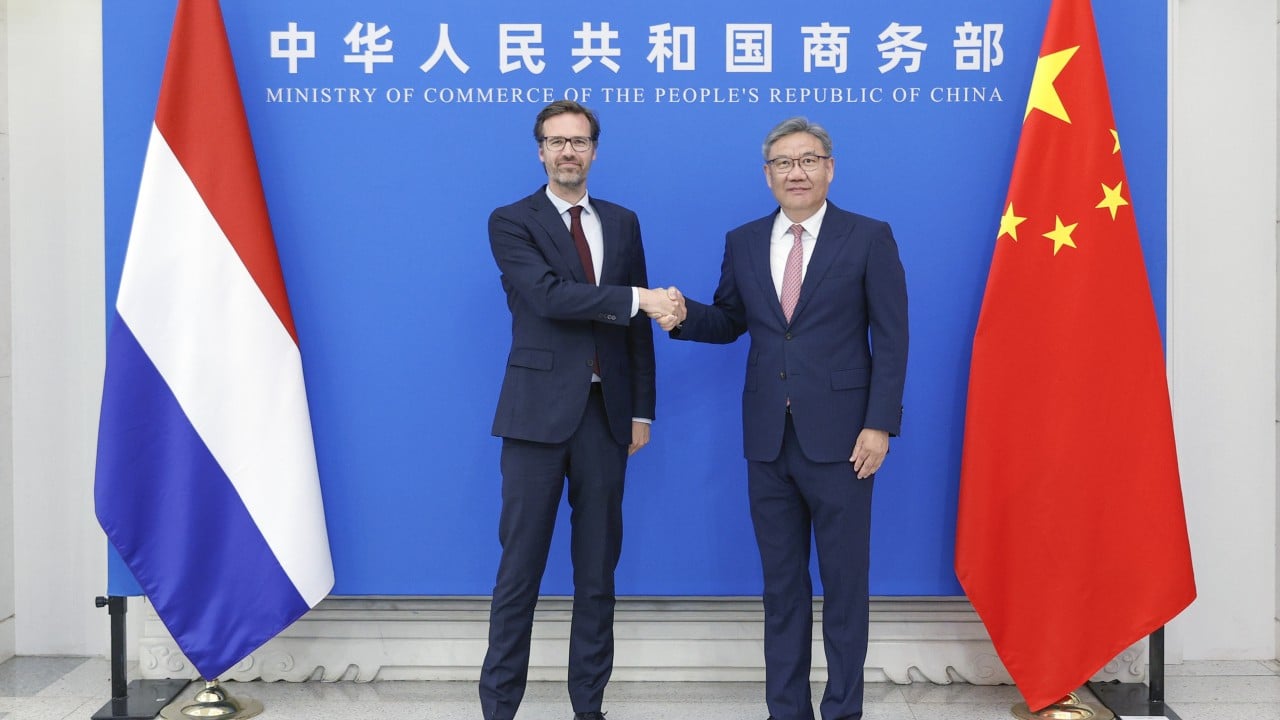
The geopolitical equilibrium of the global semiconductor supply chain hinges on a single, highly concentrated choke point: advanced photolithography. Beijing’s diplomatic engagements with the Dutch trade ministry represent a calculated effort to mitigate the systematic degradation of China's access to semiconductor manufacturing equipment (SME). This is not a standard bilateral trade negotiation; it is a high-stakes management of a structural supply chain vulnerability. Beijing aims to secure operational stability for its domestic fabrication facilities (fabs) while maintaining access to international markets. Achieving this requires navigating a dense web of multilateral export controls, commercial dependencies, and lithographic physics.
To understand the strategic reality underneath the diplomatic rhetoric, the relationship must be broken down into its hard economic and technological components. The friction between Chinese market demand and Dutch export restrictions is dictated by industrial dependencies, multi-patterning yield economics, and regulatory enforcement mechanisms.
The Architecture of Lithography Dependency
The global semiconductor manufacturing ecosystem exhibits an extreme degree of asset concentration. While microchip design is geographically distributed, the physical execution of advanced lithography is monopolized by a single European entity: ASML. This creates an absolute asymmetry in trade negotiations. Chinese semiconductor self-sufficiency initiatives, such as the national guidelines for integrated circuit industry development, face a hard physical ceiling determined by the availability of Deep Ultraviolet (DUV) and Extreme Ultraviolet (EUV) lithography systems.
[Image of semiconductor photolithography process]
The dependency model can be categorized into three distinct technological tiers, each possessing a different level of vulnerability to export controls:
- Extreme Ultraviolet (EUV) Systems: Operating at a wavelength of 13.5 nanometers, these machines are essential for manufacturing chips at nodes below 7 nanometers without resorting to prohibitively expensive multi-patterning schemes. Dutch policy, aligned with multilateral agreements, has completely restricted the export of EUV systems to China. This introduces a structural barrier to domestic leading-edge logic development.
- Advanced Immersion Deep Ultraviolet (DUV) Systems: Utilizing 193-nanometer argon fluoride (ArF) lasers combined with a liquid medium to increase the numerical aperture, immersion DUV systems (such as the Twinscan NXT:1980 and NXT:2000 series) represent the current geopolitical battleground. These systems are capable of producing sub-7-nanometer chips through iterative exposure cycles, though at a significant cost to production yield.
- Dry DUV and I-Line Systems: These legacy tools form the backbone of power semiconductor, analog chip, and sensor manufacturing. These systems remain largely unrestricted, serving as the foundation for China's massive expansion in mature node capacity.
The operational reality for Chinese fabs is defined by tool longevity. A lithography system is not a plug-and-play asset; it requires a continuous supply of proprietary spare parts, specialized chemical consumables, and software optimization from the original equipment manufacturer (OEM). Consequently, an export ban does not merely halt the acquisition of new capital equipment. It initiates a depreciation clock on existing operational capacity. Without OEM servicing, the mean time between failures (MTBF) for critical subcomponents like laser sources and precision mirrors creates a systemic risk for production continuity.
The Three Pillars of Beijing's Diplomatic Strategy
Beijing's diplomatic approach during trade discussions with the Netherlands is structured around three distinct tactical levers designed to counter unilateral and multilateral technology blockades.
+-----------------------------------------------------------------------+
|              BEIJING'S THREE-PILLAR DIPLOMATIC STRATEGY               |
+-----------------------------------+-----------------------------------+
| 1. Commercial Reciprocity         | Emphasizing market share loss for |
|                                   | Western firms to create internal  |
|                                   | political opposition to controls. |
+-----------------------------------+-----------------------------------+
| 2. Mature Node Dominance          | Weaponizing high-volume supply of |
|                                   | legacy chips to create asymmetric |
|                                   | economic dependencies.            |
+-----------------------------------+-----------------------------------+
| 3. Critical Mineral Controls      | Imposing targeted export licenses |
|                                   | on upstream elements like gallium |
|                                   | and germanium.                    |
+-----------------------------------+-----------------------------------+
1. Commercial Reciprocity and Market Access Asymmetry
The Chinese market historically accounts for a substantial percentage of total revenue for Dutch semiconductor equipment providers. In certain quarters, net sales to Chinese customers have comprised upwards of 40 percent of total bookings for immersion DUV tools. Beijing capitalizes on this commercial dependence by framing export restrictions as an existential threat to European corporate profitability and research and development budgets. The strategic objective is to incentivize corporate lobbying within the Netherlands, urging the Dutch government to resist external pressure from Washington to expand the scope of prohibited equipment.
2. Upstream Material Weaponization
To balance the asymmetric leverage held by the West in lithography tools, China utilizes regulatory control over the upstream supply chain of critical minerals. The introduction of export licensing requirements for gallium, germanium, and antimony serves as a direct counterweight. Because these elements are foundational to the production of radiofrequency chips, fiber optic systems, and specialized military hardware, Beijing signals that restriction of downstream capital equipment will result in the restricted supply of upstream raw components.
3. Asymmetric Legacy Node Scale
Recognizing the barrier to advanced nodes, China has funneled capital into legacy semiconductor fabrication (28 nanometers and above). By building immense production capacity in mature nodes, Beijing creates an economic dependency where global automotive, industrial, and consumer electronics sectors become reliant on Chinese-manufactured foundational silicon. This industrial concentration gives Beijing the power to disrupt global manufacturing supply chains if Western export controls cross into total containment.
The Cost Function of Multi-Patterning Solutions
Driven by export restrictions, Chinese logic fabs have adapted by substituting advanced EUV lithography with multi-patterning techniques on immersion DUV infrastructure. This operational shift can be modeled through an economic and physical cost function.
In standard single-exposure lithography, the cost per wafer is optimized. When a fab is forced to use Self-Aligned Quadruple Patterning (SAQP) to achieve a 7-nanometer or 5-nanometer feature size using a 193-nanometer immersion tool, the manufacturing process changes fundamentally:
$$C_{\text{wafer}} = N \cdot (C_{\text{litho}} + C_{\text{etch}} + C_{\text{deposition}}) + C_{\text{substrate}}$$
Where $N$ represents the number of patterning cycles required to resolve the features. For SAQP, $N$ escalates dramatically relative to a single EUV exposure. This multiplication of process steps introduces severe systemic penalties:
- Yield Degradation: Every additional lithographic exposure, etching step, and chemical vapor deposition layer introduces a probability of defect generation. If a single process step has a 99 percent yield, compounding that step 30 times reduces the cumulative wafer yield to approximately 74 percent. In advanced microchip manufacturing, where commercial viability requires yields exceeding 85 to 90 percent, multi-patterning on DUV strains profitability.
- Throughput Bottlenecks: A DUV system performing quadruple patterning processes fewer wafers per hour compared to an EUV system running a single exposure. This operational slowdown increases the capital expenditure required per unit of output, as more DUV machines must be deployed to match the capacity of a single EUV line.
- Metrology and Overlay Budgets: The overlay budget—the precision with which successive layers of a microchip are aligned to one another—drops below 2 nanometers for sub-7-nanometer nodes. DUV immersion tools struggle to maintain this alignment accuracy across multiple consecutive passes, leading to structural failures and timing faults in the final silicon.
This economic reality shows that while Beijing can demonstrate the technical capability to produce high-performance processors using restricted Dutch equipment, doing so at scale incurs an exponential cost penalty. The strategy is sustainable for strategic military or domestic computing applications but remains uncompetitive in global commercial markets.
The Friction in Dutch Regulatory Enforcements
The Dutch state faces a complex balancing act defined by national sovereignty, economic security, and international alliances. While the Wassenaar Arrangement historically governed dual-use technology exports, the current enforcement architecture operates under a mixture of domestic decrees and bilateral pressure.
A primary tension for Dutch regulators resides in the definition of servicing and maintenance. Under existing export regimes, the sale of new advanced immersion systems is prohibited. However, the legal definition of what constitutes software updates, diagnostic support, and spare part delivery remains subject to diplomatic maneuvering.
If the Dutch government enforces an absolute prohibition on servicing previously installed tools, it effectively destroys billions of euros in capital assets owned by Chinese entities. Such a move would likely trigger swift retaliatory measures against Dutch corporate interests in China. Conversely, allowing ongoing maintenance permits Chinese fabs to extend the operational lifespan of their existing toolsets, partially blunting the impact of the Western technology blockade.
Structural Forecast for the Supply Chain
The structural trajectory of Sino-Dutch semiconductor trade will not return to open commerce. Instead, the relationship will transition into a managed, highly regulated state of friction defined by three structural realities.
First, the bifurcation of the semiconductor equipment ecosystem will accelerate. Chinese state-backed consortia, including entities like Advanced Micro-Fabrication Equipment (AMEC) and Shanghai Micro Electronics Equipment (SMEE), will continue to receive massive capital injections to develop domestic alternatives to foreign tools. While domestic Chinese lithography systems are currently generations behind Dutch benchmarks, they will gradually absorb the market share for legacy and mid-tier processing nodes within Mainland China.
Second, Western export criteria will shift from focus on node designations (e.g., "7-nanometer") to objective physical capabilities. Regulators will target specific technical metrics, such as numerical aperture values, laser power ratings, and maximum overlay precision. This adjustment will close the regulatory gaps that currently allow fabs to repurpose unrestricted machinery for advanced manufacturing via multi-patterning.
Third, the Netherlands will increasingly align its economic security policy with a broader European framework. This collective approach is designed to distribute the financial impact of Chinese trade retaliation across the European Union, reducing the vulnerability of a single nation to concentrated economic counter-measures.
The ultimate outcome of Beijing’s diplomatic engagement is not the lifting of advanced technology bans, but rather the preservation of access to legacy tools and maintenance components. This access is vital to keep China's domestic industrial base operational while its independent, domestic equipment supply chain undergoes long-term development.