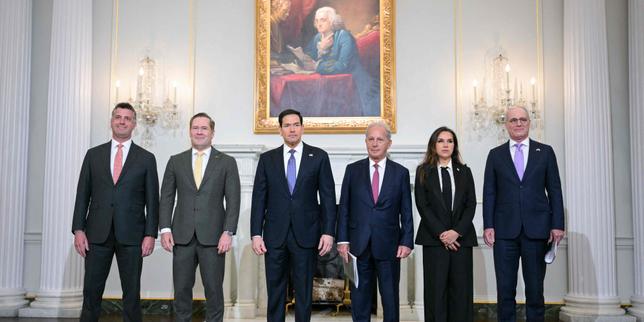
The resumption of negotiations between Israel and Lebanon, facilitated by the incoming U.S. administration, represents a tactical shift from kinetic exhaustion to a managed buffer framework. While media reports focus on the optics of renewed dialogue, the underlying reality is a calculated realignment of the security-sovereignty trade-off. This negotiation is not a search for peace in the classic sense; it is an exercise in defining the operational depth of a buffer zone and the technical parameters of enforcement.
The primary obstacle to a stable ceasefire remains the divergence between territorial sovereignty and security enforcement. Lebanon seeks the restoration of state authority over its southern territory, while Israel requires a verifiable mechanism to ensure the absence of hostile infrastructure south of the Litani River. These objectives are fundamentally at odds under the current implementation of UN Resolution 1701.
The Tri-Node Conflict Framework
To understand the current state of discussions, the conflict must be mapped across three distinct nodes: kinetic saturation, political insolvency, and external mediation pressure.
- Kinetic Saturation: Both the Israel Defense Forces (IDF) and Hezbollah have reached a point where marginal military gains are outweighed by the cost of continued mobilization and infrastructure degradation. Israel’s objective has shifted from total elimination to the creation of a "sterile zone." Hezbollah’s objective has transitioned from "unification of fronts" to organizational preservation.
- Political Insolvency: The Lebanese state lacks the coercive capacity to fulfill its obligations under 1701. This creates a vacuum where non-state actors operate with impunity. Any negotiation that does not address the Lebanese Armed Forces’ (LAF) lack of equipment, funding, and mandate is structurally doomed to fail.
- External Mediation Pressure: The transition of power in Washington provides a window of "strategic ambiguity." The Trump administration utilizes a transactional approach that prioritizes rapid stabilization over long-term ideological alignment. This pressures both parties to secure the best possible terms before a new, perhaps more rigid, status quo is established.
The Litani Delta: A Failure of Buffer Mechanics
The central technical dispute involves the enforcement of a demilitarized zone. The previous arrangement failed because it relied on "passive observation" rather than "active interdiction."
The Enforcement Gap
Resolution 1701 mandated that no armed personnel, assets, or weapons other than those of the Lebanese government and UNIFIL be deployed between the Blue Line and the Litani River. In practice, the lack of an enforcement mandate for UNIFIL allowed for the incremental buildup of subterranean infrastructure and concealed launch sites.
Israel’s current demand for "freedom of action" represents a fundamental change in the enforcement model. They are proposing a shift from a multilateral observation model to a unilateral enforcement model. Under this framework, if the Lebanese state fails to neutralize a threat, Israel retains the pre-authorized right to intervene. This clause is the primary sticking point for the Lebanese government, as it constitutes a formal surrender of territorial sovereignty.
The LAF Capacity Constraint
For a diplomatic solution to hold, the Lebanese Armed Forces must be transformed from a ceremonial presence into a credible security guarantor. This requires three specific upgrades:
- Surveillance Parity: Deployment of advanced seismic and aerial monitoring equipment to detect tunnel construction and weapon caches.
- Legal Mandate: The authority to conduct searches of private property without prior authorization from local municipal leaders, who are often under the influence of non-state actors.
- Economic Sustainability: A dedicated international funding stream to ensure the loyalty and operational readiness of soldiers amidst Lebanon’s ongoing economic collapse.
The Cost Function of Continued Attrition
The decision to return to the negotiating table is driven by an increasingly unfavorable cost-benefit analysis for all stakeholders.
Israel’s Domestic Pressure
The displacement of over 60,000 citizens from northern Israel has created a political liability that the Netanyahu government cannot sustain indefinitely. The economic cost of maintaining a high-readiness posture along the northern border, combined with the loss of agricultural and industrial productivity in the Galilee, creates a "bleed rate" that demands a resolution. The military has achieved significant tactical victories—destroying command structures and neutralizing stockpiles—but these gains are perishable without a political framework to lock them in.
The Lebanese Economic Vector
Lebanon’s economy is in a state of terminal decline. The destruction of infrastructure in the south further strains a budget that does not exist. The political class in Beirut recognizes that continued conflict risks the total disintegration of state institutions. For them, a ceasefire is not just a security necessity but a prerequisite for any future IMF bailout or international investment.
The U.S. Mediation Strategy: Transactional De-escalation
The involvement of Donald Trump introduces a "deal-centric" logic to the region. Unlike traditional diplomatic efforts that prioritize process and consensus, the incoming administration’s approach focuses on high-level pressure and the leverage of personal relationships.
This strategy relies on the Theory of Credible Threats. By signaling a willingness to withdraw support or, conversely, to provide unprecedented backing to one side, the mediator forces the combatants to re-evaluate their "Best Alternative to a Negotiated Agreement" (BATNA).
The scheduled discussions on Thursday are likely to focus on the "Implementation Road Map," which breaks the ceasefire into phased increments:
- Phase One: A 60-day cessation of hostilities and a partial withdrawal of IDF forces from newly occupied positions.
- Phase Two: Deployment of an expanded LAF contingent to the south, supported by a specialized international monitoring committee (likely including U.S. and French participation).
- Phase Three: The permanent demarcation of the land border, resolving the 13 disputed points along the Blue Line.
Structural Vulnerabilities of the Proposed Deal
Even with high-level U.S. involvement, the deal faces significant "spoiler risks."
- The Iranian Variable: Hezbollah’s calculus is inextricably linked to Tehran’s broader regional strategy. If Iran perceives a ceasefire as a strategic retreat that weakens its "Axis of Resistance," it may exert pressure on Hezbollah to maintain a low-intensity conflict.
- The Verification Paradox: There is currently no technological or political mechanism that can guarantee 100% "sterility" in the buffer zone. Small-scale violations are inevitable. The success of the deal depends on whether these violations are treated as technical failures (to be addressed by the monitoring committee) or as strategic breaches (triggering a return to full-scale war).
- The Sovereignty Trap: The Lebanese government cannot sign an agreement that explicitly permits Israeli overflights or ground incursions. Any such language must be buried in "side letters" or verbal understandings with the U.S., creating a fragile legal architecture that could collapse under public scrutiny.
The Strategic Shift from Buffer to Border
The long-term stability of the region requires a transition from a "conflict buffer" to a "recognized border." This involves moving beyond the 1949 Armistice Line and the 2000 Blue Line toward a final, mutually recognized international boundary.
A critical component of this transition is the resolution of the maritime border’s land-side equivalent. The 2022 maritime deal proved that Israel and Lebanon can reach functional agreements when economic interests (gas fields) are aligned. The current negotiations seek to replicate this logic by offering Lebanon "sovereignty and stability" in exchange for Israel’s "security and return of citizens."
The immediate tactical priority is the establishment of the Independent Monitoring Mechanism (IMM). This body must be distinct from UNIFIL, possessing the technical intelligence capabilities to verify compliance in real-time. Without a robust IMM, any signed document will merely serve as a countdown to the next escalation.
The success of the upcoming Thursday talks will be measured not by the rhetoric of the participants, but by the specificity of the enforcement protocols established. The focus must remain on the technicalities of the "Side Letter of Guarantees" provided by the United States to Israel, which likely outlines the conditions under which the U.S. would support unilateral Israeli action in the event of a breach. This document, more than the official treaty, will define the security architecture of the Levant for the next decade.
The strategic play here is to utilize the current moment of Iranian hesitation and Lebanese exhaustion to institutionalize a new security reality. The objective is to move from a state of "unstable deterrence" to one of "managed friction," where the costs of breaking the ceasefire are made prohibitively high through both military and economic mechanisms.