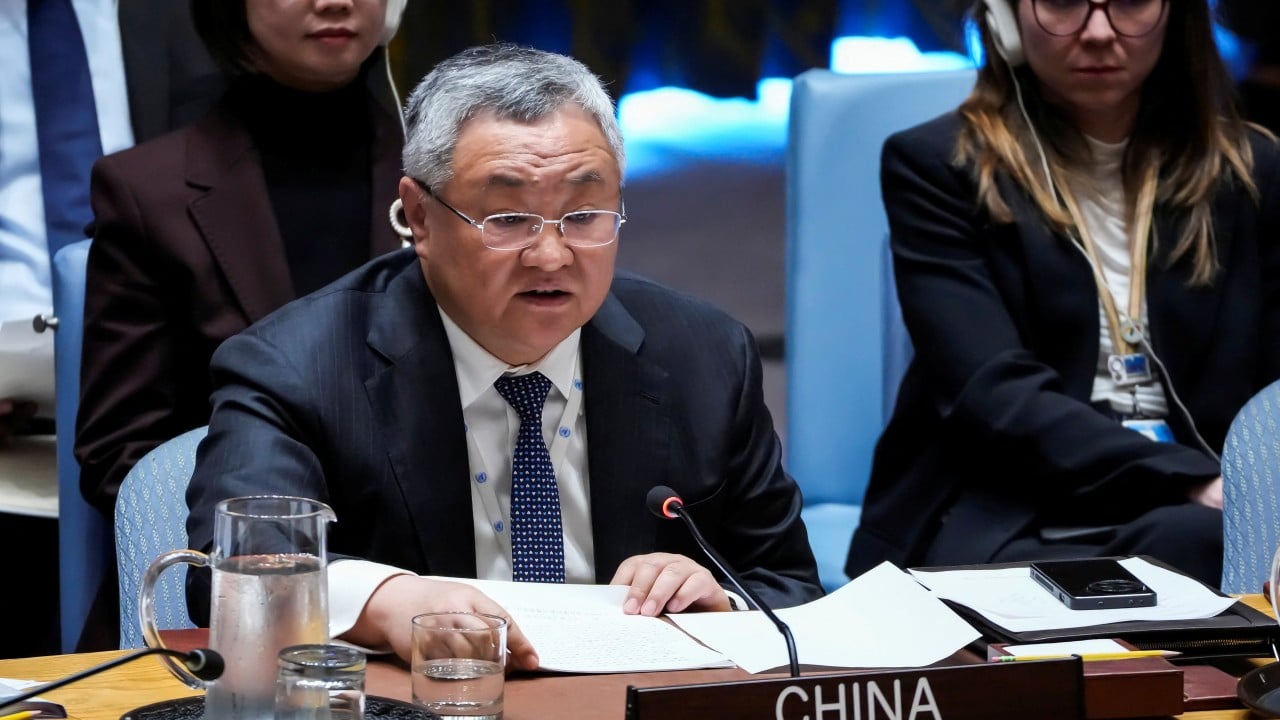
The rhetoric of "bullying" deployed by Chinese UN envoys functions not as an emotional appeal, but as a calculated signaling mechanism designed to frame the legal boundaries of upcoming Trump-Xi negotiations. When Beijing decries the widening of US sanctions, it is highlighting a shift from targeted export controls to broad-spectrum economic decoupling. The strategic intent behind these sanctions is the degradation of China’s dual-use technological capacity; the counter-strategy from Beijing is the consolidation of the "Global South" as a parallel economic ecosystem. This creates a feedback loop where every US restriction accelerates Chinese self-reliance, which in turn justifies further US restrictions to maintain a technological lead.
The Three Pillars of Pre-Summit Posturing
Diplomatic tension before a high-level summit serves three distinct functions in international relations theory. Understanding these pillars reveals why the current "blast" from the UN envoy is a prerequisite for, rather than a barrier to, a potential deal.
- The Sovereignty Anchor: By labeling sanctions as "bullying" at the UN, China establishes a non-negotiable floor for talks. It signals that any concession made by Xi Jinping will be framed as a choice by a global leader, not a submission to a hegemon.
- The Leverage Calibration: The US expands sanction lists specifically to create "disposable leverage." These are assets (or entities) restricted late in the game that can be traded away during the summit in exchange for core Chinese concessions, such as agricultural purchases or Fentanyl precursor regulation.
- The Audience Bifurcation: The UN envoy's speech is directed at two audiences simultaneously. To the domestic Chinese audience, it demonstrates strength; to the international community, it positions China as the defender of a "multipolar" order against "unilateralism."
The Cost Function of Economic Coercion
Sanctions are not static tools; they possess a decaying efficacy rate. To analyze the impact of the latest US measures, we must apply a cost-benefit framework that accounts for both the target and the initiator.
- Asymmetric Dependency Risks: The US strategy relies on China’s continued need for Western lithography (semiconductors) and capital markets. However, the marginal utility of each new sanction decreases as China builds out its "Red Supply Chain." The "Cost of Evasion" for China is high in the short term but yields long-term structural independence that the US cannot easily reverse once established.
- The Collateral Leakage: Sanctions on Chinese entities often disrupt the supply chains of US allies (Japan, South Korea, Netherlands). This creates a "Diplomatic Friction Coefficient." The US must spend political capital to keep allies aligned, meaning the net strength of a sanction is always its face value minus the cost of maintaining the coalition.
The Mechanism of "Bullying" as a Legal Defense
When the Chinese envoy uses the term "bullying," they are specifically referencing the perceived violation of World Trade Organization (WTO) norms and the principle of "Sovereign Equality" enshrined in the UN Charter.
The US justifies widened sanctions under the "National Security Exception" (GATT Article XXI). This creates a fundamental logical deadlock. The US defines national security broadly, encompassing economic dominance in AI and quantum computing. China defines "bullying" as the use of domestic law to extraterritorially govern international trade. The conflict is not merely about trade volumes; it is a collision of two irreconcilable legal interpretations of global power.
Structural Bottlenecks in the Trump-Xi Framework
The upcoming talks are pressured by a specific set of structural bottlenecks that prevent a simple "return to normal."
- The Enforcement Gap: Previous agreements (like the Phase One Trade Deal) failed because the enforcement mechanisms were viewed as intrusive by Beijing and insufficient by Washington. Any new deal faces the "Verification Paradox": China will not allow on-site inspections of its tech firms, and the US will not trust paper-only guarantees.
- The Zero-Sum Technological Horizon: In traditional trade (soybeans, steel), win-win scenarios exist. In frontier technology (AI, semiconductors), the logic is zero-sum. A gain in Chinese AI capability is viewed as a direct loss for US defensive capabilities. This limits the "Negotiable Surface Area" of the summit.
The Global South as a Hedging Asset
China’s strategy at the UN aims to mobilize the "Global South" into a cohesive bloc that views US sanctions as a threat to universal development. This is not mere altruism; it is a calculated diversification of risk. By positioning itself as the leader of the developing world, China ensures that even if Western markets tighten, it maintains a vast, if less affluent, consumer base and source of raw materials. This creates a "Sanction Shield." If the US sanctions a Chinese firm that provides the primary digital infrastructure for thirty African nations, the US risks alienating those nations, thereby increasing the geopolitical cost of the sanction.
Quantifying the Escalation Ladder
Escalation in this context follows a predictable kinetic path. We can categorize the intensity of the "bullying" claims and the counter-sanctions into four levels of severity:
- Level 1: Rhetorical Denunciation: UN speeches, press releases, and "strong concerns." This is the current state.
- Level 2: Targeted Reciprocity: The "Unreliable Entity List." China targets specific US firms in response to US actions against Huawei or SMIC.
- Level 3: Resource Weaponization: Export controls on critical minerals (Gallium, Germanium, Graphite). This is the "Nuclear Option" of trade wars, as it directly chokes Western high-tech manufacturing.
- Level 4: Financial Decoupling: Large-scale divestment from US Treasuries or the exclusion of US firms from the Chinese domestic payment ecosystem.
The Role of the Dollar Hegemony
The envoy's "bullying" critique is, at its core, a critique of the USD-denominated financial system. Sanctions work because the US Department of the Treasury can "see" and "stop" transactions involving the dollar. China’s long-term strategic response is the development of the mBridge project and the digital yuan (e-CNY). These systems are designed to bypass the SWIFT network entirely. The more the US uses sanctions as a primary tool of statecraft, the faster the "De-dollarization" incentive grows among middle powers who fear they could be next.
Logic of the Pre-Summit "Widening"
Why would the US widen sanctions right before a talk? Conventional wisdom suggests this "poisons the well." A data-driven analysis suggests the opposite: it creates "Urgency Fatigue." By the time the leaders meet, the list of grievances is so long that they are forced to focus only on the top 2% of issues. This allows both sides to ignore the remaining 98% of intractable problems while claiming a "successful stabilization of the relationship."
The wideness of the sanctions also serves to "pre-pay" for the deal. If the US administration wants to look "tough" but still reach an agreement, it can apply ten sanctions on Monday and "generously" lift three on Friday as part of the negotiation. The net result is seven new sanctions, but the narrative is one of "diplomatic progress."
Strategic Recommendation: The Resilience Pivot
For global enterprises and policy planners, the "bullying" rhetoric signals that the "China Plus One" strategy is no longer optional—it is a requirement for survival.
The move toward the Trump-Xi talks will likely produce a "Temporary Floor"—a short-term cessation of new hostilities. However, this floor is structurally unstable. The fundamental divergence in national interests regarding AI and regional security remains.
The final strategic play is not to wait for a "normalization" of ties that will never come. Instead, stakeholders must optimize for a "High-Friction Equilibrium." This involves:
- Segmenting Intellectual Property: Separating R&D into distinct geographic silos to prevent cross-contamination of sanctioned tech.
- Neutrality Arbitrage: Utilizing "bridge countries" (Vietnam, Mexico, UAE) that maintain functional relationships with both blocs to act as the processing nodes of global trade.
- Dual-Stack Logistics: Building supply chains that can function independently of both US-centric and China-centric financial rails.
The diplomatic "blast" at the UN is not a sign of a breakdown; it is the opening bell of a new, more rigid phase of the competition. Success will be defined by the ability to operate within the friction, rather than hoping for its removal.