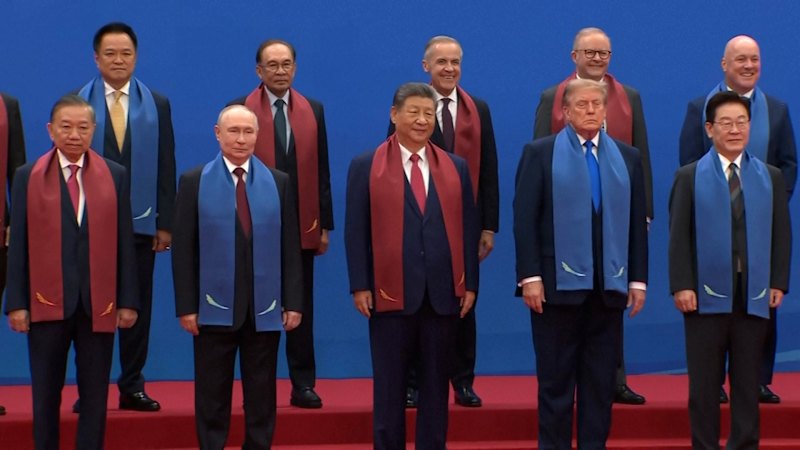
The staged "family photo" of international leaders in Shenzhen is not a ceremonial diplomatic artifact; it is an engineered signal of supply chain gravity. While surface-level coverage treats these visual assemblies as standard protocol, the choice of Shenzhen—rather than Beijing or Shanghai—shifts the analytical baseline from traditional statecraft to industrial policy. When heads of state stand together against the backdrop of the Pearl River Delta, they are validating a specific economic architecture: one where hardware iteration speed, localized component ecosystems, and state-backed capital deployment dictate diplomatic alignment.
To extract operational value from this event, analysts must separate the visual choreography from the underlying capital and trade mechanics. A summit in Shenzhen operates on three distinct structural levels: spatial signaling, supply chain deterrence, and asymmetric bilateralism.
The Architecture of Spatial Signaling
In international relations, venue selection functions as a non-verbal policy statement. Beijing represents centralized political authority, regulatory enforcement, and ideological continuity. Shanghai represents global financial integration, multinational corporate headquarters, and cross-border capital flows. Shenzhen represents something entirely different: the conversion of state directives into physical manufacturing scale within compressed timelines.
By assembling leaders in Shenzhen, the host nation enforces a specific framing for all subsequent negotiations. The setting reminds visiting delegations that diplomatic friction carries an immediate industrial cost. Over the past four decades, Shenzhen evolved from a low-cost assembly enclave into a dense, vertically integrated hardware ecosystem. Within a fifty-kilometer radius of the city center, an enterprise can source printed circuit boards, custom injection-molded enclosures, lithium-ion battery cells, and specialized semiconductor packaging.
This geographic concentration creates a structural moat that tariff regimes and reshoring subsidies struggle to dismantle. When leaders pose for photographs in this environment, the visual subtext overrides standard diplomatic communiqués. The host demonstrates that while foreign capitals debate regulatory frameworks and industrial subsidies, the physical infrastructure required to build next-generation telecommunications, electric vehicles, and autonomous systems already operates at scale in Guangdong province.
Deconstructing the Diplomatic Cost Function
Standard geopolitical commentary frequently misinterprets participation in these summits as ideological endorsement. In practice, national leaders operate under a strict economic cost function. Attendance reflects a calculated trade-off between domestic political pressure from security hawks and the immediate survival needs of domestic industrial sectors.
We can model the decision matrix for visiting delegations across three primary variables:
- Input Dependency Ratio: The percentage of critical intermediate goods—such as battery precursors, rare earth magnets, or photovoltaic wafers—that a visiting nation’s domestic industries must import from the Pearl River Delta to maintain current production targets.
- Capital Expenditure (CapEx) Access: The reliance of developing or infrastructure-constrained economies on outbound state-backed financing and engineering, procurement, and construction (EPC) contracts headquartered in southern China.
- Retaliatory Exposure: The vulnerability of a visiting nation’s flagship export sectors (e.g., European automotive manufacturing, Southeast Asian agricultural commodities, or Latin American raw minerals) to targeted customs delays or anti-dumping investigations.
When the Input Dependency Ratio exceeds a critical threshold, ideological alignment becomes a secondary variable. A leader standing in the Shenzhen family photo is rarely signaling geopolitical capitulation; they are executing a hedging strategy to insulate their domestic manufacturing base from supply shocks. The photograph serves as domestic political cover for the host, while the bilateral meetings behind closed doors serve as risk-mitigation exercises for the guests.
The Mechanics of Supply Chain Deterrence
Conventional deterrence relies on military capability and alliance structures. Economic deterrence, demonstrated in Shenzhen, relies on chokepoint control and switching costs. Moving a complex hardware supply chain out of southern China is not a linear logistical exercise; it is a multi-year capital destruction event.
Consider the mechanics of tooling and supplier qualification. An automotive or consumer electronics firm attempting to replicate a Shenzhen-based tier-two and tier-three supplier network in Vietnam, India, or Mexico faces compounding friction. First, the engineering talent required to troubleshoot yield rates on precision components remains concentrated in the Pearl River Delta. Second, the raw materials and sub-assemblies used by alternative manufacturing hubs in Southeast Asia frequently originate in southern China anyway, creating an illusion of diversification while preserving underlying dependency.
The summit leverages this reality. By bringing foreign leaders directly into the physical epicenter of global hardware production, the host forces them to confront the physical scale of the ecosystem. Factory tours, technology showcases, and infrastructure demonstrations during these gatherings are not mere hospitality; they are calibrated demonstrations of industrial capacity designed to raise the perceived cost of decoupling.
Choreography and Hierarchy in the Frame
Diplomatic photography is governed by strict protocol rules that reveal real-time shifts in bilateral standing. Every placement within a group portrait corresponds to institutional weight, seniority, and current negotiating leverage. Analysts examining the Shenzhen assembly must look past the smiles and focus on three specific visual markers:
- Proximity to the Center: Placement immediately adjacent to the host leader indicates either high strategic alignment or high immediate transactional priority. If the leader of a mid-sized economy occupies a prime central position over a traditional regional heavyweight, it signals an imminent bilateral trade agreement, infrastructure concession, or currency swap facility.
- Delegation Composition: The presence of technical ministers—specifically those overseeing industry, information technology, and energy—alongside traditional foreign ministers indicates that the summit's core agenda involves binding commercial agreements rather than broad diplomatic principles.
- Corporate Shadowing: When chief executives of major state-owned enterprises and dominant private technology firms appear in secondary staging areas adjacent to the political leaders, the boundary between statecraft and commercial negotiation has been intentionally erased.
This choreography creates an asymmetric information environment. Domestic audiences in the host country view the image as proof of global centrality and diplomatic immunity from Western containment efforts. Meanwhile, domestic audiences in visiting nations often view the same image with skepticism, forcing returning leaders to spend political capital explaining why engagement with Shenzhen does not compromise their broader security alliances.
The Limitations of Summit Diplomacy
While the Shenzhen framework projects overwhelming industrial momentum, relying on high-visibility summits to secure long-term geopolitical alignment carries severe structural limitations. No amount of visual choreography can override fundamental macroeconomic imbalances or resolve deep-seated trust deficits.
First, overcapacity creates friction that diplomacy cannot absorb. As domestic consumption in China remains subdued relative to industrial output, the manufacturing hubs surrounding Shenzhen must export surplus production in electric vehicles, solar modules, and legacy semiconductors to maintain employment and return on invested capital. Visiting leaders may pose for photographs to secure short-term supply agreements, yet those exact same leaders face intense pressure from domestic labor unions and local manufacturers to erect tariff barriers against subsidized Chinese exports the moment they return home.
Second, technology transfer anxieties limit deep integration. Foreign enterprises operating in Shenzhen increasingly maintain a strict separation between their China-for-China research and development teams and their global intellectual property repositories. Political summits cannot reverse corporate board mandates that require data localization, ring-fenced cloud infrastructure, and dual-sourcing protocols.
Third, the signaling backfires with third-party security guarantors. For nations reliant on the United States or European Union for defense umbrellas or high-end semiconductor design tools, prominent participation in a Shenzhen summit triggers immediate scrutiny from export-control authorities. The short-term commercial gains secured during the visit can be rapidly nullified by secondary sanctions or tightened screening on inbound foreign direct investment.
Distinguishing Verified Facts from Analytical Projections
To maintain analytical rigor, strategists must separate observable realities from forward-looking hypotheses when evaluating the aftermath of the Shenzhen gathering:
- Verified Fact: Shenzhen’s gross domestic product and export volume are heavily weighted toward high-tech manufacturing, telecommunications equipment, and new energy vehicles, making it the primary physical node for hardware supply chains.
- Verified Fact: Bilateral meetings conducted on the sidelines of multilateral summits historically yield higher execution rates on infrastructure and procurement contracts than standalone state visits, due to compressed negotiation timelines and peer pressure among competing delegations.
- Educated Hypothesis: Visiting nations will utilize the goodwill generated by their attendance in Shenzhen to negotiate localized assembly joint ventures—requiring Chinese firms to build factories within the visiting nations' borders rather than importing finished goods—thereby attempting to capture employment benefits while neutralizing tariff risks.
- Educated Hypothesis: Export-control regulators in Washington and Brussels will use the attendee list and corporate delegation rosters from the Shenzhen event as an intelligence baseline to audit supply chain compliance among their own domestic firms over the next two quarters.
Operationalizing This Intelligence for Enterprise Strategy
Corporate strategy teams, supply chain directors, and institutional investors cannot afford to treat the Shenzhen leaders' summit as background political noise. The event provides a clear leading indicator of where state-backed capital and regulatory permissions will flow over the next twelve to twenty-four months.
To insulate operations and capture asymmetric upside, execute the following three-step protocol:
1. Audit Tier-Two and Tier-Three Exposure Against the Attendee Roster
Cross-reference your critical component suppliers against the national delegations that received prime bilateral meetings during the Shenzhen summit. Countries that secured new trade facilitation agreements or green-channel customs protocols with Guangdong province will become primary transit and light-assembly hubs. If your supply chain relies on "China Plus One" jurisdictions that just deepened their institutional ties in Shenzhen, recognize that your geographical diversification may still route through the same underlying regulatory and customs frameworks.
2. Restructure Joint Venture Terms Around Localization Mandates
If your enterprise competes directly with Shenzhen-based hardware or clean-tech manufacturers in third-party markets (such as Southeast Asia, Latin America, or the Middle East), expect an immediate wave of aggressive pricing and state-supported financing bids backed by agreements signed during this summit. Counter this by shifting your commercial pitch from pure hardware delivery to localized lifecycle maintenance, sovereign data compliance, and integration with non-Chinese enterprise software stacks—areas where Shenzhen’s hardware-centric export model remains structurally vulnerable.
3. Establish Dual-Track Inventory Buffers for High-Friction Components
The political capital expended by foreign leaders to attend the Shenzhen summit signals that trade friction is accelerating, not subsiding. Leaders only take the domestic political risk of standing in that family photo when supply chain continuity is actively threatened. Treat the summit as a pre-crisis warning. Immediately establish a 90-to-120-day buffer inventory for any specialized sub-assembly, battery cell, or printed circuit board sourced from the Pearl River Delta that lacks an immediate, qualified non-Chinese alternative. Do not wait for formal tariff announcements or export license delays; by the time policy shifts hit the press, freight capacity and component allocations will already be locked up by the state-backed entities that hosted the summit.