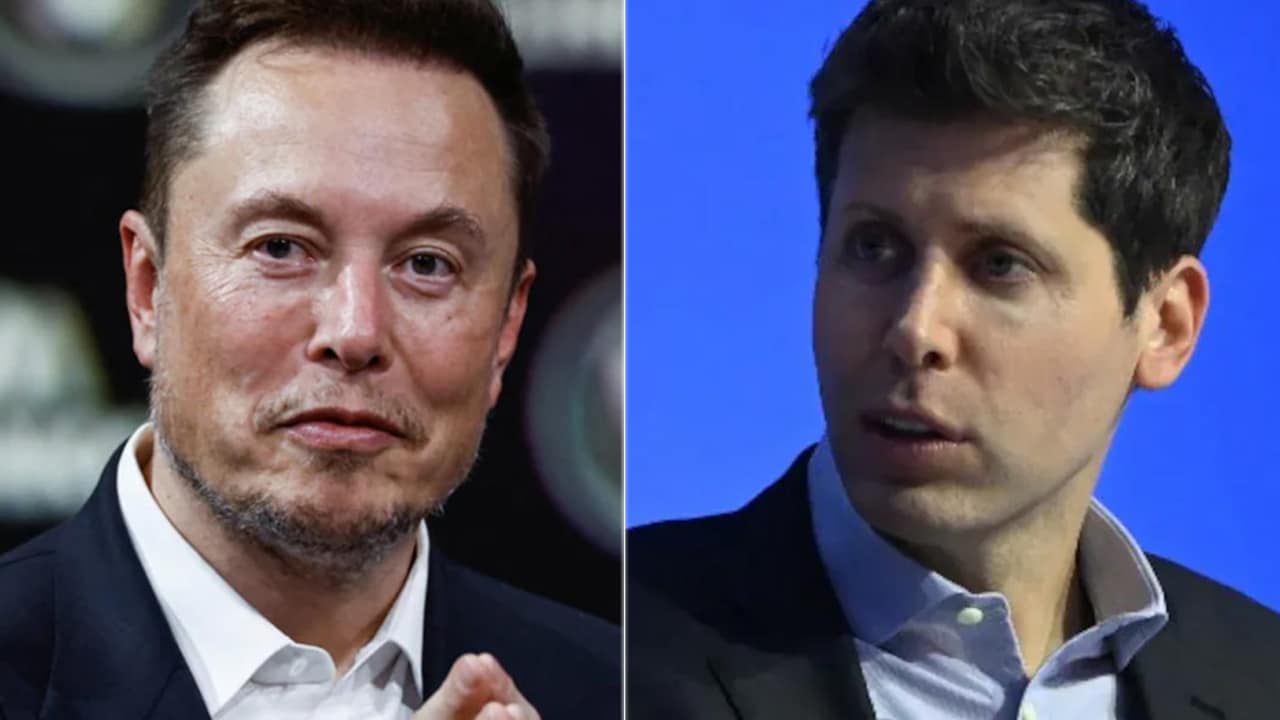
The public sparring between Elon Musk and Sam Altman is not a personal dispute; it is a structural byproduct of an industry shifting from algorithmic optimization to physical asset control. While public commentary focuses on the rhetorical exchanges on social media—such as Musk labeling Altman "Scam Altman" and Altman claiming Musk's obsession is a proxy benchmark for OpenAI’s model performance—the underlying driver is an aggressive capital deployment battle over the physical supply chain of artificial general intelligence (AGI).
The catalyst for the July 2026 escalation is Apple’s federal corporate espionage lawsuit against OpenAI. Apple alleges that OpenAI executed a coordinated campaign to extract trade secrets, blueprints, and proprietary manufacturing techniques to construct its newly formed hardware division, io Products. This legal friction has re-opened the ideological and commercial chasm between Musk—who recently lost a jury verdict against OpenAI regarding its non-profit restructuring due to the statute of limitations—and Altman, who is steering OpenAI toward vertical integration. Recently making waves lately: The Architecture of Open Source Intelligence Systems The Operational Blueprint of Thomas Wolf.
The Three Pillars of the AI Hardware Supply Chain
To understand why a software-centric firm like OpenAI is facing a multi-billion-dollar trade secret lawsuit from Apple, one must analyze the physical constraints of next-generation AI deployment. The industry is moving past the cloud-hosted LLM model toward localized, device-native agentic systems. This transition relies on three scarce capital inputs:
- Human Capital and Domain Expertise: Building consumer hardware requires highly specialized electrical, mechanical, and industrial design engineering talent. OpenAI's acquisition of io Products for a reported $6.5 billion brought in over 400 former Apple employees, including notable design and engineering executives.
- Proprietary Manufacturing Processes: Industrial execution requires specialized metal-finishing, thermal management, and micro-component housing techniques. Apple’s complaint explicitly alleges that OpenAI used poached personnel to approach Apple's exclusive manufacturing suppliers, attempting to replicate closed-loop production processes under the guise of authorized collaboration.
- Edge Compute Architecture: To replace traditional smartphone application ecosystems with frictionless AI agents, hardware must process complex inferences locally while managing severe thermal and battery constraints. Access to unreleased component specifications and system blueprints short-circuits years of costly R&D cycles.
The friction between Apple and OpenAI demonstrates that software excellence cannot bypass the physical realities of manufacturing. By targeting Apple’s hardware pipeline, OpenAI attempted a capital-for-time swap to accelerate its first physical device rollout, targeted for late 2026. More details into this topic are explored by The Verge.
The Economics of Accusation: Tracking the Capital Narratives
The rhetorical strategy deployed by both executives on social media maps directly to the commercial vulnerabilities of their respective enterprises.
[Apple Trade Secret Lawsuit] ──> Triggers ──> [Musk Escales "Scam" Narrative]
                                                   │
                                           (Aims to devalue)
                                                   ▼
                                        [OpenAI Private Valuation]
                                                   ▲
                                           (Aims to defend)
                                                   │
[Altman Deflects via Model Benchmarks] ──> Rebuts ──┘
The Cost Function of the "Scam" Narrative
Musk’s focus on Altman's lack of direct equity and corporate restructuring is designed to erode OpenAI’s institutional trust. By highlighting Altman's historical Senate testimony ("I have no equity... I'm doing this because I love it") alongside the structural pivot from an open-source charity to a closed, for-profit entity, Musk aims to drive a wedge between OpenAI and its sovereign or institutional capital allocators.
The mechanism here is risk premium inflation. If public market investors and sovereign wealth funds view OpenAI’s leadership as legally or ethically compromised—particularly with Musk raising the specter of "parole officers" following federal trade secret theft allegations—the cost of capital for OpenAI rises.
The Benchmark Deflection Strategy
Altman’s counter-strategy relies on a basic principle of tech valuation: product performance overrides structural friction. By stating that the most reliable benchmark for OpenAI’s new GPT-5.6 Sol model is that "Elon is obsessed with me again," Altman seeks to convert legal and personal attacks into a proof of market dominance.
In this framework, competitor aggression is framed as a trailing indicator of OpenAI's technological lead. This signals to the market that despite ongoing litigation with Apple and unresolved friction with Musk's xAI, OpenAI retains the superior algorithmic asset, thereby preserving its private valuation.
Orbital Data Centers vs. Edge Devices: Two Divergent Capital Bets
Beneath the insults lies a fundamental divergence in how xAI and OpenAI intend to scale compute infrastructure over the next decade. The clash over "space datacenters" highlights two distinct capital-allocation strategies for achieving AGI.
1. The Decentralized Edge Paradigm (OpenAI)
OpenAI’s strategy, anchored by its io Products division, posits that the ultimate bottleneck for AI adoption is user interface friction. By building an independent hardware device where AI agents replace traditional operating systems and application stores, OpenAI aims to capture the primary layer of consumer data collection. This strategy requires immense upfront capital expenditures in industrial engineering, supply chain management, and intellectual property acquisition—explaining the aggressive poaching of Apple talent.
2. The Infrastructure Off-Shoring Paradigm (xAI / SpaceX)
Conversely, Altman’s jab at Musk ("selling public market investors on short-term space datacenters") illuminates xAI’s structural advantage: deep integration with SpaceX and Starlink. Musk’s hypothesis assumes that terrestrial data centers will eventually face unresolvable power grid and cooling constraints.
By leveraging orbital infrastructure, xAI could theoretically tap into continuous solar energy and vacuum-cooling environments, bypassing earthbound regulatory and energy bottlenecks. The limitation of this strategy is its extreme latency and immense orbital deployment cost, making it a long-term infrastructure play rather than a near-term consumer play.
Strategic Playbook for Navigating the AI Hardware War
The legal and rhetorical warfare between these entities establishes a clear set of operational boundaries for technology firms attempting to transition from software to hardware.
First, aggressive talent acquisition must be accompanied by strict, clean-room isolation protocols. The core vulnerability exposed in the Apple v. OpenAI suit is the tracking of digital footprints—specifically, departing engineers accessing proprietary files and blueprints immediately prior to interviews. Companies must enforce rigorous, audited onboarding processes that legally bar the injection of prior employer IP into new hardware designs, or risk injunctions that can halt product launches entirely.
Second, firms must diversify their supply chains early to avoid litigation over exclusive manufacturing techniques. Relying on an incumbent's established manufacturing partners to replicate highly specific industrial processes invites immediate trade secret misappropriation claims.
The ultimate victor in the AI era will not merely hold the highest benchmark score on a synthetic LLM index, but will successfully secure the closed-loop pipeline from raw silicon and proprietary industrial design to the consumer's hand.