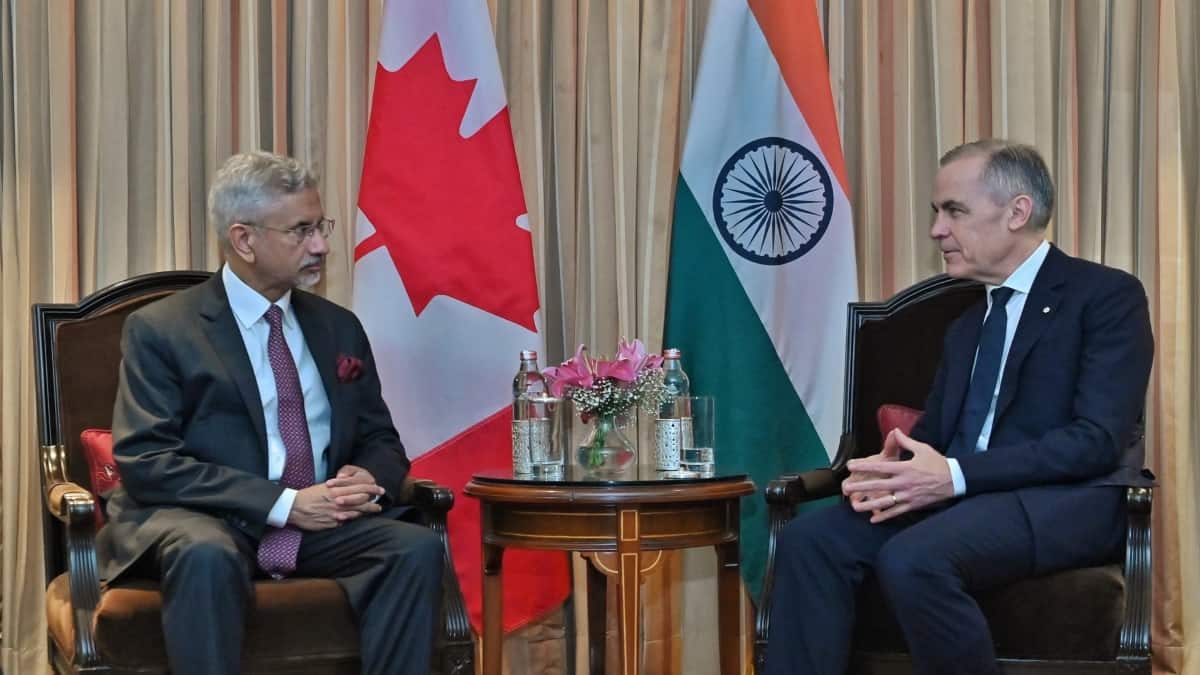
The diplomatic freeze between New Delhi and Ottawa has reached a point of diminishing marginal utility for both sovereign actors, necessitating a transition from emotive posturing to a calculated, interest-based reset. While the meeting between S. Jaishankar and Mark Carney—a figure representing both Canada’s economic establishment and its potential political future—signals a thaw, the path to normalization is constrained by a rigid set of domestic political variables and security imperatives. To understand the trajectory of this "reset," one must look past the optics of the meeting and analyze the structural friction points: the divergence in internal security definitions, the asymmetry of trade dependencies, and the shifting role of the North American diaspora as a political lobby.
The Asymmetric Trade Calculus
The economic relationship between India and Canada is defined by a specific complementarity that makes prolonged hostility counterproductive. Canada serves as a critical supplier of energy, potash (fertilizer), and pulses, which are fundamental to India’s food security and industrial growth. Conversely, India provides Canada with a massive market for its services and pension fund investments, alongside a steady stream of high-skilled labor.
- Capital Flows: Canadian pension funds, such as CPPIB and CDPQ, have billions of dollars committed to Indian infrastructure and renewable energy. A permanent diplomatic rupture creates a "sovereign risk premium" on these investments, potentially devaluing Canadian retirement assets.
- Labor Supply Chains: The Canadian education sector operates as an export industry where Indian students are the primary consumers. A restriction on visas or a decline in "brand India" sentiment in Canada threatens the solvency of many Canadian mid-tier colleges.
- Resource Dependency: India’s agricultural sector is sensitive to the price of Canadian lentils and potash. Disruptions in these supply chains lead directly to domestic inflation in India, a variable that any New Delhi administration must minimize.
The halt in the Comprehensive Economic Partnership Agreement (CEPA) negotiations represents a lost opportunity cost. Resuming these talks requires a decoupling of "high politics" (security and sovereignty) from "low politics" (trade and investment). The meeting with Carney, a former central banker, suggests that both sides are attempting to use economic logic to bypass the current diplomatic stalemate.
The Security Dilemma and Sovereignty Gap
The primary bottleneck in the relationship is a fundamental disagreement over the definition of "extremism" versus "freedom of expression." This is not a mere misunderstanding; it is a clash of legal and political architectures.
- The Canadian Framework: Canada’s legal system prioritizes the Charter of Rights and Freedoms, which provides a high threshold for restricting political speech, even when that speech advocates for secession in foreign territories. For Ottawa, taking preemptive action against diaspora activists without evidence of a specific Canadian crime is a domestic political impossibility.
- The Indian Framework: New Delhi views the activities of certain diaspora groups as a direct threat to its territorial integrity. In the Indian strategic calculus, "freedom of speech" does not extend to the incitement of separatism or the glorification of violence against its diplomats.
This creates a deadlock. India demands actionable intelligence and arrests; Canada demands respect for its judicial independence and sovereignty. The "reset" depends on the creation of a Joint Working Group on Counter-Terrorism that can produce tangible results—extraditions or financial freezes—that satisfy Indian security concerns without violating Canadian law.
The Diaspora as a Political Constraint
The Indian diaspora in Canada is not a monolith, yet its internal divisions drive the foreign policy of both nations. In Canada, concentrated voting blocks in suburban Ontario and British Columbia make the "diaspora vote" a critical variable in federal elections. This incentivizes Canadian politicians to cater to vocal minority segments within the community, even if those segments complicate foreign relations.
In India, the government’s stance toward the diaspora is part of a broader "Global South Leader" narrative. Protecting Indian interests abroad and taking a hard line against perceived anti-India elements is a core component of the current administration’s domestic appeal.
The political cost of "giving in" is currently higher for both Prime Minister Justin Trudeau and Prime Minister Narendra Modi than the cost of maintaining the status quo. Therefore, any meaningful reset will likely be spearheaded by "track two" diplomacy—engaging opposition leaders like Carney or business leaders who can frame the relationship in terms of national interest rather than electoral math.
Strategic Transition to Middle Power Realism
The engagement with Mark Carney is a tactical pivot. By talking to a figure who is not currently part of the embattled Trudeau cabinet, India is "future-proofing" the relationship. It is an acknowledgment that while the current leadership may be at an impasse, the structural necessity of the bilateral link remains.
- Diversification of Energy: India seeks to reduce its reliance on Middle Eastern oil. Canada’s LNG and uranium resources are the logical alternatives.
- Technology Transfer: Collaboration in AI, quantum computing, and green hydrogen requires a stable regulatory environment which is currently absent.
- Geopolitical Balancing: Both nations view the rise of an assertive China as a long-term challenge. In the Indo-Pacific strategy of both Ottawa and New Delhi, each is a "natural partner" currently sidelined by a "temporary" dispute.
The bottleneck remains the investigation into the death of Hardeep Singh Nijjar. Until there is a judicial conclusion or a quiet diplomatic "grand bargain" regarding the intelligence shared by the Five Eyes, the relationship will function at a sub-optimal level.
Execution of the Reset
The path forward requires a three-stage de-escalation:
- Restoration of Consular Efficiency: Normalizing visa processing is the first step to lowering the heat for the general population and business travelers.
- Private Security Coordination: Establishing a non-public channel for sharing intelligence on fringe elements to prevent public provocations that force leaders into defensive postures.
- Economic Re-engagement: Re-starting the CEPA talks under the guise of "technical discussions" to signal to markets that the long-term economic trajectory is secure.
The India-Canada relationship is currently undergoing a stress test of its fundamental structures. The "reset" is not a return to the previous status quo of polite indifference, but a transition toward a more mature, if more friction-filled, partnership defined by hard interests rather than shared values. The meeting between Jaishankar and Carney suggests that both sides are now mapping the exit ramp from a crisis that has become too expensive to maintain.
Identify the specific Canadian pension fund assets currently exposed to Indian infrastructure and monitor their "hold" vs. "divest" signals over the next fiscal quarter. These financial flows will serve as a more accurate barometer of the diplomatic "reset" than any official communique. Would you like me to analyze the specific portfolio exposure of the Canada Pension Plan Investment Board (CPPIB) in the Indian energy sector to quantify this risk?