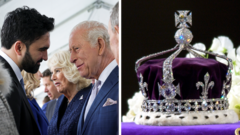
Zohran Mamdani’s proposal to demand the return of the Koh-i-Noor diamond from the British Crown to India represents more than a populist appeal; it is a stress test for the diplomatic and legal structures governing colonial-era artifacts. While the discourse often centers on historical grievance, the actual mechanism for restitution involves a complex interplay of international property law, bilateral trade leverage, and the internal political calculus of the United Kingdom. To evaluate the feasibility of such a demand, one must move past the emotive weight of the gemstone and analyze the three specific vectors that dictate the success or failure of high-value cultural asset recovery.
The Tripartite Framework of Restitution Feasibility
The movement of an asset of this magnitude is governed by three distinct structural pillars. Without alignment across all three, any political declaration remains purely rhetorical. You might also find this related article interesting: Why Zambia Refused to Trade Minerals for Medicines.
- The Legislative Barrier (The British Museum Act and Precedent): The primary hurdle is not just the Crown’s preference, but the statutory limitations placed on British institutions. While the Koh-i-Noor is part of the Crown Jewels and not strictly subject to the British Museum Act of 1963, the legal precedent surrounding it creates a "slippery slope" paradox for the UK government. If the state acknowledges a legal obligation to return the diamond, it inadvertently validates claims for the Elgin Marbles or the Benin Bronzes, potentially hollow-out the UK’s cultural economy.
- The Jurisdictional Ambiguity: The Koh-i-Noor’s history involves multiple modern nation-states, including India, Pakistan, Afghanistan, and Iran. This creates a multi-claimant bottleneck. From a strategic perspective, the UK utilizes this ambiguity as a defensive shield; by pointing to the lack of consensus among the diamond's previous owners, they maintain the status quo under the guise of preventing further regional instability.
- Diplomatic Leverage as a Transactional Asset: Symbolic restitution is rarely a vacuum-sealed moral act. In modern statecraft, the return of cultural property is often used as a "sweetener" in broader negotiations, such as Free Trade Agreements (FTAs) or defense pacts. Mamdani’s stance suggests that the demand itself is the leverage, though historical data indicates that such assets are typically the final piece of a much larger geopolitical puzzle.
Quantifying the Value of Symbolic Sovereignty
To understand why a New York State Assemblyman’s comments on a British-Indian issue carry weight, one must quantify "symbolic sovereignty." This isn't a nebulous concept but a measurable political tool used to consolidate domestic support and signal a break from post-colonial subservience.
The Koh-i-Noor, a 105.6-carat diamond, carries a market value that is effectively infinite due to its provenance, but its real utility lies in its function as a unifying narrative engine. For a political actor like Mamdani, or for the Indian state, the diamond represents a "sunk cost" of colonialism. The logic follows a simple restorative function: As extensively documented in latest reports by The Guardian, the effects are worth noting.
$R = V(h) + L(p)$
Where $R$ is the total restorative value, $V(h)$ is the historical value of the object, and $L(p)$ is the political legitimacy gained by the actor who secures its return. As $L(p)$ increases, the actual physical possession of the stone becomes secondary to the process of demanding it. This explains why the demand persists even when the legal likelihood of return is low; the friction of the demand generates political heat that can be used elsewhere.
The Mechanism of Modern Repatriation
Successful repatriation in the 21st century has shifted from "theft-based" arguments to "ethical-stewardship" models. The British government’s stance has historically been one of "retentionist" logic, arguing that these items are part of a global heritage best preserved in universal museums. To counter this, restitution strategies have evolved into three tactical phases:
Phase I: Cultural Diplomacy and Soft Power Pressure
This involves the use of international forums like UNESCO to reframe the conversation from "legal ownership" to "moral right." India has increasingly used its G20 presidency and growing economic weight to signal that the "Age of Discovery" legal frameworks are no longer compatible with modern global partnerships.
Phase II: The Legal Nullification of Colonial Treaties
The British claim to the Koh-i-Noor rests heavily on the Treaty of Lahore (1849), where the young Maharaja Duleep Singh surrendered the diamond to the East India Company. Legal analysts argue that a treaty signed by a minor under duress fails the modern test of "informed consent." This creates a bottleneck in international law: does modern ethics retroactively invalidate 19th-century contracts? If the answer is yes, the entire global order of property rights is theoretically subject to upheaval.
Phase III: The "Shared Heritage" Compromise
Recognizing the legal stalemate, some strategists suggest a "long-term loan" or "dual-custody" model. This bypasses the legislative finality of "returning" the asset while satisfying the visual requirement of its presence in the country of origin. However, for hardline advocates like Mamdani, anything short of full title transfer is viewed as a continuation of the colonial hierarchy.
The Economic Implications of Cultural Restitution
There is a direct correlation between the return of high-profile artifacts and the growth of domestic cultural tourism. However, the UK views the Koh-i-Noor as a "load-bearing" asset of the Royal Collection. The loss of such a piece isn't just about the diamond; it is about the erosion of the "Brand Britain" prestige that drives millions of tourists to the Tower of London.
The cost function of returning the diamond involves:
- Direct Revenue Loss: Decreased ticket sales for the Crown Jewels exhibit.
- Precedent Cost: The legal fees and administrative overhead of processing the subsequent thousands of claims for other artifacts.
- Diplomatic Capital: The "face-saving" cost of admitting that the initial acquisition was illegitimate.
Conversely, for India, the economic gain is centered on "nationalist capital." Securing the Koh-i-Noor would be an unprecedented victory for the current administration's "decolonizing the mind" initiative, providing a tangible win that transcends economic data points like GDP growth or inflation rates.
Strategic Bottlenecks in the Mamdani Proposal
While the proposal aligns with the zeitgeist of global decolonization, it faces two significant structural flaws that most analysts overlook.
First, the Internal UK Political Schism. The British monarchy is currently in a transition phase. King Charles III has shown more openness to discussing the legacy of the British Empire than his predecessor. However, the King does not have the unilateral power to return the diamond. Such a move would require an Act of Parliament. Given the current UK political climate, where "anti-woke" sentiment often equates cultural restitution with a betrayal of British history, any Prime Minister would see a return of the Koh-i-Noor as a "high-risk, low-reward" move.
Second, the Claimant Conflict. If the UK government were to agree to return the diamond tomorrow, to whom would they give it? The government of India? The government of Pakistan (which has made similar claims based on the Lahore location of the gemstone's surrender)? Or the Taliban-led government in Afghanistan? By maintaining possession, the UK positions itself as the "neutral" party preventing a regional diplomatic crisis. This is a classic "stalling" tactic, but it remains effective because the claimants have not formed a unified front.
The Definitive Path to Asset Recovery
For a demand like Mamdani’s to move from a speech to a reality, the strategy must pivot from moral outrage to institutional pressure.
The first movement must be the establishment of a Multilateral Cultural Commission consisting of all claimant nations. This removes the UK’s primary defense (the "who do we give it to?" argument). By presenting a unified proposal—perhaps a rotating exhibition or a shared digital repository—the claimants force the UK to argue against a collective rather than a single state.
The second movement requires the Linkage of Cultural Assets to Trade Agreements. India is currently one of the world's fastest-growing economies and a critical partner for post-Brexit Britain. If the return of cultural property is codified as a "non-tariff barrier" or a condition of high-level defense cooperation, the UK’s legislative resistance will eventually be outweighed by economic necessity.
The final play is the Institutional Internalization of the issue within the UK. This involves funding British academics and legal scholars to build the case from within, utilizing the UK’s own legal frameworks regarding "stolen goods" and "unconscionable transactions." When the pressure is internal and professional rather than external and political, the cost of retention becomes higher than the cost of restitution.
The Koh-i-Noor is no longer just a diamond; it is a geopolitical barometer. Its movement—or lack thereof—signals the current balance of power between the former colonial center and the rising powers of the Global South. The resolution will not come from a single demand, but from the steady application of economic and legal friction that makes the status quo untenable for the British state.