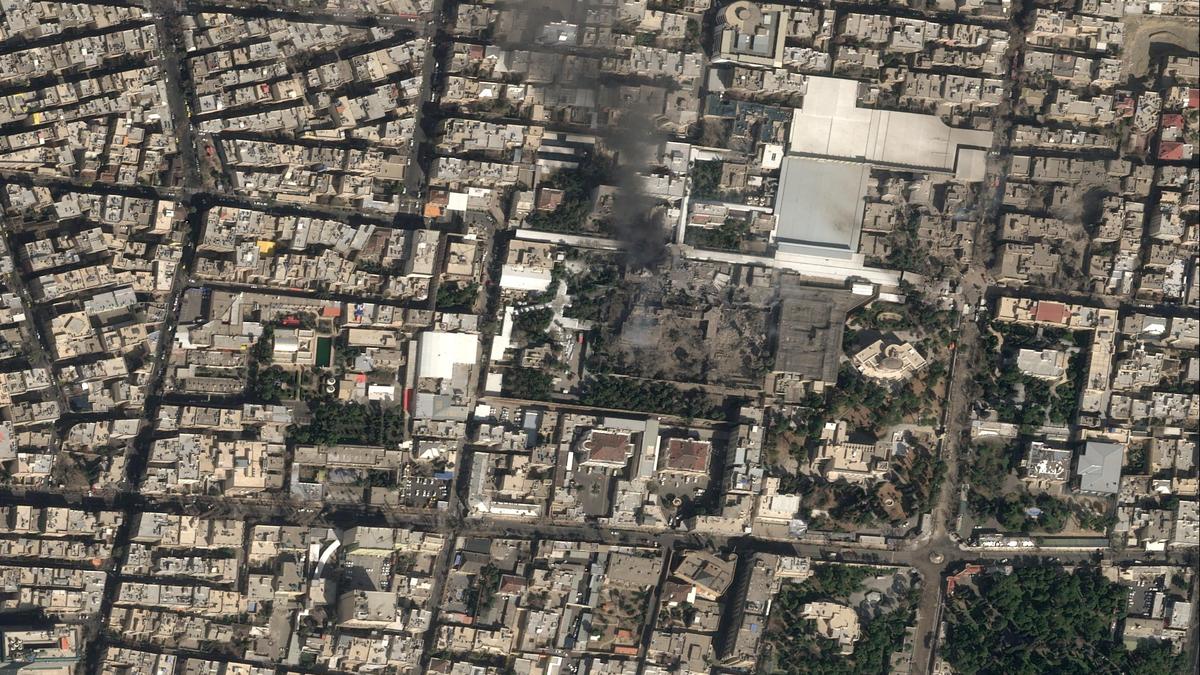
The recent escalation in the Middle East, characterized by joint US-Israeli kinetic strikes against Iranian military and nuclear-adjacent infrastructure, represents a fundamental shift from "containment through proxy" to "direct attributional deterrence." While political discourse often collapses these events into binary debates of "necessary defense" versus "wars of choice," a rigorous strategic audit reveals a complex cost-benefit function driven by three primary variables: the degradation of the "Ring of Fire" proxy network, the preservation of regional maritime energy corridors, and the technological race against Iranian centrifuge hardening.
The Triad of Strategic Objectives
To analyze the efficacy of these strikes, one must move beyond the rhetorical surface of "allies defending allies" and look at the structural mechanics of the operation. The mission profile suggests a multi-layered objective set designed to reset the regional balance of power.
- Kinetic Attrition of Logistics Chains: The strikes specifically targeted IRGC (Islamic Revolutionary Guard Corps) logistical hubs. By destroying mid-range ballistic missile assembly sites and drone manufacturing plants, the coalition seeks to increase the "unit cost" of Iranian regional influence. When the cost of replacing a precision-guided munition exceeds the strategic value of the strike it was intended for, the proxy model begins to fracture under its own economic weight.
- Signal Intelligence and Cyber-Kinetic Integration: These operations were not merely about dropping ordnance. They served as a live-environment test of integrated electronic warfare suites. By suppressing Iranian-made S-300 batteries, the US and Israel demonstrated a qualitative military edge (QME) that renders traditional ground-based air defense systems obsolete against fifth-generation stealth platforms.
- Nuclear Breakout Delay: The strikes targeted dual-use facilities. While avoiding a direct hit on primary enrichment halls—which would trigger environmental and diplomatic fallout—the operations focused on the power grids and cooling systems essential for centrifuge stability.
The Economic Impact on Maritime Energy Transit
A central point of contention among domestic US critics is the necessity of direct intervention. However, the logic of the strikes is inextricably linked to the protection of the Bab el-Mandeb and the Strait of Hormuz.
The global energy market operates on a razor-thin margin of perceived stability. Iran’s strategy of "asymmetric blockage"—using Houthi or direct IRGC assets to harass tankers—acts as a regressive tax on the global economy. Every percentage point increase in maritime insurance premiums for VLCCs (Very Large Crude Carriers) translates to billions in lost GDP across the Eurozone and Asia.
The US-led strikes function as a capital investment in "Sea Line of Communication" (SLOC) security. By removing the launch platforms used for anti-ship cruise missiles (ASCMs), the coalition reduces the volatility index of Brent Crude. Critics calling this a "war of choice" fail to account for the "non-intervention cost," which includes the potential for a permanent $20/barrel risk premium if Iran achieves undisputed "choke point" dominance.
Degrading the Ring of Fire: A Quantitative Assessment
Iran’s regional strategy relies on a decentralized network of militants—Hezbollah, Hamas, and the PMF in Iraq. The recent strikes targeted the "central nervous system" of this network rather than its extremities.
- Command and Control (C2) Erasure: By neutralizing high-level coordinators and encrypted communication nodes, the strikes force these groups into autonomous, uncoordinated actions. This reduces their ability to launch the kind of saturation attacks that overwhelm the Iron Dome or Aegis combat systems.
- The Technology Gap: The use of the F-35I "Adir" and US B-2 Spirits represents a technological mismatch that Iran cannot currently solve with Russian or Chinese imports. The inability of Iranian sensors to maintain a "lock" on these assets creates a psychological "asymmetry of vulnerability."
The Democratic Critique: The Sovereignty vs. Security Paradox
The pushback from Democratic leadership centers on the lack of a formal Congressional "Authorization for Use of Military Force" (AUMF) and the fear of an uncontrolled escalatory spiral. This critique is rooted in the "War Powers Resolution," which seeks to limit executive overreach.
However, the executive branch’s counter-argument rests on Article II of the Constitution, viewing these strikes as "pre-emptive self-defense" against imminent threats to US personnel in the region. The friction here is not just political; it is a fundamental disagreement on the definition of "imminence." In the age of hypersonic missiles and cyber-warfare, waiting for a formal declaration of war may be equivalent to accepting a catastrophic first strike.
The risk of "miscalculation" is the primary bottleneck in this strategy. If the strikes are too light, they fail to deter; if they are too heavy, they force the Iranian leadership into a "use it or lose it" scenario regarding their remaining ballistic inventory.
The Technical Reality of Centrifuge Hardening
A significant portion of the strategic community misses the technical urgency of these operations. Iran has been moving its enrichment capabilities into "hardened" facilities like Fordow, buried deep within mountain ranges.
$$D_{penetration} \propto \frac{1}{\sqrt{Density_{rock}}} \times Velocity_{impact}$$
As the depth and reinforcement of these facilities increase, the window for a successful kinetic intervention closes. The current strikes serve as a "proof of concept" to Iranian leadership that no facility is currently beyond the reach of modern bunker-buster technology, specifically the GBU-57 Massive Ordnance Penetrator (MOP). This is a game of physics where the structural integrity of the mountain is pitted against the kinetic energy of specialized metallurgy.
Long-Term Strategic Recommendation
The US and its allies must transition from a reactive strike posture to a "Persistent Engagement" framework. This involves three critical shifts:
- Decoupling the Proxy from the Principal: Continue to strike IRGC assets directly when proxy attacks occur. This removes the "deniability" shield that has allowed Iran to project power without consequence for decades.
- Accelerating Regional Air Defense Integration: The "Middle East Air Defense" (MEAD) alliance must move from a concept to a functional, real-time data-sharing network. Integrating Saudi, Emirati, Jordanian, and Israeli radar feeds creates a "spherical defense" that makes Iranian missile saturation mathematically improbable.
- Economic Strangulation of the Drone Supply Chain: Focus intelligence assets on the procurement of "off-the-shelf" dual-use components (microchips, small engines) that fuel the Shahed drone programs.
The strategic endgame is not the total destruction of the Iranian state, which would create a power vacuum similar to post-2003 Iraq, but the forced "normalization" of the Iranian military. By making the cost of external aggression higher than the benefit of domestic stability, the coalition forces a pivot in Iranian grand strategy.
Would you like me to generate a detailed technical comparison of the air defense systems currently active in the Levant to illustrate the current saturation limits of the Iron Dome and Patriot batteries?