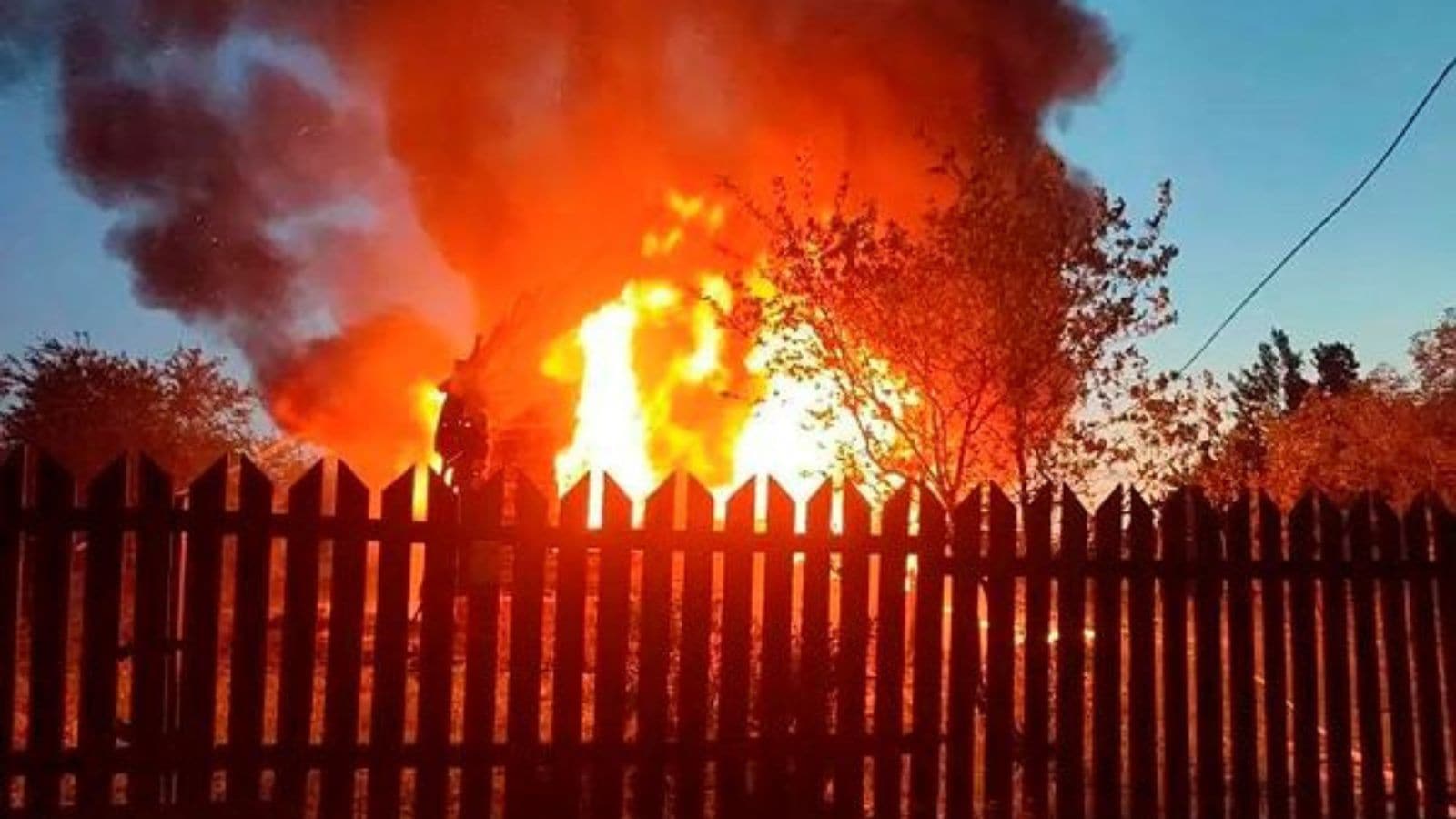
Mainstream newsrooms love a neat, tragic narrative. A drone strike hits Russian soil. A migrant worker from India is killed. Three more are injured. The headlines write themselves, spinning a tale of Escalation and Unprecedented Scale. They call it one of the largest drone attacks against Russia.
They are looking at the wrong map.
The lazy consensus across global news desks is that these massive drone swarms are primary military instruments designed to break frontlines or decapitate command structures. They parse the casualties, tally the downed quadcopters, and treat modern warfare like a 20th-century artillery duel with a digital face-lift. It is a fundamental misunderstanding of automated attrition.
The real story of these cross-border strikes is not the physical destruction they cause. It is the economic and psychological distortion of global labor supply chains and air defense architecture.
The Myth of the Precision Super-Weapon
Let us dismantle the first illusion. The media frames these long-range drone operations as pin-point strategic strikes. In reality, they are cheap, loud, and intentionally chaotic.
When a swarm of fifty loitering munitions crosses a border, the objective is rarely the specific warehouse or oil depot listed on the flight plan. The objective is the radar signature it triggers on the way there.
I have watched defense analysts lose their minds over intercept rates. They point to data showing Russian Pantsir or S-400 systems shooting down 80% of incoming drones and declare the attack a failure. That is a amateur calculation.
Consider the mathematics of modern air defense:
- An indigenous long-range strike drone costs between $20,000 and $50,000 to manufacture.
- A single interceptor missile from a modern defense system costs anywhere from $500,000 to $2 million.
- Even if the defense system achieves a perfect intercept rate, the attacker wins the economic equation by a factor of forty to one.
When fifty drones fly toward a Russian industrial hub, they are forcing the defender to burn through millions of dollars in finite, irreplaceable missile stockpiles. The headline says "Drone Shot Down." The reality is "Defender Pocketbook Bled Dry." The death of a civilian or the destruction of a factory roof is just collateral noise to the cold calculus of resource depletion.
The Collateral Cost of Globalized Labor
The media fixates on the tragic death of an Indian national in these strikes, framing it as an anomaly or a freak accident of geography. This reveals a massive blindspot regarding how modern war economies actually function.
Russia is experiencing severe labor shortages due to mobilization and emigration. To keep its military-industrial complex running, it has quietly integrated thousands of foreign workers from South Asia, Central Asia, and parts of Africa into its logistics, construction, and manufacturing sectors. Some are lured by high-paying construction gigs; others find themselves trapped in logistics hubs near the conflict zone.
When drone strikes hit these regions, they are not just hitting Russian infrastructure. They are puncturing the illusion of safety that Russia uses to recruit global labor.
If you are an engineer or a logistics specialist from New Delhi or Tashkent, the calculus changes the moment a drone factory or a shipping depot becomes a kinetic target. By shifting the threat matrix deep into the Russian rear, these attacks act as a violent deterrent against foreign labor capitalization. It forces a diplomatic headache for countries trying to balance neutrality while their citizens return home in body bags.
The Flaw in the "Largest Attack" Metric
Every time a military launches more than three dozen drones simultaneously, the press uses the phrase "one of the largest attacks." This metric is useless. It measures volume instead of velocity and saturation instead of strategic effect.
Imagine a scenario where a military launches a hundred low-tech, slow-flying wooden drones with lawnmower engines. It looks massive on a radar screen. It creates panic on social media. But if those hundred drones are simply meant to unmask the positions of mobile radar units so that two actual cruise missiles can slip through an hour later, then analyzing the drone strike in isolation is a fool's errand.
The press treats the drone swarm as the main event. The true operators know the swarm is just the opening act, a piece of electronic warfare chaff with a physical fuselage.
Stop Asking if the Strikes Work
The public constantly asks: "Are these strikes helping win the war?"
It is the wrong question because it assumes "winning" looks like a flag raised over a captured city. These deep strikes are designed for systemic dislocation. They force Russia to make a brutal choice: leave front-line troops vulnerable by stripping them of air defense, or leave critical domestic infrastructure—refineries, power grids, labor hubs—exposed to cheap, automated arson.
Every Pantsir missile system deployed to protect a facility inside Russia is a system that cannot protect a tank column or a command bunker on the actual line of contact.
The media will keep counting the bodies of unfortunate migrants and measuring the craters in rural provinces. They will keep writing about tactical incidents while ignoring the macroeconomic strangulation happening right in front of them.
The drones do not need to destroy their targets to achieve their mission. They just need to keep flying, forcing the enemy to spend its future to protect its present.