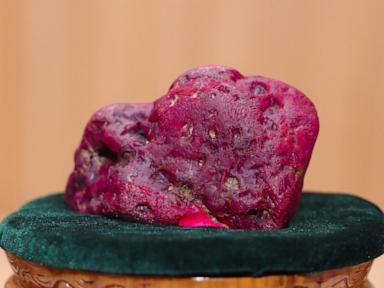
The discovery of an 11,000-carat rough ruby in Myanmar’s Mogok region represents more than a geological anomaly; it is a profound stress test for the global gemstone supply chain and the valuation models of ultra-rare physical assets. While the sheer mass of the specimen captures public attention, the strategic significance lies in the intersection of extreme mineralogical rarity and the fractured governance of the world’s most prolific corundum deposits. To understand the impact of this find, one must deconstruct the mechanics of the ruby trade through three specific lenses: the extraction-security paradox, the valuation ceiling of singular assets, and the structural volatility of the Mogok corridor.
The Extraction Security Paradox in Mogok
The Mogok Stone Tract operates under a unique economic constraint where geological yield is inversely proportional to regional stability. This creates a bottleneck in the formal market. The "Valley of Rubies" produces the highest quality "pigeon’s blood" stones due to a specific marble-hosted formation that results in low iron content, allowing for high fluorescence and superior saturation.
The presence of a specimen weighing 2.2 kilograms (11,000 carats) indicates a rare stabilization of metamorphic conditions during the stone’s formation, yet its discovery occurs within a theater of active civil conflict. This creates the primary friction point for the asset:
- Verification Deficit: In stable jurisdictions, a find of this magnitude would undergo immediate, transparent spectrographic analysis and 3D density mapping. In a war-scarred heartland, the chain of custody is opaque, introducing significant risk regarding the stone's internal clarity and color consistency.
- Resource Nationalization vs. Guerilla Financing: Assets of this scale frequently become instruments of political leverage. When a central authority or a local paramilitary group secures such a find, the stone ceases to be a commodity and becomes a geopolitical bargaining chip. This transition removes the asset from the standard liquid market, creating an "artificial scarcity" within the already narrow segment of investment-grade rubies.
The paradox remains that the very instability that limits modern, mechanized exploration is often what preserves these massive deposits, as large-scale industrial mining would have likely exhausted such shallow-depth pockets decades ago.
The Valuation Mechanics of Megagem Specimens
Standard appraisal logic fails when applied to a stone of 11,000 carats. Most high-end gemstones are valued using the Four Cs (Color, Clarity, Cut, Carat), with the price-per-carat increasing exponentially as the weight rises. However, this exponential curve hits a "utility ceiling" when a stone moves from the category of "jewelry grade" to "museum grade" or "state asset."
The Cutting Value Floor
If the 11,000-carat specimen is opaque or heavily included, its value is derived solely from its weight and status as a mineralogical specimen. If it possesses "gemmy" sections, the valuation shifts to a derivative model:
- Yield Projection: Master cutters must estimate the percentage of the rough that can be converted into faceted stones. A typical yield is 20% to 35%.
- The Risk of Internal Fractures: In a stone of this mass, internal tension is high. The risk that the stone will shatter during the initial sawing process creates a massive "uncertainty discount" on the initial purchase price.
The Prestige Premium
For a singular stone, the market price is decoupled from the sum of its potential parts. The value is instead dictated by the Replacement Cost Theory. Since there is no secondary 11,000-carat ruby of comparable provenance, the holder of the asset can dictate terms, provided there is a buyer with the sovereign-level capital required to settle the transaction. This creates a liquidity trap; the asset is worth hundreds of millions on paper, but the pool of potential buyers is limited to a handful of private collectors and national museums, many of whom may be restricted from transacting due to sanctions on Myanmar’s gemstone exports.
Structural Volatility and the Gray Market Pipeline
The discovery of a record-breaking ruby exacerbates the existing "leakage" in the Southeast Asian gemstone market. Because Mogok is largely cut off from the formal global banking system, massive finds often migrate through the "gray market" into hubs like Bangkok or Hong Kong.
This migration follows a predictable path of value dissipation:
- Extraction: Local miners or artisanal cooperatives discover the stone but lack the legal framework to claim full market value.
- Middleman Aggregation: The stone is moved across borders, often in pieces or under heavy security, where its provenance is "washed" or obscured to bypass international trade bans.
- Final Auction: By the time a massive ruby reaches a Tier-1 auction house, the premium is captured not by the region of origin, but by the entities that managed the logistical and legal risk of transit.
The 11,000-carat find highlights the failure of the "Responsible Sourcing" movement in the face of extreme value. While organizations attempt to track "conflict rubies," the sheer density of wealth represented by a 2.2kg ruby makes it almost impossible to regulate. The economic incentive to smuggle a single high-value object outweighs the risk of detection, unlike bulk commodities like timber or oil.
The Physicality of Rarity vs. Synthetic Displacement
In the broader luxury market, the rise of lab-grown rubies has commoditized the lower and middle tiers of the industry. However, a specimen of this size reinforces the "Moat of Natural Rarity." Synthetic processes can grow large crystals, but they cannot replicate the specific geological "fingerprint" of a Mogok-born giant.
The strategic play for investors is to recognize that as synthetic technology perfects the aesthetic of the ruby, the market will bifurcate. Value will migrate exclusively toward "provenance-heavy" assets. The 11,000-carat ruby serves as a lighthouse for this trend. It is an unreplicable geological event. The "war-scarred" nature of its origin, while tragic from a humanitarian perspective, adds to the "scarcity narrative" that drives the highest echelons of the stone trade.
Strategic Forecast for High-Mass Gemstone Assets
The appearance of the 11,000-carat ruby will likely trigger a temporary surge in exploration within the Mogok district, despite the prevailing conflict. This "gold rush" effect often leads to a short-term increase in the supply of lower-quality rough stones, which may depress prices for commercial-grade rubies while the "investment-grade" market remains unaffected.
Market participants should anticipate the following:
- Increased Scrutiny on Provenance: As this stone enters the global discourse, regulators will likely tighten the "know your crystal" protocols, making it harder to move large, un-certified stones into the West.
- Valuation Volatility: If the stone is cut into several 100-plus carat gems, it could saturate the market for ultra-large stones, which only sees a few transactions per decade.
- The Rise of Fractional Ownership: Given the estimated price tag, we may see the first attempts at the "securitization" of a ruby rough, where the stone is held in a free-port vault while shares of its eventual cut value are traded among private equity participants.
The ultimate fate of the stone depends on the stability of the local corridor. If the conflict intensifies, the stone will likely disappear into a private collection, removed from the public record for a generation, further inflating the "legend premium" associated with Myanmar's heartland. The most viable strategy for institutional collectors is to avoid the rough market entirely and wait for the secondary, faceted stones to emerge with verified laboratory certifications, as the risk-to-reward ratio of unverified Burmese rough in a conflict zone is currently outside the bounds of rational investment.
The most probable outcome involves a high-stakes negotiation between the current holders and regional brokers, where the stone will be treated as a currency substitute rather than a mineral specimen. In an environment of high inflation and currency instability within Myanmar, a physical asset of this density is the ultimate store of value. Expect the stone to be held as a "frozen" asset until political conditions allow for a high-transparency sale, which may not occur for several years.