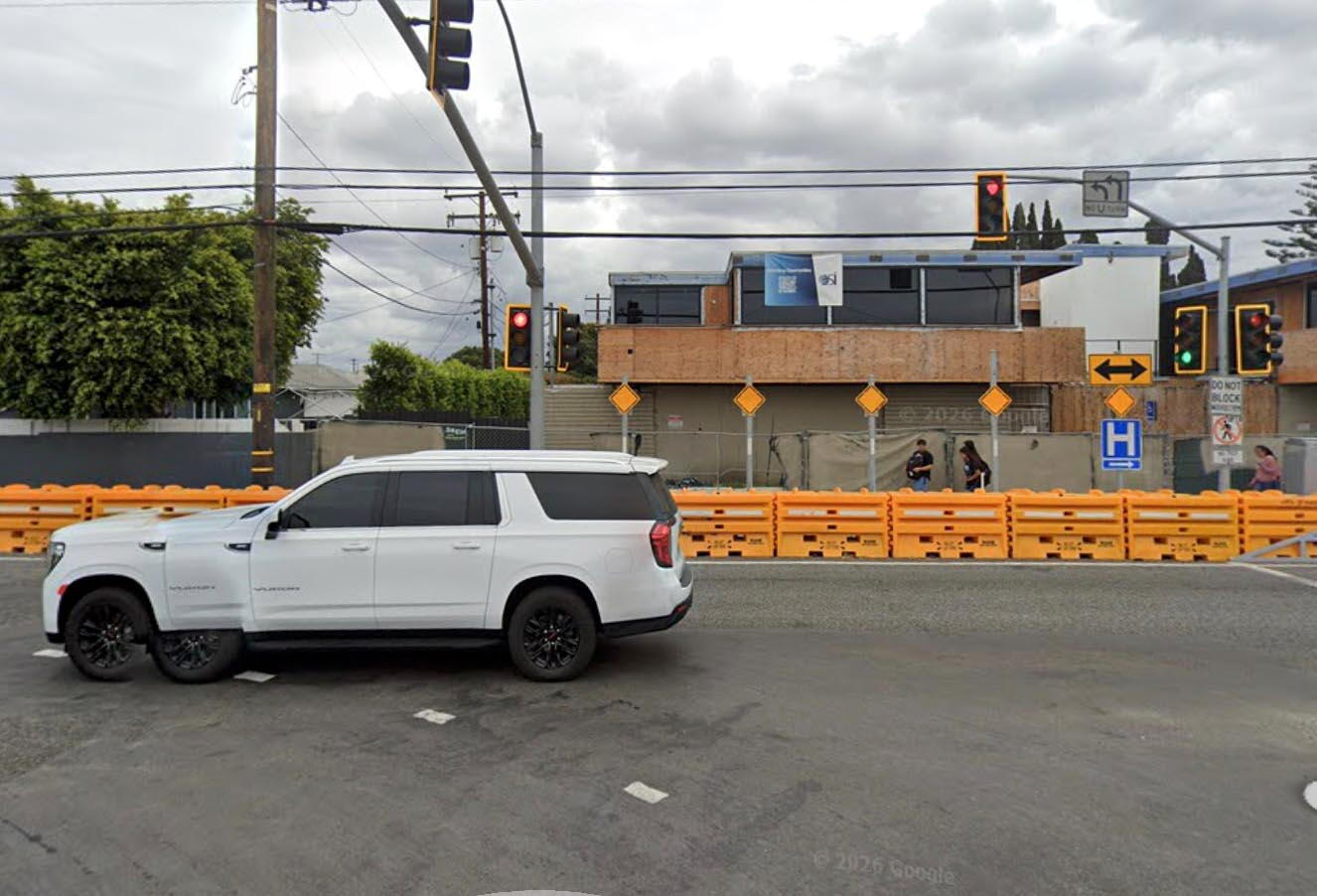
High-speed infrastructure cannot terminate abruptly into surface street grids without introducing severe kinetic friction points. When the Glenn Anderson Freeway transitions instantly into Studebaker Road in Norwalk, California, it violates foundational principles of traffic engineering by forcing a multi-lane, high-velocity kinetic stream to resolve its momentum through a standard municipal traffic light.
The viral attention garnered by local residents documenting vehicles careening into adjacent structures at this specific terminus is less a commentary on modern social media amplification than it is a symptom of systemic urban design failure. To understand why this intersection functions as a persistent crash generator, we must deconstruct the mechanics of speed transition, cognitive load, and the structural mismatch between highway engineering and municipal urban planning.
The Kinematics of Abrupt Termination
The core physical variable governing highway safety is deceleration distance. Civil engineering standards dictate that high-speed corridors require progressive transition zones—ramp geometries, gradual grade changes, and extended off-ramps—that allow operators to shed kinetic energy safely before encountering stationary traffic control devices.
At the eastern terminus of the 105 freeway, this transition zone is severely compressed. Vehicles travelling at highway velocities encounter a sudden spatial compression where multi-lane high-speed throughput crashes directly into an urban arterial grid. The kinetic energy equation dictates that stopping distance scales quadratically with velocity. When drivers are given insufficient physical real estate to dissipate that energy, braking systems overheat, reaction times prove inadequate, and human error is immediately magnified into structural impact.
Cognitive Load and Environmental Signage Deficits
Human factors engineering measures operator performance against environmental information processing loads. Approaching a highway terminus requires clear, redundant visual cues that signal a radical shift in operational rules.
Standard signage often fails under conditions of high traffic density or visual clutter. When drivers experience a sustained period of high-speed, low-decision driving—typical of enclosed freeway corridors—they enter a state of highway hypnosis or reduced situational awareness. The transition point in Norwalk lacks the architectural framing that naturally signals an incoming hazard. Without aggressive physical mitigation, such as continuous rumble strip arrays, extended electronic warning infrastructure, or geometric deflection lanes, the driver's cognitive system registers the end of the road too late to execute safe braking maneuvers.
The Municipal Cost Function
The ongoing structural damage to local commercial and medical properties at the Studebaker Road boundary exposes a fundamental flaw in how municipal risk is allocated. State-level transportation agencies design high-throughput regional connectors, but local municipalities inherit the terminal externalities.
When a freeway dumps high-volume traffic directly onto a local street, the municipal jurisdiction absorbs the property damage, emergency response expenditures, and pedestrian safety risks. Traditional traffic calming measures—such as striping modifications, signal timing adjustments, and isolated flashing beacons—represent surface-level interventions that fail to alter the fundamental physics of the terminus. A true structural remedy requires shifting the terminus westward or engineering an elevated physical ramp system that forces velocity dissipation long before vehicles reach the surface grid.
Reconfigure the approach architecture by installing progressive mechanical speed-reduction arrays, including heavy-duty grooved pavement rumble strips spanning the entire width of the lanes at quarter-mile intervals prior to the off-ramp exit. Extend the deceleration geometry by converting the immediate terminal approach into a mandatory sweeping curve that physically prevents linear high-speed entry into the surface street grid.


