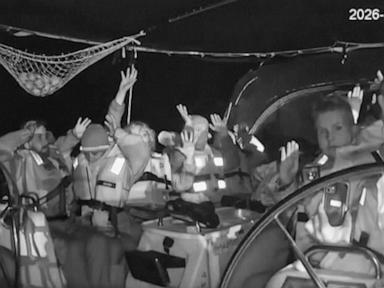
The recent interception of an aid flotilla near Crete isn't a humanitarian tragedy. It is a masterclass in performative failure. While headlines scream about detained crews and "blocked" bread, they ignore the cold mechanics of maritime logistics and international law. We are watching a repeat of a decades-old script that prioritizes the optics of confrontation over the actual calories delivered to people in need.
The lazy consensus suggests these voyages are the only way to break a "siege." That is a lie born of a lack of imagination. If your goal is to feed people, you use established corridors, trucks, and high-volume piers. If your goal is to get arrested on camera, you rent a boat and sail directly into a naval blockade. Let’s stop pretending these are the same thing.
The Logistics of Failure
I have spent years looking at supply chain disruptions in conflict zones. Efficiency is measured in tonnage per hour. These activist vessels are, by any professional standard, a joke. They carry a fraction of what a single commercial freighter or a line of fifty trucks can move in a morning.
When an organization chooses a high-cost, low-yield maritime route that they know will be intercepted, they aren't engaging in logistics. They are engaging in theater. The "detention" of the crew isn't an obstacle to their mission; it is the mission.
Consider the math. The cost of chartering vessels, paying crews, insuring a high-risk voyage, and the inevitable legal fees could fund thousands of tons of flour delivered through the Kerem Shalom crossing or the Jordan route. Activists claim the land routes are "unreliable," but they are choosing a maritime route with a 0% success rate for unauthorized docking.
The Sovereignty Myth
The outcry over the interception taking place "near Crete" or in international waters relies on a fundamental misunderstanding of the San Remo Manual on International Law Applicable to Armed Conflicts at Sea.
A state engaged in an armed conflict can establish a naval blockade. Under international law, if a vessel is clearly intending to breach that blockade, it can be intercepted on the high seas. This isn't "piracy." It’s the standard operating procedure for every navy on earth.
- Misconception: Interception in international waters is illegal.
- Reality: Article 67 of the San Remo Manual explicitly allows for the capture of merchant vessels outside neutral waters if they are believed to be attempting to breach a blockade.
By framing this as a violation of international law, activists are betting that the public won't actually read the law. They are banking on the emotional weight of "international waters" to carry their narrative. It’s a cynical play that treats the audience like they’re too lazy to check the facts.
The Humanitarian Industrial Complex
We have entered an era where "awareness" has become a more valuable currency than actual relief. These flotillas are the ultimate product of the Humanitarian Industrial Complex. They exist to generate content for social media feeds, not to fill bellies.
I’ve seen NGOs burn through millions of dollars on "symbolic" actions while the unglamorous work of fixing water pumps or negotiating truck schedules goes underfunded. The flotilla is the "influencer" of the aid world. It looks great in a 30-second clip, but it does nothing to solve the underlying structural issues of food security in Gaza.
The activists argue that "doing something" is better than doing nothing. I disagree. Doing something that predictably results in the seizure of aid and the detention of personnel is a net negative. It consumes resources, exhausts the patience of the international community, and hardens the resolve of the blockading power.
The Counter-Intuitive Truth About Access
If you want to help Gaza, you don't sail a boat toward a navy. You build a better bureaucratic engine.
Real change in conflict zones happens in boring offices in Amman, Cairo, and Tel Aviv. It happens when logistics experts find ways to streamline inspections and when diplomats negotiate the opening of new gates. The flotilla model actually undermines these efforts. Every time a "confrontation" occurs at sea, the security protocols on land tighten. The "freedom sailors" are effectively paying for their headlines with the delays of the trucks sitting at the border.
Imagine a scenario where the millions spent on these boats were instead used to hire a fleet of a thousand trucks and a legion of lawyers to contest every single rejected shipment at the land crossings. That would be a logistical nightmare for the authorities. It would be a relentless, grinding pressure that produces actual results. But it doesn't make for a good documentary.
The Professional Price of Performativity
There is a cost to this obsession with the spectacular. It erodes the credibility of legitimate humanitarian workers. When "activists" blur the line between aid delivery and political provocation, the people who actually wear the blue vests and drive the white trucks become targets.
The "contrarian" take isn't that Gaza doesn't need aid—it’s that Gaza doesn't need this kind of aid. It doesn't need the ego-trips of Western activists who want to feel like they are on the front lines of history.
We are seeing a strategic vacuum filled by noise. The activists are shouting, the navy is intercepting, and the cargo is rotting in a warehouse in a port far from where it was needed. This isn't a fight for human rights. It’s a fight for the morning news cycle.
Stop Funding the Spectacle
If you are a donor, stop giving money to people who buy boats they know will never dock. You are funding a stunt. You are paying for a theatrical production that uses suffering as a backdrop.
Demand better. Demand logistics. Demand tonnage. Demand the boring, difficult, non-televised work of getting food through the gates that already exist.
The flotilla is dead as a strategic tool. It has been for years. The only reason it still exists is because we haven't been honest enough to call it what it is: a spectacular waste of time, money, and hope.
The crew is in detention. The boat is seized. The people in Gaza are still hungry. Tell me again how this was a success.