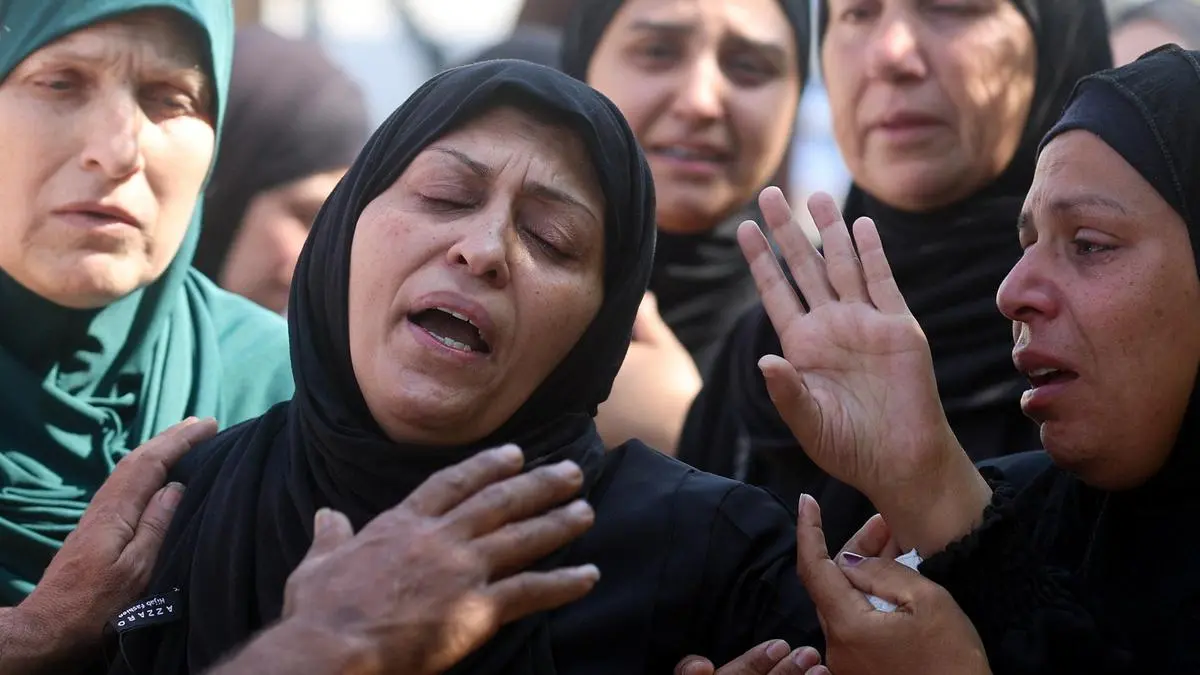
The term "ceasefire" in Gaza has become a bitter joke. While diplomats in air-conditioned rooms talk about regional stability, the reality on the ground is a relentless drumbeat of drone strikes and sniper fire. This past weekend offered a grim reminder of how thin that peace really is. At least four more Palestinians are dead. Among them was a 14-year-old boy.
You’d think a truce meant the killing stopped. It hasn't. Since this "peace" deal was inked last October, the death toll has quietly climbed toward a thousand. We aren't seeing the massive carpet bombing of 2023 or 2024, but the "micro-violations" are just as lethal. It's a slow-motion war that the world has mostly stopped watching because it isn't "breaking news" anymore.
The Lethal Reality of the Yellow Line
If you want to understand why people are still dying, you have to look at the "Yellow Line." This is the boundary the Israeli military drew when they pulled back to the eastern side of the Strip. It essentially carves Gaza in two. To the east, the IDF maintains full military control over about 60% of the land. To the west, hundreds of thousands of displaced people are squeezed into what's left.
The problem is the line isn't just a mark on a map; it's a kill zone.
On Sunday, a drone strike turned a motorcycle near the Kuwait Roundabout into a charred skeleton of metal. Two people died instantly. The Israeli military often claims these targets are "immediate threats" or individuals crossing into restricted zones. But when you’re living in a ruin where every street looks like the next, a "restricted zone" is often just the next block over where someone is trying to find water or scrap metal.
Then there’s the case of the 14-year-old in Sheikh Radwan. He didn't die in a frontline skirmish. He died from injuries sustained in a strike the night before. This is the part of the "ceasefire" no one talks about: the hospitals are so broken and the medical supplies so scarce that a survivable wound yesterday becomes a death sentence today.
A Peace That Only Exists on Paper
Let’s be real about the numbers. The Gaza government media office says there have been over 2,400 violations of this agreement. That’s more than ten "incidents" every single day. If you’re living in Al-Bureij or Khan Younis, a ceasefire doesn't mean you're safe. It just means the explosions are spaced further apart.
The humanitarian side of this is even worse. The deal promised 600 trucks of aid a day. Most days, we’re lucky to see 150. Honestly, you can't maintain a ceasefire when people are starving. When a father risks walking near the "Yellow Line" because he heard there’s a flour distribution, and he gets shot by a quadcopter drone, that’s not a security measure. That’s a failure of the entire diplomatic process.
Why the Violence Persists
- Expansion of Control: Israeli forces are moving the yellow blocks further west, eating into the "safe" zones.
- Unclear Rules of Engagement: Civilians often don't know where the restricted zones begin until it's too late.
- The Siege Continues: A ceasefire that doesn't open the borders is just a slower version of a blockade.
The Human Cost of Strategic Ambiguity
I’ve looked at the reports from Al-Shifa Medical Complex. It’s a conveyor belt of tragedy. One day it’s two brothers in Beit Lahia. The next, it’s a 40-year-old woman in Khan Younis. The Israeli military frequently says it doesn't provide evidence for its "militant" claims because of security, but the families burying their teenagers see things differently.
We have to stop calling this a ceasefire. A ceasefire implies a cessation of hostilities. What we have in Gaza right now is a "managed conflict." It's a system where high-tech drones and snipers enforce a boundary that keeps an entire population in a state of permanent anxiety.
The international community seems content with this status quo because the casualty counts are in the single digits instead of the hundreds. But for the family of that 14-year-old boy in Sheikh Radwan, the war never ended. It just got quieter.
Don't wait for a headline about a "new war" to pay attention. The current one is doing plenty of damage right now. If you want to actually support the people on the ground, look into organizations like the Palestinian Medical Relief Society or local kitchens in Deir al-Balah that are operating despite the "violations." Supporting local, direct aid is the only way to bypass the political deadlock that is currently costing lives.