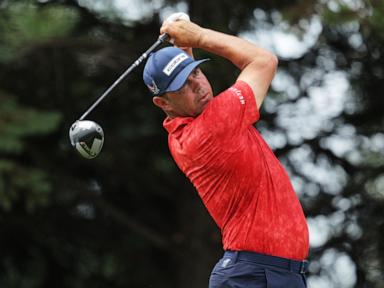
The sports media industrial complex loves a pity party wrapped in a miracle. When Gary Woodland returned to competitive golf after undergoing brain surgery to remove a lesion, the headlines practically wrote themselves. We were spoon-fed the narrative of the heroic survivor, the brave athlete overcoming insurmountable odds, the man whose toughest year was also his proudest.
It is a great story for a Sunday morning feature segment. It makes for fantastic television when galleries clap until their hands turn red. But it is also a dangerous, lazy flattening of reality.
We romanticize the struggle so intensely that we completely miss the point. Woodland is a professional athlete who underwent a serious neurosurgical procedure, yes. He faced a terrifying medical crisis, yes. But turning his recovery into a Hallmark card does a massive disservice to the cold, calculating mechanics of elite competition. Sympathy does not make putts. Courage does not correct a swing path.
Strip away the tear-jerking sentimentality, and you find a much harsher truth: professional sports are entirely indifferent to your trauma.
The Myth of the Inspirational Comeback
The lazy consensus in sports journalism is that trauma acts as a great equalizer or a magical catalyst. The narrative goes that once an athlete stares down mortality, they return to the course with a pure perspective, free from pressure, swinging with the unburdened joy of a child.
This is absolute garbage.
Brain surgery does not grant a golfer supernatural equanimity. It leaves physical deficits, cognitive fatigue, and neuro-chemical shifts that take years to normalize. When Woodland stepped back onto the PGA Tour, he was not some Zen master floating above the cut line. He was a guy trying to recalibrate his depth perception, his spatial awareness, and his nervous system while competing against twenty-somethings who treat every tournament like a video game.
I have spent decades watching elite competitors try to weaponize their personal tragedies. I have seen organizations pour millions into player support structures, expecting emotional breakthroughs to translate instantly into lower scores. It rarely works that way.
"Suffering is not a competitive advantage. It is an obstacle to be managed, minimized, and neutralized."
When commentators coo over Woodland being proud of his toughest year, they are praising the survival, not the execution. We are grading on a curve because we feel uncomfortable holding a medical anomaly to a ruthless standard. But Gary Woodland didn't sign up for the PGA Tour to be a medical anomaly. He signed up to win golf tournaments.
Why Your Perspective on Adversity is Completely Backwards
People love to ask: How does a player find the strength to return after brain surgery?
That is the wrong question. It assumes the primary battle is emotional, an internal war of wills that requires a movie-montage mindset.
The real question you should be asking is: Why do we expect professional athletes to function as motivational speakers when their actual job is entirely mechanical?
Neurosurgeons do not operate on a golfer's brain to improve their swing tempo. They do it to save a life. Once that life is saved, the romantic era ends and the brutal economics of elite performance begin.
Imagine a scenario where a Tour player breaks both legs, spends six months in a wheelchair, and returns to finish tied for fiftieth. The media treats it like a major victory. The sponsors send fruit baskets. The fans weep. But inside the locker room, fifty-first place means a missed paycheck, lost FedEx Cup points, and a declining world ranking. The scoreboard does not care about your scar tissue.
Woodland’s pride in his recovery is entirely valid on a human level. Any person who survives brain surgery and re-enters a high-stress workplace deserves respect. But conflating personal survival with professional excellence is a trap. It allows mediocrity to hide behind a tear-jerker storyline.
The Brutal Mechanics of Elite Return
Let us look at the actual data of athletic comebacks after major neurological interventions.
When you disrupt the central nervous system, you disrupt proprioception—the body's ability to sense its position in space. For a golfer whose swing relies on sub-millimeter precision repeated thousands of times under high adrenaline, a shift in neurological processing is catastrophic.
This is why Woodland’s return wasn't just a simple matter of dusting off the clubs. It required a complete neurological rebuild. Hand-eye coordination had to be retrained. Fatigue management became a full-time job.
Yet, the press corps kept asking him about his mental outlook. They wanted soundbites about appreciation and life lessons. They wanted him to say that golf doesn't matter anymore.
If golf doesn't matter anymore, Gary, why are you on the first tee?
If you truly believe that health is everything and the game is secondary, you stay home. You take the pension, you spend time with your family, and you walk away. The moment you step back into the competitive arena, you are inviting the game to judge you by its brutal, uncompromising metrics. You do not get to cash the check of a competitive athlete while wearing the shield of a survivor.
Stop Romanticizing the Struggle
The cultural obsession with the "triumphant return" is a coping mechanism for spectators. It lets fans feel like they are part of something noble. It transforms a brutal meritocracy into a morality play where good guys get rewarded with happy endings.
Sports are not a morality play. They are a Darwinian sorting machine.
When Woodland struggled to make cuts following his return, it wasn't because he lacked grit. It was because golf is a game of microscopic margins where a tenth of a millimeter off-center results in a missed green. No amount of emotional resilience can override physics.
We do a disservice to athletes when we applaud their mere presence on the field while their performance plummets. It infantilizes them. It suggests they are fragile creatures who should be judged by a sliding scale of sympathy rather than the cold, hard numbers on a scorecard.
Gary Woodland is a United States Open champion. He possesses a level of physical and mental horsepower that ninety-nine point nine percent of the human population cannot comprehend. Treating him like a charity case who deserves a standing ovation just for showing up strips him of his agency and his dignity.
He didn't come back to inspire you. He came back because he is a competitor who believes he can still beat the best players in the world.
If he can't, no amount of pride in a difficult year will save his card. And he wouldn't want it to.