The collapse of the June 2026 United States-Iran Memorandum of Understanding (MoU) demonstrates the structural failure of using temporary diplomatic truces to solve permanent geographic bottlenecks. Following the formal declaration by the executive branch that the brief spring ceasefire has concluded, the theater has shifted from asymmetric proxy friction to direct, state-on-state kinetic attrition. The execution of a seventh consecutive night of precision airstrikes by US Central Command (CENTCOM) against targets inside mainland Iran underscores a pivot toward structural degradation rather than political deterrence.
The strategic imperative underlying the current campaign is not merely punitive; it is an enforcement mechanism for a total naval blockade aimed at suppressing Iran’s capacity to project power across the Strait of Hormuz. By treating the maritime corridor as an active denial zone, the US military is attempting to sever the relationship between Iran’s coastal infrastructure and its non-state logistical networks. However, this operational approach introduces an intense cost asymmetry, exposing forward-deployed US assets to retaliatory salvos and freezing commercial trade in one of the world's primary energy arteries. Meanwhile, you can find related events here: The Illusion of the Indian Visa Fix.
The Operational Matrix of the Tactical Air Campaign
The seventh night of aerial operations reveals a deliberate targeting taxonomy designed to paralyze specific operational nodes within Iran's southern and central command sectors. Rather than engaging in broad counter-value or purely psychological targeting, CENTCOM has structured its air campaign around four functional categories.
1. Surveillance and Early Warning Disruption
Initial waves targeted coastal radar arrays, signal intelligence stations, and maritime tracking nodes in critical littoral zones including Jask, Sirik, and Qeshm Island. Neutralizing these assets systematically blinds the Islamic Revolutionary Guard Corps (IRGC) Navy, preventing the coordinated tracking of commercial shipping and reducing their ability to intercept US naval assets with early-warning telemetry. To see the bigger picture, we recommend the recent article by Associated Press.
2. Maritime Capability and Interdiction Suppression
Strikes directly impacted underground weapons storage facilities and fast-attack craft pens along the coast of the Persian Gulf and the Gulf of Oman. By striking reinforced subterranean storage facilities, the campaign seeks to exhaust the tactical inventory of anti-ship cruise missiles (ASCMs) and explosive uncrewed surface vessels (USVs) before they can be deployed into the shipping lanes.
3. Logistical and Inland Transport Bottlenecks
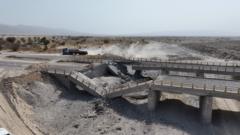
The expansion of the target list to include civilian-use infrastructure with dual military utility represents a significant escalation in the scope of the campaign. Precision strikes destroyed multiple transit bridges in the southern Hormozgan province—the primary inland transport pipeline feeding the strategic port city of Bandar Abbas. Additionally, infrastructure near Iranshahr airport and a key communications tower in the port of Chabahar were disabled, fragmenting local command and control networks.
4. Energy and Utility Strain
Air assets struck electrical grid infrastructure, creating immediate regional blackouts in southern Iran during a period of peak seasonal heat. While creating domestic political friction for the Iranian regime, this targeting choice also forces military facilities onto localized diesel generation, introducing a fuel-consumption bottleneck into the IRGC’s defensive posture.
[Targeting Vector] -> [Surveillance / Coastal Radar] -> [Result: Blinded Coastal Defenses]
[Targeting Vector] -> [Bridges / Port Infrastructure] -> [Result: Severed Supply Corridors]
[Targeting Vector] -> [Subterranean Storage] -> [Result: Direct Inventory Attrition]
The Attrition Asymmetry and Retaliatory Dynamics
The assumption that sustained aerial bombardment will force a rapid capitulation or an unconditional reopening of shipping lanes overlooks the distributed nature of Iran's defensive doctrine. The current conflict model operates on a deep mismatch in the cost-benefit equation between the two state actors.
The United States relies heavily on high-cost precision munitions, long-range carrier-based sorties, and extended logistical support chains. Maintaining a force of over 50,000 service members in theater requires continuous replenishment. Conversely, the Iranian counter-strategy relies on decentralized, low-cost asset deployment to impose a severe friction cost on regional US assets and Western allies.
The retaliatory strikes launched by Iranian forces immediately following the seventh night of US attacks illustrate this asymmetric response model:
- Regional Asset Proliferation: Iranian forces launched synchronized drone and missile salvos targeting forward US operating sites across the Middle East. Key targets included the Al-Adiri camp and Ali Al-Salem Air Base in Kuwait, alongside the Muwaffaq Salti/Al Azraq Air Base in Jordan, causing localized damage and service member casualties.
- Infrastructure Counter-Value Targeting: By widening their target list to include civilian infrastructure in allied states—such as launching missile strikes against water desalination facilities in Kuwait—Tehran is testing the limits of regional air defenses. This forces neighboring countries to weigh the economic consequences of hosting US launch platforms.
- Theater Air Defense Saturation: The interception of ten Iranian missiles by Jordanian air defense systems, alongside repeated air raid activations over Bahrain’s Sheikh Isa Air Base, demonstrates a calculated attempt to deplete the region's inventory of interceptor missiles, such as the MIM-104 Patriot system.
The Economic Bottleneck of Hormuz Transit Kinetics
The primary strategic objective stated by the executive branch—establishing the United States as the definitive regulator of traffic through the Strait of Hormuz—runs into a brutal geographic reality. A naval blockade is binary; it is either absolute or it is ineffective. By declaring a total blockade on Iranian ports, the US has functionally committed to tracking, intercepting, and redirecting all commercial traffic suspected of violating enforcement parameters.
The immediate consequence of this policy is the total paralysis of commercial maritime transit. Maritime risk management models cannot calculate insurance premiums in an environment where both state actors are actively conducting kinetic operations within international shipping lanes. Despite US assurances of a protected corridor along the Omani side of the strait, the majority of global shipping firms have opted for complete asset anchoring or lengthy route diversions.
The economic reality is defined by an unavoidable trade-off:
- The Route Verification Trap: Forcing commercial vessels to follow a US-sanctioned route requires constant naval escort and continuous air cover. This draws significant resources away from offensive operations and leaves warships vulnerable to swarm attacks by low-cost drones or sub-surface mines.
- The Shadow Fleet Alternative: While mainstream commercial transit has dropped off sharply, specialized vessels operating under flag-of-convenience protocols continue to utilize the Iranian coastal route. This bypasses the blockade entirely and maintains minimal export lines despite the active air campaign.
- Secondary Waterway Vulnerabilities: To pressure global supply chains further, Iran retains the leverage to signal its regional proxies to restrict shipping at secondary chokepoints, such as the Bab al-Mandeb Strait via Houthi forces. This effectively cuts off the Red Sea as a viable workaround for Gulf energy exports.
Strategic Realities and Future Posturing
The operational reality of a seven-day air campaign indicates that air power alone cannot clean out deeply entrenched, underground military installations or stop decentralized missile launches from inside Iran's rugged interior. The conflict cannot be settled by a simple return to the framework of the June MoU. That agreement failed because it lacked a verifiable mechanism to stop Iran from asserting regulatory control over the strait, while failing to address the regime's core security anxieties after the high-level leadership losses suffered during the initial phase of the war in February 2026.
The United States faces a distinct tactical choice: it must either scale up the conflict into a sustained campaign targeting the regime's economic core—including major oil terminals and domestic power generation—or shift its naval strategy toward a long-term, defensive convoy system. Continuing the current nightly bombing campaign without an explicit ground or total economic component yields diminishing returns. It burns through expensive precision weapon inventories while giving Iranian forces ample opportunity to refine their counter-battery tactics, exploit gaps in regional air defenses, and inflict steady, politically sensitive casualties on forward-deployed US personnel.