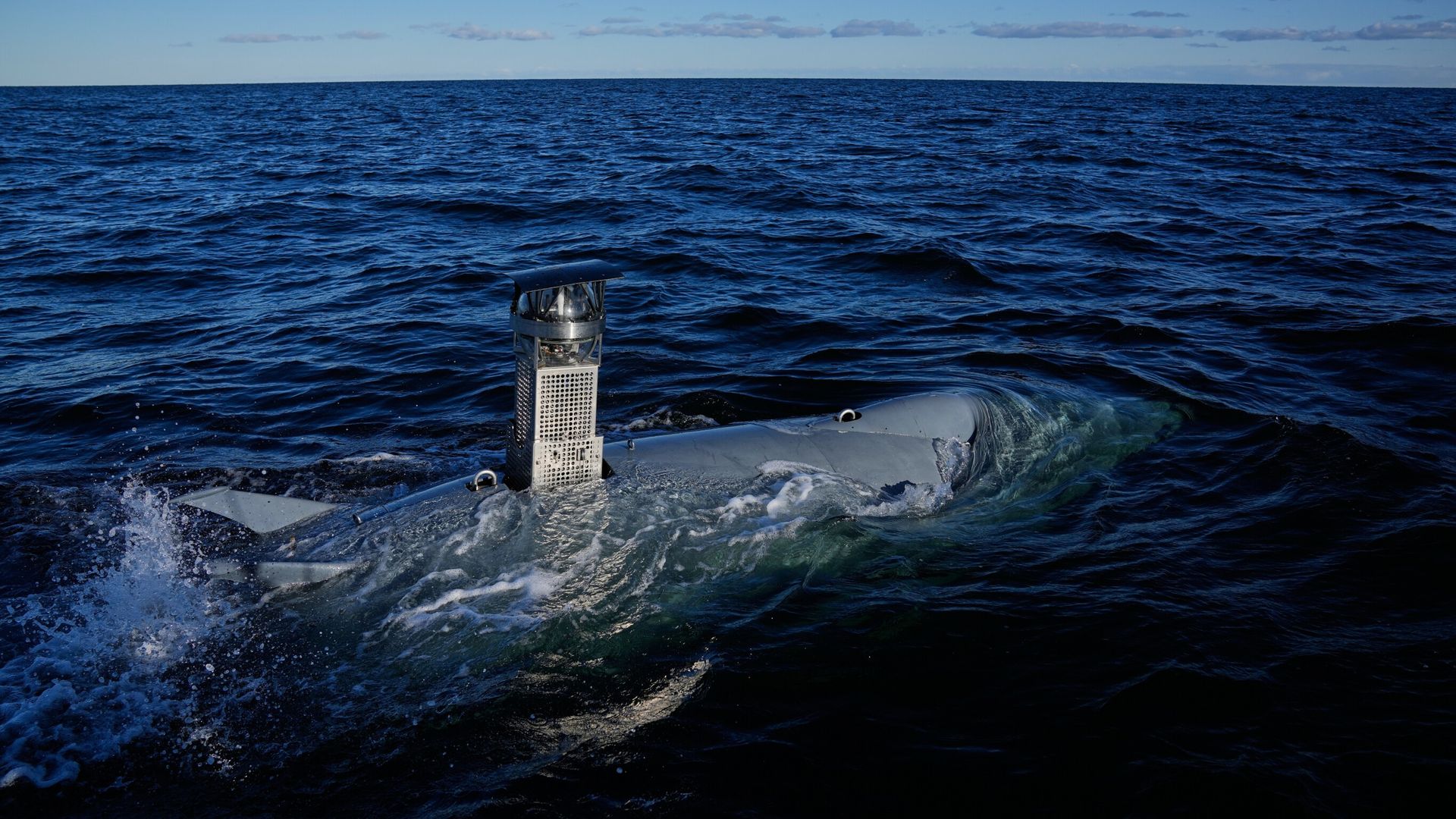
The strategic efficacy of the AUKUS trilateral partnership hinges on a fundamental pivot: shifting from a decades-long capital acquisition cycle under Pillar One to an immediate, software-defined attrition model under Pillar Two. While global media covers the long-term delivery of conventionally armed, nuclear-powered submarines (SSN-AUKUS), the immediate operational deterrence in the Indo-Pacific relies on the newly consolidated AUKUS Pillar Two Uncrewed Undersea Vehicles (UUV) signature project. This initiative aims to deploy interchangeable payloads and common control architectures across the United States, United Kingdom, and Australian fleets by 2027. However, the strategic utility of this autonomous undersea network is constrained by structural bottlenecks in data interoperability, regulatory export controls, and acoustic transmission physics.
The trilateral defense framework must be evaluated not through the lens of geopolitics, but as an optimization problem: how to maximize sensor-to-shooter closed loops across asymmetric naval forces within a highly contested, GPS-degraded maritime environment.
The Core Architecture: Decoupling Hull from Payload
The defense pact establishes a decoupled development framework that separates the physical manufacturing of maritime platforms from the rapid iteration of their mission payloads. Historically, naval procurement bound sensors, electronic warfare suites, and kinetic payloads to specific hull designs, yielding development cycles exceeding a decade. The UUV signature project enforces an open architecture paradigm designed to break this dependency.
This architectural framework operates across three distinct operational layers:
1. Modular Interchangeable Payloads
Instead of designing a unified trilateral UUV hull, each nation develops localized autonomous platforms while adhering to universal mechanical, electrical, and data interfaces. This allows a sensor array manufactured in Australia to slot directly into a United States Navy Large Ocean Uncrewed Underwater Vehicle (LUUV) or a Royal Navy autonomous platform. Initial trilateral development focuses on specific mission packages:
- Acoustic and Non-Acoustic Intelligence, Surveillance, and Reconnaissance (ISR): Synthetic aperture sonars and magnetic anomaly detectors optimized for detecting ultra-quiet conventional submarines in shallow littoral waters.
- Seabed Infrastructure Protection: Specialized payload modules containing high-frequency localized sonar and robotic manipulators designed to identify and counter interference with subsea fiber-optic cables and energy pipelines.
- Kinetic and Asymmetric Strike: Attritable payload delivery mechanisms capable of deploying micro-torpedoes or smart mines within denied zones without risking crewed platforms.
2. Common Control Systems and Unified Software Architecture
Interoperability fails if platforms require proprietary command-and-control (C2) software. The pact mandates the creation of a common trilateral software baseline for uncrewed systems. By enforcing shared data schemas and message-routing protocols, a single operator stationed at Submarine Rotational Force-West in Western Australia can command a distributed swarm of multi-national UUVs via a unified interface.
3. Resilient and Autonomous Artificial Intelligence Technologies (RAAIT)
Undersea autonomy cannot rely on continuous cloud connectivity. The RAAIT framework shifts data processing from centralized shore stations directly to the tactical edge. UUVs utilize onboard edge-computing clusters running common machine learning algorithms to process high-volume raw acoustic data derived from trilateral sonobuoy arrays and distributed autonomous sensors. Instead of transmitting raw sensor feeds over constrained bandwidth, the platform processes the data locally, transmitting only highly compressed contact alerts and target tracks.
The Physics of Undersea Attrition: The Cost-Exchange Ratio
The strategic rationale for deploying dense swarms of UUVs throughout the First and Second Island Chains is rooted in the economics of modern anti-access/area-denial (A2/AD) warfare. The cost-exchange ratio of defending a maritime zone with crewed nuclear submarines versus attacking or monitoring it with autonomous systems is deeply asymmetric.
The operational math favors what the United States Department of Defense characterizes as "all-domain attritable autonomy." Consider the basic financial and operational cost function:
$$C_{\text{total}} = C_{\text{platform}} + C_{\text{sustainment}} + C_{\text{opportunity}}$$
For a Tier 1 crewed nuclear attack submarine (SSN), $C_{\text{platform}}$ exceeds $3 billion, with a multi-year maintenance cycle that severely suppresses deployment availability. The loss of a single SSN represents a catastrophic reduction in national combat power and irreplaceable human capital.
Conversely, an advanced, long-endurance UUV carries a unit cost orders of magnitude lower, operating without a human survival envelope. By transferring the burden of persistent ISR and mine countermeasures to autonomous swarms, the AUKUS nations achieve a force-multiplier effect that shifts the adversary’s targeting calculus.
+-------------------------------------------------------------+
|                     TRILATERAL NETWORK                      |
|                                                             |
|   [ US Navy LUUV ]      [ UK Royal Navy ]     [ Aus UUV ]   |
|          |                     |                   |        |
+----------+---------------------+-------------------+--------+
                                 |
                  [ Universal Payload Interface ]
                                 |
            +--------------------+--------------------+
            |                                         |
 [ Modular Sensor Payload ]               [ Kinetic Strike Module ]
This structural shift introduces a critical operational vulnerability: the communication bottleneck. Radio frequency signals attenuate rapidly in salt water, forcing UUVs to rely on acoustic telemetry for underwater networking. Acoustic communication is inherently limited by narrow bandwidths, high latency caused by the speed of sound in water ($\approx 1500 \text{ m/s}$), and susceptibility to environmental thermal layers or active adversary jamming.
Consequently, these autonomous systems cannot operate as tightly coupled, remote-controlled assets. They must possess sufficient conceptual maturity to execute complex mission profiles—such as collaborative search patterns and automated target recognition—while completely severed from human oversight for extended operational durations.
Institutional and Regulatory Bottlenecks
While technical milestones receive considerable attention, the primary constraint on the velocity of Pillar Two deployment is institutional, not technological. The integration of three distinct defense industrial bases requires navigating severe legal and bureaucratic impediments.
The ITAR and Export Control Bottleneck
The United States International Traffic in Arms Regulations (ITAR) has historically treated close allies identically to non-aligned nations regarding the transfer of unclassified defense data and source code. Although legislative reforms within the US National Defense Authorization Act (NDAA) established structural license exemptions for the UK and Australia, translating these statutory exemptions into operational regulatory frameworks remains a major administrative friction point.
Advanced AI algorithms developed for UUV navigation and sonar processing frequently intersect with highly restricted dual-use technology lists. If a software patch designed by an Australian defense technology firm cannot be compiled on a US military system without a multi-month State Department review, the trilateral software pipeline collapses.
Intellectual Property and Cross-Border Co-Development
Developing interchangeable payloads requires sharing sensitive proprietary data across multinational defense contractors. BAE Systems, Anduril, and various defense primes must co-develop hardware interfaces without compromising their underlying commercial intellectual property. Establishing equitable technical and commercial frameworks that protect corporate IP while enabling open source architecture standards is a complex legal challenge that requires ongoing ministerial intervention.
Operational Concept and Doctrine Misalignment
The three navies possess divergent operational profiles and regional priorities. The Royal Australian Navy requires long-range, persistent territorial defense and choke-point monitoring across the vast, shallow littoral waters of the Indo-Pacific. The UK Royal Navy focuses heavily on deep-water anti-submarine warfare and critical infrastructure protection across the Euro-Atlantic and North Atlantic corridors.
The US Navy demands global power projection capability across all depth strata. Designing a single family of interchangeable payloads that satisfies these distinct operational doctrines requires careful balancing to prevent the technology from becoming overly complex and diluted.
Strategic Action Plan for Combined Undersea Operations
To successfully transition the AUKUS Pillar Two architecture from experimental deployment to an operational deterrent by the 2027 target date, the defense establishments must immediately execute a coordinated operational play.
First, the partners must establish a permanent Trilateral Undersea Software Integration Office. This office must operate outside traditional procurement cycles, utilizing a shared cloud environment cleared for multi-national secret data. Software engineers from all three nations must co-author the containerized applications driving the common control systems, bypassing traditional ITAR transfer mechanisms by building within a unified, pre-cleared digital ecosystem.
Second, the scheduled Maritime Big Play exercise series must be utilized to execute a rigorous, adversarial red-teaming of the autonomous network. Exercises must simulate a completely disconnected acoustic environment where UUVs are subjected to active electronic warfare and cyber degradation. The evaluation metric for success must not be the performance of individual platforms, but rather the system-wide time required to detect, classify, and distribute a target track across all three nations' tactical networks without human intervention.
Finally, the procurement strategy must shift toward a distributed manufacturing model. Rather than centralizing payload production within the United States, manufacturing specifications for the newly validated sensors and weapon systems must be licensed immediately to industrial facilities in the United Kingdom and Australia. Building parallel, redundant supply chains is the only mechanism to ensure the alliance possesses the industrial surge capacity necessary to sustain a high-attrition autonomous fleet in a protracted regional conflict.