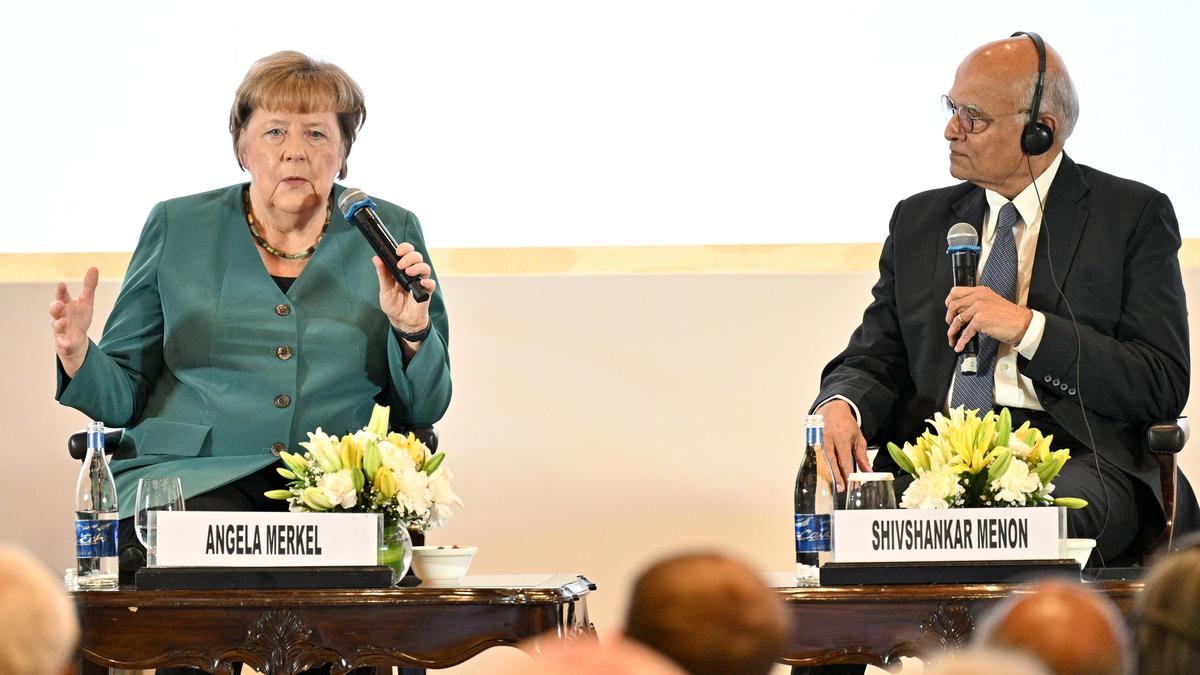
The air in the glass-walled conference rooms of Davos and Berlin often feels thinner than it should. It isn’t the altitude. It is the weight of what is left unsaid between the world’s most powerful people.
Angela Merkel once sat at the center of this thinning air, a physicist by training who spent sixteen years treating global politics like a complex thermodynamic system. She understood a fundamental law that many of her contemporaries ignored: entropy. If you do not actively put energy into maintaining order, things fall apart.
When she spoke about the crumbling pillars of global cooperation, she wasn't just reciting a diplomatic script. She was issuing a structural warning. The world we built after the Great Wars—a world of treaties, handshakes, and shared rules—is currently being eaten from the inside by a new kind of silence. It is the silence of the United States and China, two titans who have decided that the race for artificial intelligence is more important than the survival of the track they are running on.
The Ghost in the Assembly Line
To understand why this matters to someone who isn't a world leader, consider a hypothetical engineer named Elena. Elena works for a mid-sized logistics firm in Hamburg. She isn't a politician. She spends her days trying to ensure that a shipment of life-saving insulin from a factory in Indiana reaches a clinic in rural Ethiopia without the cold-chain being broken.
Ten years ago, Elena relied on a predictable web of international standards. Every sensor, every customs form, and every satellite ping followed a global sheet of music. But today, the music is jarringly off-key.
The U.S. has its own set of algorithmic standards, designed to protect proprietary interests and national security. China has a different set, baked into a "Great Firewall" of digital sovereignty. Elena’s software, caught in the middle, begins to glitch. The AI managing the route can’t "talk" to the port’s AI because the underlying code is now a geopolitical weapon.
The insulin spoils on a tarmac.
This is the "peril" Merkel warned about. It isn't a sudden explosion. It is a slow, agonizing loss of connectivity. It is the moment we realize that the internet—once promised as a global village—has become a collection of fortified bunkers.
The Great Opt-Out
The tragedy of the current global order is that the two biggest players have opted out of the conversation. Washington and Beijing are locked in a digital arms race that mirrors the nuclear tensions of the 1960s, but with one terrifying difference: you could see a silo. You can't see an algorithm.
Merkel’s frustration with the U.S. and China stems from their refusal to submit to a common rulebook for AI. For the Americans, regulation is often seen as a shackle on innovation, a way for "slow" Europe to catch up by legislating what it cannot build. For the Chinese, AI is the ultimate tool for social stability and state power, a domestic matter that no international body should touch.
But AI does not respect borders.
A rogue trading algorithm written in a basement in Seattle can flash-crash a market in Tokyo. A deepfake generated by a server in Shenzhen can incite a riot in Nairobi. When the two largest economies refuse to agree on where the guardrails go, they aren't just protecting their own interests. They are removing the brakes from everyone else’s car.
The Physics of Trust
Trust is not a moral feeling. In the world of high-stakes diplomacy, trust is a technical requirement.
During the Cold War, the U.S. and the Soviet Union eventually agreed on "Hotlines" and "Open Skies." They did this not because they liked each other, but because they both realized that an accidental war was just as deadly as an intentional one. They created a shared language for crisis.
We have no such language for AI.
Imagine a scenario where an automated defense system on a disputed border misinterprets a flock of birds as a drone swarm. In a world of cooperation, there is a protocol to de-escalate. In our current world—the one Merkel described as being in peril—there is only a vacuum. The silence between Washington and Beijing means that neither side knows where the other’s "red lines" are drawn in the code.
They are flying blind through a thunderstorm, and they are carrying the rest of us in the cargo hold.
The European Dilemma
Europe often finds itself in the position of the world’s "Regulatory Referee." Lacking the massive tech giants of Silicon Valley or the state-funded behemoths of Hangzhou, the European Union has leaned into its greatest export: the rule of law.
The AI Act was supposed to be the blueprint. It was an attempt to categorize AI by risk—deciding that an algorithm that recommends a movie is fine, but one that decides who gets a mortgage or who goes to jail needs human oversight.
But a referee is useless if the star players refuse to take the field.
Merkel saw the writing on the wall. She knew that if the U.S. and China continue to treat AI regulation as a zero-sum game, the global order won't just shift; it will vanish. We will return to a world of "might makes right," where the strongest code dictates the reality for everyone else.
The Cost of Fragmentation
The human element of this geopolitical spat is often buried under jargon like "interoperability" or "digital sovereignty." But let’s look closer at the friction.
Consider the small business owner in Brazil trying to sell handmade goods to a global market. If the digital world splits into two irreconcilable halves, that owner has to choose an ecosystem. Do they optimize for the Western cloud or the Eastern one? If they choose wrong, they lose half their customers. If they try to do both, the cost of compliance eats their profit.
The "lack of cooperation" Merkel lamented is a tax on human potential. It is a friction that slows down medical research, hampers climate change modeling, and makes global finance more brittle.
We are currently building a world where the left hand doesn't just ignore what the right hand is doing—it is actively trying to cut it off.
A Table with Empty Chairs
There is a specific kind of loneliness in being the only person in the room advocating for a boring, stable peace. Merkel often looked like that person.
She understood that the "Global Order" isn't a natural state of being. It is an artificial construction, like a bridge. Every day, the salt air and the weight of the traffic try to pull it down. Every day, you have to go out and tighten the bolts.
The U.S. and China have stopped tightening the bolts. They are too busy trying to build their own, separate bridges, even as the main one begins to sway in the wind.
They claim that regulation will stifle "the future." But what kind of future is it if it can’t be shared? If a doctor in Paris can’t trust the diagnostic AI developed in Boston because the data sets are "national secrets," then we haven't advanced. We have just built higher walls.
The Invisible Stakes
The stakes are not just about who wins the race to AGI (Artificial General Intelligence). The stakes are about whether we remain a single civilization or fracture into digital fiefdoms.
When we lose the ability to cooperate on technology, we lose the ability to solve any problem that is bigger than a single nation. You cannot fix the climate in a vacuum. You cannot stop a pandemic in a vacuum. And you certainly cannot manage an intelligence that evolves faster than the human mind if you are too busy sabotaging your neighbor's servers.
The peril isn't the AI itself. The peril is us.
It is our sudden, collective amnesia regarding how much we need each other. We have become so enamored with the power of our new tools that we have forgotten the fragility of the hands holding them.
Merkel’s warning was an invitation to the table. But as the lights dim on an era of global integration, the chairs remain empty. The titans are in their labs, coding in the dark, convinced that they can win a game where the board is already on fire.
The most sophisticated algorithm ever written cannot calculate its way out of a broken world. It can only process the data of our decline.
Somewhere, in a silent server farm, a cooling fan whirs, keeping a processor at exactly the right temperature while the world outside grows cold from a lack of human warmth.