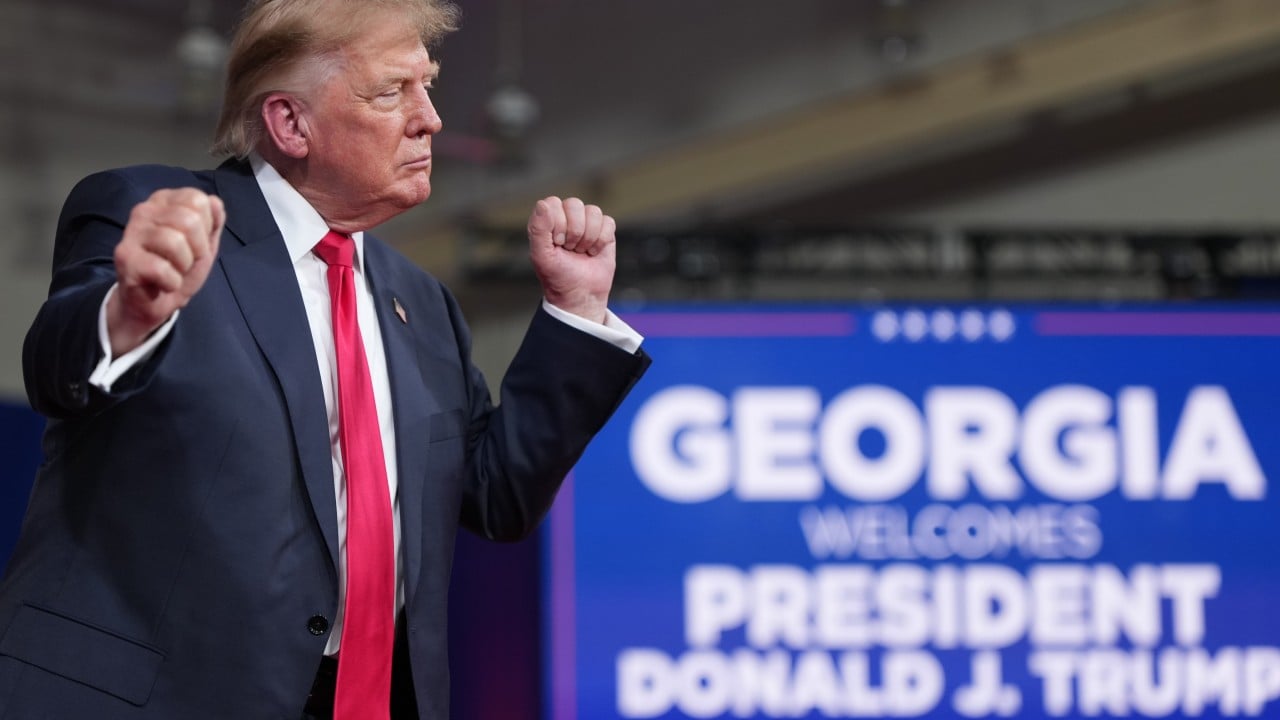
Two thousand miles separate the humid pine barrens of Macon, Georgia, from the cold, immaculate assembly halls of Neckarsulm in southwestern Germany, yet in late October 2026, the fate of both places collided on a makeshift wooden stage in Perry, Georgia.
Under harsh stadium lights, days before a knife-edge midterm election, U.S. President Donald Trump stood beside Audi Chief Executive Gernot Döllner to announce a deal worth roughly $4.2 billion. Audi, the luxury crown jewel of the Volkswagen Group and the last major German automaker without an American assembly line, had finally blinked. By 2031, if blueprints survive reality, a sprawling facility in central Georgia will churn out 200,000 Q7, Q8, and Q9 SUVs a year, employing 4,500 workers. Meanwhile, you can explore other stories here: Why Building a $70M Neighborhood Next to Netflix Is a Real Estate Trap.
"If it weren't for the tariff, they wouldn't have come," Trump told the roaring crowd.
The headlines wrote themselves. A clean, triumphant victory lap for economic nationalism. A tidy transaction where border taxes forced a foreign giant to bend the knee and pour concrete in the American South. To understand the full picture, we recommend the recent report by Harvard Business Review.
Except global manufacturing never moves in straight lines. Behind the applause in Perry lies a far messier, deeply human story about survival, quiet desperation, and the invisible bill that someone, somewhere, always has to pay.
The Anatomy of a Corporate Squeeze
To understand why Gernot Döllner flew across the Atlantic to stand at a partisan political rally—a move that triggered immediate fury among German labor unions back home—you have to look at the bleeding on Audi's balance sheet.
For years, Audi operated on a simple, profitable assumption: build precision machines in Europe and Mexico, ship them across the ocean, and sell them to wealthy Americans. While rivals BMW and Mercedes-Benz poured billions into sprawling factories in South Carolina and Alabama decades ago, Audi stayed away from U.S. soil. Its Mexican plant in San José Chiapa handled the popular Q5, while flagship SUVs rolled off European docks.
Then the trade walls went up.
Tariffs on imported vehicles, steel, aluminum, and auto parts hammered Audi like a sledgehammer against plate glass. In 2025 alone, those border taxes cost the automaker roughly €1.2 billion—nearly $1.4 billion—evaporating margins overnight. By May 2026, a 25 percent tariff on European-built vehicles turned every transatlantic shipment into a financial wound.
At the exact same moment, Audi's historical cash cow was drying up. In China, the brand's largest single market, domestic electric vehicle makers were eating German luxury alive. Global sales dropped for two straight years, falling another 7 percent in the first half of 2026. In the United States, sales plunged 16 percent.
Think of tariffs not as a neat surgical scalpel, but as a heavy wool blanket thrown over a runner mid-sprint. A manufacturer can absorb the extra weight for a mile or two by eating the cost, or pass the suffocating heat onto the buyer through higher sticker prices. Eventually, the runner collapses or changes direction.
Audi had nowhere left to run. Either build inside the fortress walls or abandon the world's most lucrative market for massive, gas-guzzling luxury SUVs.
Two Workers, One Ledger
Numbers in the billions feel abstract until you shrink them down to the size of a kitchen table. Consider a hypothetical comparison between two people whose lives are bound together by this single corporate ledger, even though they will never meet.
First, picture Marcus, a 34-year-old maintenance technician in Bibb County, Georgia. For years, Marcus has watched industrial announcements sweep past central Georgia toward Atlanta or the coast, leaving Macon with stubbornly flat wages and aging warehouses. When news breaks that Audi is breaking ground in 2027 with state incentives totaling roughly $1.4 billion, Marcus doesn't care about trade theory or midterm polling. He cares that 4,500 jobs mean apprenticeship pipelines for his nephew, packed booths at local diners, and a shot at earning union-adjacent manufacturing pay without leaving home.
Now, shift your gaze four thousand miles east to Markus, a 49-year-old toolmaker in Neckarsulm, Germany. Markus has spent twenty-five years calibrating body panels for Audi sedans. His factory is one of four Volkswagen Group plants staring down the barrel of potential closure after 2030. Every billion euros Audi wires to Georgia is a billion euros not spent retooling Neckarsulm. For Markus, the red clay of Macon isn't a rebirth; it is a slow-motion eviction notice.
This is the unspoken reality of industrial policy. Factories rarely materialize out of thin air. More often, they migrate like tectonic plates—lifting one coastline while submerging another.
Did Tariffs Actually Build This Plant?
Here is where the political narrative begins to fray under closer inspection.
Did Donald Trump's tariffs trigger Audi's move to Georgia? Yes, and no. To claim tariffs alone conjured a $4.2 billion factory is like crediting a sudden thunderstorm for a crop a farmer planted three seasons ago.
Audi did not wake up in the autumn of 2026 and throw a dart at a map of the American South. Internal planning for a North American manufacturing footprint began roughly three years earlier, around 2023, long before the current tariff regime took hold. Executives spent years quietly evaluating more than seventy potential sites across the continent, weighing highway corridors, rail access to the Port of Savannah, electricity grid capacity, and local tax packages.
Market gravity pulled Audi toward America first. American buyers still crave full-size, three-row petrol SUVs—vehicles like the upcoming Q9 that make little sense on narrow European streets. Building them near the people who buy them was always logical.
What the tariffs did was turn a leisurely corporate timeline into a five-alarm fire. Facing a $1.4 billion annual penalty and watching rivals BMW and Mercedes-Benz enjoy tariff-free production from their existing Southern plants, Audi accelerated its decision and wrapped it in political theater. In exchange for standing beside the president ten days before voters went to the polls, Audi gained leverage in quiet negotiations over transitional tariff relief—a framework allowing automakers that commit capital to U.S. factories to offset import penalties while their plants are being built.
Politicians got a headline. Audi got a lifeline.
The Invisible Bill
If you are shopping for a car in the United States, you might wonder how a factory opening in 2031 affects your wallet today.
It already has.
I remember standing on a dealership lot in late 2025, staring at the window sticker of a mid-tier crossover whose price had crept up four thousand dollars in eighteen months without a single meaningful upgrade under the hood. The salesperson didn't bother pitching the leather seats. He just pointed at the bottom line and shrugged, murmuring about supply chain surcharges and import duties. That quiet, helpless shrug is the true sound of a trade war.
Tariffs are not paid by foreign governments, nor are they absorbed indefinitely by benevolent executives in Munich or Wolfsburg. When Audi bled €1.2 billion in duties in 2025, part of that loss squeezed corporate profits, and part of it quietly migrated into higher retail prices and thinner dealer incentives across the entire automotive market. When foreign imports get artificially expensive, domestic automakers rarely keep their prices low out of patriotism; they raise their prices to just below the new ceiling.
Meanwhile, the broader American auto sector hasn't experienced a painless renaissance. Since 2025, overall employment in U.S. motor vehicle and parts manufacturing has actually softened, weighed down by higher steel and aluminum costs, consumer sticker shock, and a sharp pullback in electric vehicle and battery investments after federal incentives were slashed.
Even Georgia's own industrial history offers a cautionary footnote. Just a year earlier, federal immigration raids at a massive Hyundai battery and vehicle complex in the state sent shockwaves through foreign boardrooms, reminding international executives that building on American soil carries its own unpredictable political storms.
Five Years Is an Eternity
Announcements are easy. Pouring concrete is hard.
Between a ceremonial handshake in October 2026 and the first Georgia-built Audi Q9 rolling off the line in 2031 lies half a decade of execution risk. Ground doesn't even break until 2027.
In five years, interest rates can spike, consumer tastes can swing violently back toward hybrids or electrics, and trade agreements like the U.S.-Mexico-Canada Agreement can be rewritten or torn up. A factory promise is not a factory; it is an option on the future, funded heavily by $1.4 billion in state-backed incentives that Georgia taxpayers are betting will eventually pay off in income taxes and local commerce.
I want to be honest about the tension here, because anyone who tells you this deal is purely good or purely disastrous is selling you a slogan. If you live in Macon, watching rusted rail spurs give way to clean-room robotics and steady paychecks is an undeniable blessing. If you are an economist tallying the billions American households have paid in higher vehicle prices to force that single investment across the ocean, the math looks far more punishing.
Both truths occupy the exact same patch of ground.
Walk the perimeter of the proposed site outside Macon right now, and you won't hear the hum of stamping presses or the hiss of pneumatic wrenches. You will only hear wind moving through pine needles, dry red dirt crunching under work boots, and the distant rumble of freight trains carrying someone else's goods toward the coast—waiting for five long years to find out whether a political promise can outlast the storm that made it.