Inertia.
That is the cold, mechanical word a physicist would use to describe what happened on a blistering January afternoon in Trujillo, Peru, when a strand of wooden beads launched from a frantic crowd struck an eighty-one-year-old man squarely in the left eye.
To the people pressing against the metal barricades along Avenida Larco, however, that flying rosary was not an object governed by Newtonian mechanics. It was a desperate prayer given physical weight. It was a mother’s trembling hope for a sick child, a grandmother’s plea for a blessing, or a young man’s clumsy attempt to bridge the unbearable distance between the dirt at his feet and the man in white riding past in an open-sided vehicle. In the heat of that Peruvian summer in 2018, devotion turned kinetic, and devotion hurt.
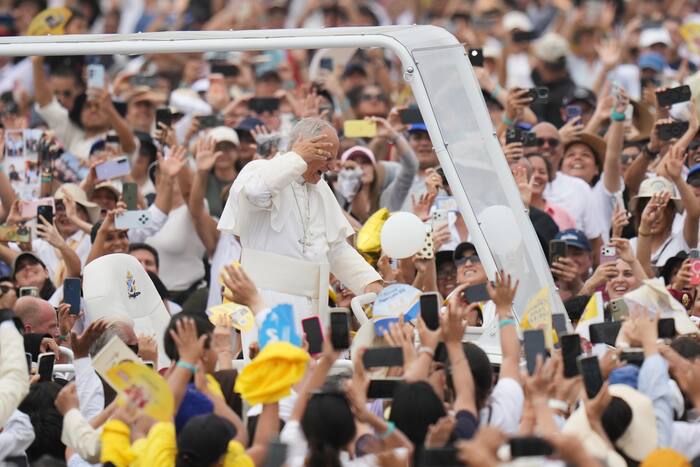
I remember watching the footage on a grainy screen years ago, wincing at the exact millisecond the beads connected. You see the popemobile gliding slowly through a sea of waving hands and fluttering yellow-and-white flags. You see Pope Francis leaning out, smiling that familiar, slightly crooked smile, reaching to touch the fingertips of people who had camped on the concrete for days just to catch a glimpse of him. And then, out of the blur of sunburned arms and shouting faces, a dark arc cuts across the frame.
Thwack.
His head snaps back slightly. His left hand flies to his brow. For a fraction of a second, the cheer of hundreds of thousands of voices seems to vanish, replaced by the sickening realization that someone in the crowd had just injured the very person they came to revere.
The Anatomy of an Accident
When news outlets first reported the incident, they treated it like a quirky footnote from a papal tour. "Pope hit in the eye with a rosary in Peru," the headlines read, accompanied by clips of Francis emerging later that evening with a dark, plum-colored shiner swelling beneath his left eyebrow and a small bandage taped near his cheekbone. The internet chuckled, made a few predictable jokes about aggressive piety, and moved on to the next news cycle.
But if you stop and actually look at what occurred in Trujillo, the humor evaporates. What remains is something far more uncomfortable and infinitely more human.
Consider the sheer physics of crowd devotion. In Peru, a nation where Catholicism is woven into the bone marrow of daily life—not as a polite Sunday habit, but as an urgent, tactile lifeline—the arrival of a Latin American pope was nothing short of seismic. Trujillo itself was still nursing deep wounds from the catastrophic El Niño floods of 2017, which had torn through the northern coast, washing away homes, crops, and entire livelihoods. People stood behind those barricades carrying grief in their pockets and desperation in their chests.
When you hold a rosary in that kind of crowd, you do not want a souvenir. You want contact. In Catholic tradition, an object touched or blessed by the pontiff becomes a tangible anchor for faith, something you can press into the hands of a dying parent or hang above a newborn’s crib. Multiply that longing by three hundred thousand people packed shoulder-to-shoulder under a relentless sun, separated from their spiritual father by armed guards, steel fences, and a moving vehicle.
To understand the person who threw those beads, let us imagine a hypothetical figure in that crowd—call her Elena, a seamstress from a neighborhood still drying out from the floodwaters. She has stood behind the metal barrier since four in the morning, her ankles swollen, clutching a cheap plastic rosary her aunt gave her before she left home. As the white truck approaches, the crowd surges forward like a breaking wave. Taller men block her view. The vehicle is moving too fast; the window of opportunity is shrinking from ten seconds to five, to two. Panic overrides etiquette. She does not think about trajectory, wind resistance, or the fragile skin around an elderly man’s eye socket. She just wants the beads to land on the floorboards of the popemobile, maybe brush against the hem of his cassock, and be tossed back to her. So she throws.
It was never an act of malice. Security officials confirmed that immediately, and anyone watching the video could see the trajectory was an overenthusiastic toss rather than a hostile pitch. Yet the result was the same as if it had been thrown in anger. Blood pooled beneath the thin skin of Francis’s lower eyelid. Swelling closed in around his vision.
Good intentions, it turns out, leave the exact same bruise as hatred.
The Reflex We Never Question
Think about the last time someone hurt you by accident.
Maybe it was a friend who blurted out your deepest insecurity at a dinner party because they were trying to be funny. Maybe it was a colleague whose careless mistake cost you a promotion you had spent two years earning. Maybe it was a stranger in traffic whose momentary distraction left your bumper crumpled on the asphalt.
What happened inside your chest in the first three seconds after the impact?
If you are like almost every human being who has ever walked the earth, your nervous system did not pause to conduct a fair-minded inquiry into the other person’s motives. Before your rational brain could even register the words they didn't mean to, an ancient, coiled spring snapped inside you. Heat rushed to your face. Your jaw clenched. A surge of cortisol and adrenaline flooded your bloodstream, demanding a target, an explanation, a scapegoat. Even when we know, intellectually, that an injury was unintentional, our wounded pride insists that someone must pay for the pain. We want an apology loud enough to match our embarrassment. We want the room to know we were wronged.
We live in an era that has perfected the art of nursing grievances. Every digital platform we inhabit is engineered to take a stray spark of offense and fan it into a wildfire of righteous indignation. When someone throws a metaphorical rosary at our heads—a clumsy comment, an insensitive joke, an honest mistake—our instinct is to hold up the bruise to the cameras and demand justice. Forgiveness, in our modern calculus, is something you dispense only after the offender has crawled across broken glass, issued a carefully worded statement, and satisfied every condition of your anger.
Now place yourself inside that popemobile in Trujillo.
You are eighty-one years old. You have one functioning lung, a chronic sciatic nerve condition that makes every step an exercise in quiet endurance, and a schedule that has dragged you across oceans, time zones, and altitudes for six straight days. You have spent the morning comforting flood victims whose stories of loss would break a younger man. Your face is stinging from a sharp blow that will leave you looking like you just went three rounds with a heavyweight boxer in front of the global press.
Nobody would have blamed Francis if he had pulled back into the cabin, dabbed his eye with a handkerchief, and let the motorcade accelerate past the crowd. Nobody would have faulted him for flashing a tight, clipped grimace—the universal signal of a public figure whose patience has finally hit a wall.
Instead, he did something that looked almost unnatural on camera.
What Happened in the Next Five Seconds
Watch the recording closely, frame by frame, and you will see the exact architecture of real grace.
Right after the rosary strikes his eye, Francis winces. He brings his left hand up to check the damage, his fingers pressing gently against the bridge of his nose. His eyes water instantly. The bodyguard standing on the rear bumper tenses, scanning the crowd for a threat.
And then, before the popemobile has rolled twenty feet farther down Avenida Larco, Francis lowers his hand. He looks back toward the section of the barricade where the beads came from. He does not scowl. He does not wag a finger in warning. He raises his right hand, traces the sign of the cross in the air toward the very crowd that just struck him, and keeps smiling.
Later that afternoon, when he appeared at the Virgin of the Door sanctuary in Trujillo with a vivid black eye that no amount of lighting could hide, he did not treat the injury as a badge of martyrdom. According to aides and Vatican reporters traveling with him, he brushed off the incident with characteristic dry humor, forgiving the unknown thrower immediately and refusing to let security tighten the perimeter between himself and the people.
To understand why that reaction matters, you have to understand what forgiveness actually is—and what it is not.
We tend to confuse forgiveness with weakness, or worse, with denial. We think forgiving someone means pretending the blow didn't land, or telling the world that our pain doesn't count. That is a cheap caricature of mercy. Real forgiveness is the exact opposite of denial; it requires you to feel the full, throbbing weight of the injury and consciously choose not to pass that pain back to the person who caused it.
Psychologists who study interpersonal trauma and resentment often describe anger as a closed loop. When someone hurts you, energy enters your system. If you retaliate, you bounce that energy back at them, escalating the conflict. If you suppress it and stew in bitterness, you trap that energy inside your own body, where it corrodes your sleep, your blood pressure, and your capacity for joy. Forgiveness is the third option—the radical, counterintuitive act of absorbing the shock so the chain reaction stops with you.
In metallurgy, engineers call this property toughness: the ability of a material to absorb sudden impact and deform slightly without shattering. Glass is hard, so it resists scratches, right up until the moment a pebble hits it at the wrong angle and it explodes into a thousand jagged pieces. Wrought iron is softer, so it takes the dent, holds its shape, and keeps carrying the load.
Most of us walk through the world like tempered glass. We look invulnerable until the slightest unexpected slight shatters our composure and sends sharp fragments flying at everyone standing nearby. Francis, taking a wooden rosary to the orbital bone in front of a million eyes, behaved like wrought iron. He took the dent. He wore the bruise in front of bishops, presidents, and television cameras for the rest of the trip. And he refused to let a moment of clumsy devotion curdle into suspicion.
The Invisible Distance Between Us
There is a deeper layer to this story that reaches far beyond religion or papal politics. It touches a nerve that aches inside almost every modern relationship, whether inside a marriage, a family, or a fractured neighborhood.
Why do people throw rosaries at a moving truck in the first place? Because there is a barrier in the way.
Think about how much of our daily friction happens across barricades of our own making. We communicate through glowing screens where tone is stripped away and every sentence lands harder than intended. We rush past coworkers in hallways, shouting half-formed instructions over our shoulders. We love our children and our partners fiercely, yet we are so exhausted by the pace of our lives that our affection comes out sideways—as a sharp remark, an impatient sigh, a clumsy gesture that bruises when it was meant to bless.
I think back to a season in my own life, a few years ago, when a close friend was going through a brutal divorce. I wanted so badly to help him, to throw him a lifeline across the mess he was drowning in. One night, over coffee, I offered what I thought was clear-eyed, practical advice about how he should handle his custody arrangement. I didn't realize how raw he was, or how much my words sounded like a judgment on his failures as a father. I tossed a rosary over the barricade; it hit him right in the eye. He went quiet, stared at his cup, and didn't call me back for three weeks. When we finally sat down again, he could have easily weaponized my clumsiness, made me grovel, or written me off as another insensitive bystander. Instead, he looked at me, acknowledged that my words had stung like hell, and said, "I know you were trying to reach me. Just aim a little lower next time."
That sentence has stayed with me for years. I know you were trying to reach me.
How much of human cruelty is actually just botched outreach? How many arguments in our homes are really two exhausted people throwing clumsy attempts at connection across a crowded street, only to watch them land like projectiles?
When we insist on judging other people solely by the bruises they leave on us, while demanding that the world judge us solely by our noblest intentions, we guarantee a life of permanent isolation. We build higher barricades. We hire better security. We pull the windows up on our popemobiles and wave politely from behind bulletproof glass, safe from stray beads and safe from any real human touch.
Francis famously hated the enclosed, bulletproof popemobiles used by some of his predecessors. He once called them "sardine cans" that walled a pastor off from his flock. He knew full well that riding in an open vehicle meant accepting the risk of sweat, grabbing hands, dropped babies, and flying rosaries. You cannot invite the crowd close enough to touch your sleeve without accepting the statistical certainty that someone, eventually, will poke you in the eye.
The Shiner That Stayed in the Photographs
For the remaining days of his visit to Peru, that dark purple bruise beneath Pope Francis’s left eye appeared in every official photograph.
It was there when he met with Indigenous leaders in the Amazonian basin of Puerto Maldonado, listening to their warnings about illegal mining and deforestation. It was there when he celebrated Mass for over a million people at the Las Palmas air base in Lima, standing beneath a vast canopy in the coastal humidity. State photographers didn't airbrush it out. Vatican spokespeople didn't issue a stern warning about crowd behavior.
The bruise simply stayed there, unadorned and unhidden, a small dark moon beneath his eye.
And if you look closely at those photographs from Lima, something striking happens. The bruise does not diminish him. It does not make him look weak, foolish, or compromised. On the contrary, it makes the entire spectacle of the papacy—all the gold embroidery, the Swiss Guards, the ancient titles, the roaring crowds—suddenly, disarmingly real. It reminds you that grace is not an abstract theological concept discussed in quiet libraries. It is a messy, physical transaction that happens in the dust, in the heat, amid imperfect people who misjudge their throws.
We never learned the name of the person in Trujillo who hurled those beads. They slipped back into the anonymity of Avenida Larco, perhaps horrified by what they had just done, perhaps never even realizing their rosary was the one that struck the mark. Whoever they were, they received a gift they could never have earned: the assurance that their clumsy, desperate reach for something sacred was met not with condemnation, but with a blessing traced through the afternoon air.
Next time someone you love—or someone you barely know—flings a careless word or a botched gesture across the barricade and catches you right where it hurts, you will feel that familiar, hot surge of pride rising in your throat. You will have every right to flinch, to nurse the swelling, to demand an explanation.
Or you can remember an old man in a white truck in northern Peru, rubbing a throbbing brow for two seconds in the blinding sun, lowering his hand, and choosing to bless the crowd anyway.