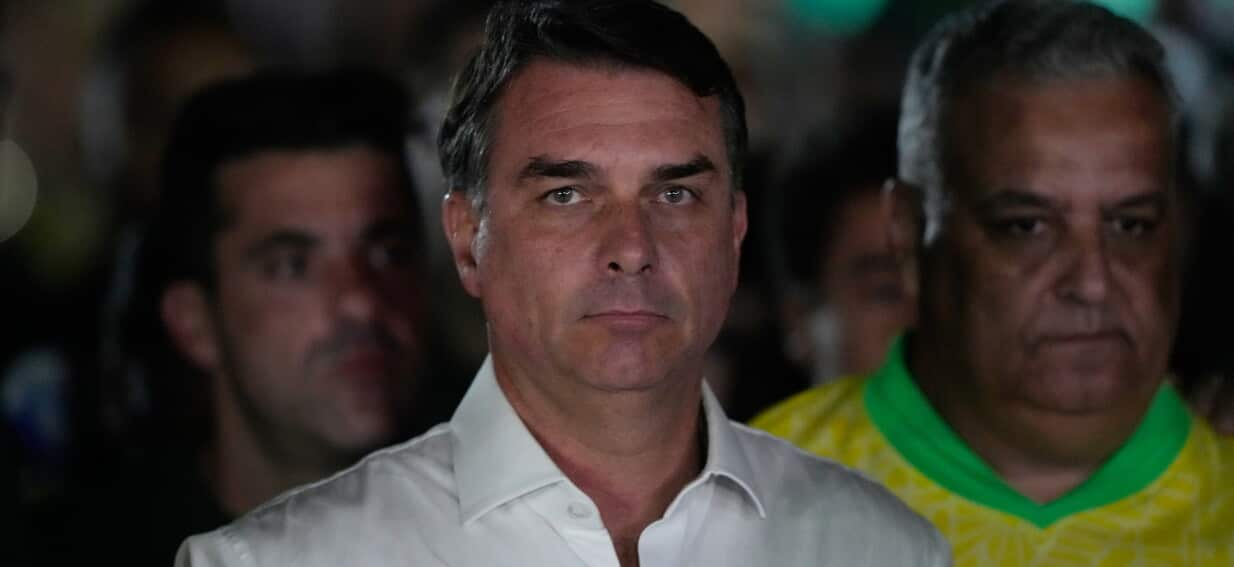
When a sitting Brazilian senator walks onto an international flight despite a judicial order barring him from leaving the country, the story is not merely about a single politician defying a court. It is about the mechanics of parliamentary immunity, the friction between Brazil's Supreme Federal Court and its legislature, and the geopolitical refuge available to the Bolsonaro political dynasty. Flávio Bolsonaro, the eldest son of former President Jair Bolsonaro, bypassed domestic travel restrictions by relying on a combination of diplomatic passport privileges, jurisdictional ambiguities, and political allies abroad, turning a routine legal restriction into a high-stakes constitutional standoff.
The incident did not happen in a vacuum. For years, the relationship between the Brazilian judiciary—specifically Supreme Federal Court Justice Alexandre de Moraes—and the Bolsonaro family has operated on the edge of open institutional warfare. To understand how Flávio Bolsonaro boarded a plane when authorities explicitly sought to keep him within national borders, one must examine the architecture of Brazilian law, the specific loopholes inherent to senatorial office, and the strategic calculus driving the right-wing opposition in Brasília.
The Mechanics of a Border Breach
In most jurisdictions, a travel ban is enforced through a straightforward digital flag. A judge issues an order, the federal police update a border control database, and an immigration officer stops the subject at passport control. Brazil operates differently when the subject holds a seat in the National Congress.
Under the 1988 Brazilian Constitution, members of Congress possess foro privilegiado—a special legal standing that shields them from standard lower-court rulings and places them exclusively under the jurisdiction of the Supreme Federal Court (STF). More importantly, senators carry diplomatic passports issued by the Ministry of Foreign Affairs. While a judicial order can theoretically cancel or suspend a standard civilian passport, revoking or blocking a diplomatic passport requires specific, coordinated communication between the judiciary, the Federal Police, and the Senate's own administrative leadership.
Timing played a decisive role. Judicial orders in high-profile political cases often leak or face procedural delays between issuance and technical execution at airport terminals. In Brazil, Federal Police agents stationed at international hubs like Brasília, Guarulhos, or Galeão operate under strict protocols when dealing with sitting lawmakers. Unless an explicit, unambiguous arrest warrant or immediate seizure order is active in the system at the exact moment of boarding, border agents face severe legal and career risks for detaining a senator. Doing so without ironclad authorization can trigger accusations of abuse of authority—a charge weaponized frequently in Brazilian politics.
Furthermore, congressional recesses and official parliamentary missions create gray zones. Lawmakers routinely travel abroad under the banner of legislative diplomacy, attending conferences, meeting foreign counterparts, or participating in conservative political summits. When a senator claims an international trip falls within the scope of parliamentary duties, the Senate Presidency often steps in to defend the institution's autonomy against what lawmakers characterize as judicial overreach.
The Judicial Friction Behind the Order
To grasp why the restriction existed in the first place, look at the broader legal siege surrounding the Bolsonaro family. Since leaving office, Jair Bolsonaro and his inner circle have faced a relentless series of investigations led by the Federal Police and overseen by the STF. These probes span multiple fronts, including allegations of attempting to overturn the 2022 presidential election results, the falsification of COVID-19 vaccination records, and the misappropriation of high-value state gifts, such as luxury jewelry received from foreign governments.
Jair Bolsonaro himself had his passport confiscated in early 2024 during Operation Tempus Veritatis, an investigation targeting alleged coup plotters. The logic applied by Justice Alexandre de Moraes was simple: high-profile defendants with strong international ties and substantial financial backing pose an acute flight risk. The precedent was set early when figures aligned with the former administration fled to the United States, Argentina, or European nations to avoid prosecution, often claiming political persecution.
When similar preventative measures or travel restrictions target Flávio Bolsonaro, the judicial rationale follows the same pattern. Prosecutors and judges argue that unchecked international travel allows suspects to coordinate narratives outside the reach of Brazilian subpoenas, hide assets, or seek asylum in sympathetic jurisdictions.
Yet, from the perspective of Flávio Bolsonaro and his legal team, these restrictions represent an unconstitutional prior restraint on a democratically elected representative. Defense attorneys consistently argue that preventative travel bans without a formal criminal conviction violate the presumption of innocence and cripple a senator's ability to represent their constituents. In their framing, the judiciary is not enforcing the law; it is acting as a political censor, using administrative hurdles to isolate opposition leaders from international allies.
The Senate as a Shield
The Brazilian Senate has historically functioned as a club that fiercely protects its own, regardless of ideological divides. Even senators who fiercely oppose the Bolsonaro movement politically often hesitate to endorse aggressive judicial measures against a colleague, fearing the precedent could eventually be turned against them.
When the executive and judicial branches clash with the legislature, the President of the Senate holds immense discretionary power. By delaying administrative compliance with court directives or demanding formal plenary votes before enforcing restrictions on a member's freedom of movement, Senate leadership can effectively neutralize a judge's order for days or weeks.
Flávio Bolsonaro leveraged this institutional solidarity. By framing his travel not as an evasion of justice, but as a defense of parliamentary prerogative, he forced the Senate into a position where blocking him would look like institutional capitulation to the Supreme Court. In Brasília, perception is leverage. Once a legal dispute is successfully reframed as a separation-of-powers crisis, the original merits of the judicial order fade into the background.
The Role of Diplomatic Channels and Private Aviation
Beyond commercial terminals and standard immigration desks, wealthy and well-connected political figures in South America have alternative avenues for cross-border movement. While commercial flights from major international airports require passing through Federal Police checkpoints, regional travel across Mercosur nations—such as Argentina, Uruguay, and Paraguay—operates under different border protocols.
Citizens of Mercosur member states can cross land borders or board regional flights using only a national identity card, bypassing the need for a passport entirely. If a travel restriction is tied specifically to passport confiscation rather than a comprehensive border alert across all identity documents, a traveler can easily exit Brazil into a neighboring country and board a long-haul international flight from Buenos Aires, Montevideo, or Asunción.
Private aviation presents another layer of complexity. While international private flights departing Brazil must file flight plans and clear customs, smaller regional airfields near border zones have long been recognized by security analysts as porous points of exit. Though there is no public evidence indicating Flávio Bolsonaro used clandestine routes—his movements are typically tracked by press and political observers—the mere existence of Mercosur identity-card travel highlights a massive vulnerability in how Brazilian courts enforce preventative measures.
Geopolitical Refuge and the Conservative Network
Why leave at all? For Flávio Bolsonaro, stepping outside Brazil accomplishes several strategic objectives simultaneously.
First, it shifts the battlefield to international public opinion. Inside Brazil, the Bolsonaro movement faces a hostile Supreme Court and a federal government led by President Luiz Inácio Lula da Silva. Abroad—particularly in the United States, Israel, or European nations with strong right-wing movements—Bolsonaro allies find sympathetic audiences, friendly media ecosystems, and lawmakers willing to amplify claims of judicial authoritarianism in Brazil.
Second, international travel allows for direct coordination with foreign political figures. Over the past several years, Brazilian conservative lawmakers have traveled repeatedly to Washington, D.C., testifying before U.S. congressional subcommittees and meeting with American legislators to lobby for sanctions or diplomatic pressure against Justice Alexandre de Moraes. By leaving the country despite domestic restrictions, Flávio Bolsonaro sends a clear signal to both his domestic base and international observers: the Brazilian courts do not control his movements or his political reach.
Third, it tests the resolve of the judiciary. Every time a high-profile figure defies an order without facing immediate, severe consequences, the perceived authority of the court erodes. If the Supreme Court orders preventative detention in response, it risks igniting massive street protests and deepening the narrative of political martyrdom. If the court does nothing, it invites further defiance from other targets of ongoing investigations.
The Enforcement Dilemma Facing Brazilian Courts
This episode exposes a fundamental weakness in Brazil's legal architecture: the gap between judicial authority on paper and enforcement capacity on the ground.
Supreme Court justices in Brazil wield extraordinary legal powers. They can initiate investigations, authorize wiretaps, freeze bank accounts, and order arrests. However, the judiciary has no police force of its own. It relies entirely on the Federal Police—an agency administratively subordinate to the Ministry of Justice under the executive branch—and on the compliance of congressional authorities to execute its rulings.
When those enforcement mechanisms encounter a sitting senator, friction is inevitable. Federal Police leadership must balance their legal obligation to obey court orders against the political fallout of physically confronting a member of Congress. Meanwhile, airline carriers, airport authorities, and foreign immigration services will not detain a holder of a valid diplomatic passport unless Interpol or an official bilateral alert is active—a step rarely taken in domestic political disputes unless a formal criminal indictment and arrest warrant exist.
Legal scholars in Brazil remain deeply divided over these preventative measures. Critics of the Supreme Court's approach point out that indefinite travel bans, social media suspensions, and passport seizures imposed during the investigative phase—before formal charges are even filed by the Prosecutor General's Office—stretch the boundaries of due process. They argue that when courts rely on broad, open-ended restrictions, they create the very legal ambiguities that savvy politicians exploit to bypass them.
Conversely, defenders of the court's actions maintain that extraordinary measures are necessary to protect democratic institutions from coordinated subversion. They point to the January 8, 2023 riots in Brasília—when thousands of Bolsonaro supporters stormed and ransacked Congress, the Supreme Court, and the presidential palace—as proof that conventional legal guardrails are insufficient against actors willing to dismantle the constitutional order.
The Precedent Set for Future Investigations
The long-term impact of Flávio Bolsonaro's departure extends far beyond his personal legal standing. It establishes a blueprint for other political figures entangled in Brazil's sprawling web of judicial probes.
By demonstrating that a sitting lawmaker can navigate around judicial travel restrictions without triggering immediate arrest, the incident highlights the limits of judicial containment. It forces prosecutors to reconsider how preventative measures are drafted, compelling them to specify not just the surrender of a civilian passport, but the suspension of diplomatic travel documents, notification to Mercosur border authorities, and explicit directives to the Senate's administrative board.
At the same time, it deepens the polarization gripping Brasília. For Bolsonaro supporters, the trip is celebrated as an act of defiance against an overreaching judiciary. For critics, it is proof that political elites operate above the law, treating court orders as optional suggestions while ordinary citizens face immediate incarceration for far lesser infractions.
Until Brazil's legislative and judicial branches establish clear, mutually respected boundaries regarding parliamentary immunity and judicial enforcement, borders will remain porous for those with the title, the passport, and the political leverage to walk right through them.