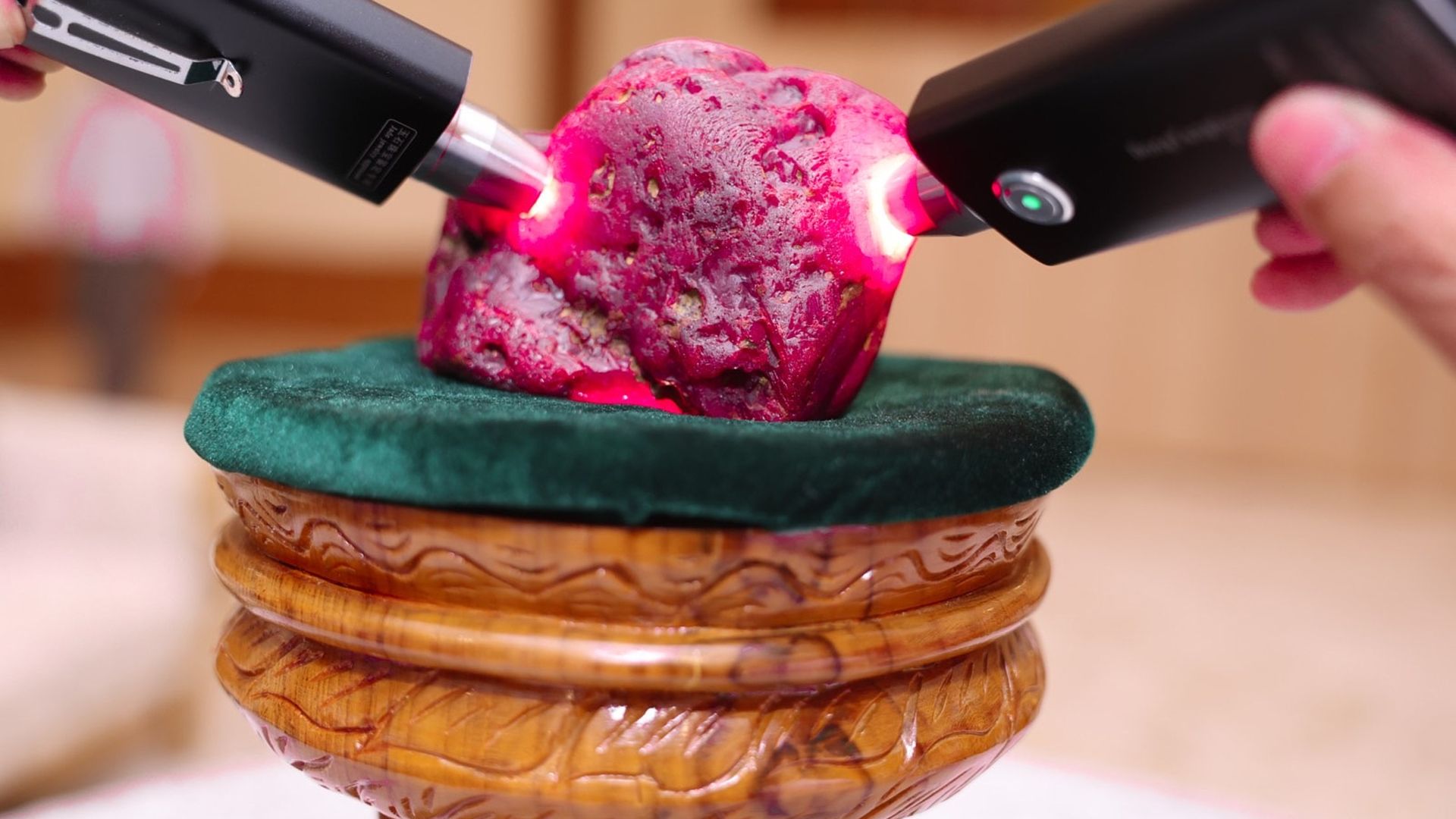
Miners in Tanzania recently unearthed a rough ruby weighing nearly five pounds, a staggering 11,000-carat specimen that has captured global headlines. While the sheer scale of the find is undeniable, the transition from a massive hunk of rock to a record-breaking payday is fraught with geological and market realities that most news outlets ignore. In the gemstone trade, size is a secondary metric. Quality, clarity, and the ability to yield faceted stones are the only factors that actually move the needle on a balance sheet.
This specific find, discovered in the Mundarara mine near Longido, represents a rare moment of physical scale. However, the history of African corundum—the mineral family that includes rubies and sapphires—is littered with massive "specimen grade" stones that look impressive on a scale but fail to perform under a jeweler’s loupe. To understand whether this discovery is a generational wealth event or a decorative paperweight, one must look past the 11,000-carat headline and into the brutal physics of gemstone cutting.
The Brutal Physics of the Eleven Thousand Carat Burden
When a stone of this magnitude surfaces, the immediate instinct of the public is to multiply the weight by the price of a high-quality ruby. That is a mistake. A one-carat, vivid "pigeon's blood" ruby can fetch over $1,000,000 at auction. A five-pound rock rarely follows that trajectory.
The primary hurdle is transparency. Most massive rubies found in the Longido region are encased in zoisite, a green mineral that often grows alongside corundum. While the contrast makes for beautiful carvings or "any-rock" specimens, it usually indicates that the ruby itself is opaque. If light cannot pass through the stone, it cannot be faceted into the sparkling gems seen in high-end jewelry. Instead, these stones are often destined for cabochon cutting—rounding and polishing—or industrial carving.
Value drops off a cliff the moment a stone is classified as opaque. We are talking about a difference between millions of dollars per gram and a few hundred dollars for the entire rock. The market for a five-pound ruby carving is niche, limited to a handful of collectors or museums. The market for investment-grade faceted rubies is a global, liquid powerhouse.
Geopolitics of the Tanzanian Soil
Tanzania sits on some of the richest mineral deposits on earth, yet the extraction of a stone this size highlights the friction between local mining operations and the global luxury supply chain. The Mundarara mine has a reputation for producing large-volume corundum, but the infrastructure required to process and verify such finds often lags behind the discovery itself.
For the miners, a discovery like this is a double-edged sword. On one hand, it brings international eyes to the region. On the other, it triggers a bureaucratic scramble. The Tanzanian government has historically tightened its grip on gemstone exports, seeking to ensure that value-adding processes—like cutting and polishing—happen within its borders rather than in traditional hubs like Bangkok or Jaipur.
This "resource nationalism" is designed to keep profits in-country, but it often creates a bottleneck. If the 11,000-carat stone cannot be exported to the world’s best master cutters, its true potential might never be realized. A master cutter is a surgeon with a diamond-tipped saw. One wrong move on a stone this size, particularly if it has internal fractures or "silk" inclusions, can shatter the specimen into thousands of worthless shards.
The Myth of the Record Breaking Price Tag
Speculation often surrounds these finds before a single lab report is issued. You will hear numbers in the tens of millions. These figures are almost always based on "insured value" or "appraised retail value," which bear little resemblance to what a buyer will actually pay in a private sale.
Take the "Burj Alhamal" ruby, another massive specimen that surfaced in Dubai recently. It was touted as one of the largest in the world, with an estimated value of $120 million. Yet, months later, the buzz faded. Why? Because the professional trade looks for "yield." If an 11,000-carat rough stone only yields 100 carats of gem-quality material, the rest is essentially byproduct.
Furthermore, the ruby market is currently obsessed with "origin." A Burmese ruby still commands a massive premium over a Tanzanian or Mozambican stone, regardless of size. The chemical "fingerprint" of the stone—trace elements like chromium, iron, and vanadium—tells a story that collectors use to justify seven-figure checks. A Tanzanian stone of this size must fight an uphill battle against the prestige of the Mogok Valley in Myanmar.
Inside the Appraisal Smoke and Mirrors
How does a five-pound rock get a price tag? The process is less scientific than the industry likes to admit. It involves a dance between the mining company, the auction house, and third-party grading labs.
The Grading Conflict
Most major labs, such as the GIA (Gemological Institute of America) or the SSEF in Switzerland, are conservative. They provide data: weight, measurements, species, and evidence of heat treatment. They do not provide a dollar value. The dollar value comes from "appraisers" who often use a comparative method that fails when a stone is unique.
The Treatment Trap
Most rubies on the market today are heat-treated to improve color and clarity. This is an industry-standard practice. However, a massive stone like the 11,000-carat find is often "glass-filled" if it has significant surface-reaching fissures. Glass filling involves injecting lead glass into the cracks to make the stone look more transparent.
The moment a stone is glass-filled, its value as an investment asset vanishes. It becomes a decorative object. Serious collectors want "unheated, no clarity enhancement" stones. Finding a five-pound ruby that is naturally clear and vivid without human intervention is geologically improbable. It would be a freak of nature that defies the cooling patterns of the Earth’s crust.
Market Saturation and the Auction Gamble
We are living in an era of "mega-finds." In the last decade, we have seen the 1,109-carat Lesedi La Rona diamond and the 55-carat Estrela de Fura ruby. These discoveries create a crowded room at the top. When every other year brings a "once in a lifetime" discovery, the "once in a lifetime" premium starts to erode.
The 11,000-carat ruby faces a liquidity problem. To sell a stone of this size, you need a buyer who isn't just wealthy, but who wants to own a specific piece of geological history. This isn't a diamond you can hide in a safe; it’s a boulder. The pool of buyers for a five-pound ruby is perhaps smaller than the pool of people who can afford a private space flight.
If the owners choose to cut it, they risk destroying the "record-breaking" weight that gives the stone its current fame. If they keep it whole, they are stuck with a specimen that is hard to display and even harder to insure. It is the ultimate white elephant of the mineral world.
Why Quality Always Trumps Mass
The history of the "Liberty Bell Ruby" serves as a grim reminder of the risks involved with massive gemstones. That four-pound carved ruby was stolen in a heist in 2011 and never recovered. Its value was tied to its carving and its size, but because the material was not "gem quality" (transparent), it couldn't be easily broken down and sold as individual stones on the black market.
This 11,000-carat find is currently in its "honeymoon phase." The photos look impressive, the weight is mind-boggling, and the miners are hopeful. But the real work begins in the darkrooms of the gemological labs. If the reports come back showing high levels of inclusions, low transparency, or evidence of significant treatment, the "millions of dollars" projected by the media will evaporate.
In the high-end gemstone world, the goal is not to find the biggest rock. The goal is to find the most "pure" rock. A microscopic 2-carat ruby that glows with internal fire is worth more to a savvy investor than a five-pound block of red-tinted corundum.
The true test of this discovery will not be the headline it generated this week. It will be whether or not it appears at a Christie’s or Sotheby’s auction in five years. If it quietly disappears into a private collection or a museum shelf in East Africa, we will know the truth: that it was a geological marvel, but a commercial footnote. The industry doesn't pay for weight; it pays for the light that weight can reflect. Any miner who forgets that is just hauling heavy rocks for free.