The radar screen does not blink. It does not panic. It simply displays a trajectory that defies forty years of aerospace engineering.
For a radar operator stationed aboard an American Arleigh Burke-class destroyer in the Philippine Sea, life is usually measured in predictable patterns. Commercial airliners cruise at thirty-five thousand feet. Conventional ballistic missiles arc high into the exosphere, tracing a predictable, mathematical curve like a tossed baseball, allowing computers to calculate exactly where they will land the moment they burn through their fuel.
But a hypersonic glide vehicle changes the geometry of fear.
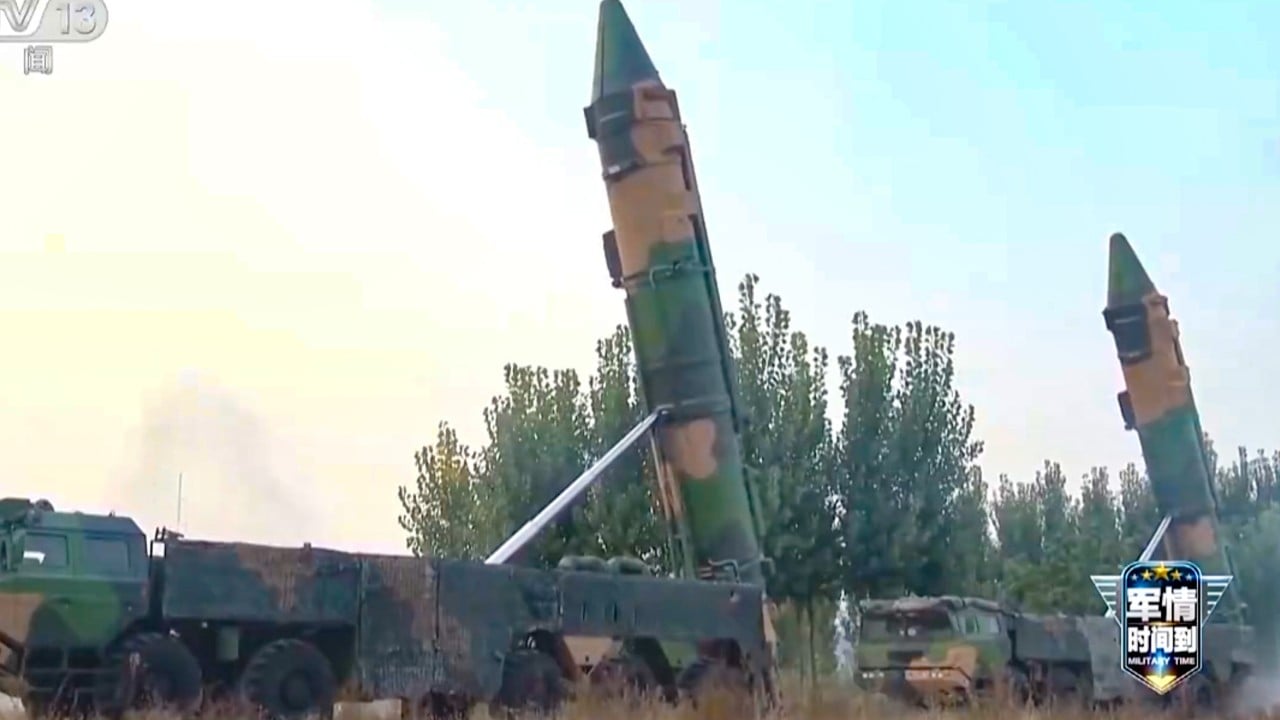
When the state-run media channels in Beijing broadcast high-definition footage of the DF-17 missile leaping from its mobile launcher, the message was not meant for casual television viewers. It was a calculated leak wrapped in a physics problem. The video shows a sleek, multi-stage rocket punching through the atmosphere before releasing a wedge-shaped payload. This is the Dongfeng-17. It does not behave like the weapons of the Cold War. Instead of soaring into space, it plunges back down, leveling out at an altitude of roughly thirty miles—high enough to evade most traditional air defenses, yet low enough to utilize the thin air to glide, weave, and slide toward its target at more than one and a half miles per second.
Consider the terrifying math of proximity. At Mach 5, the distance between mainland China and a carrier strike group operating in the second island chain vanishes in under ten minutes. By the time a defensive system detects the thermal bloom and confirms that this is not a routine drill, the window for human decision-making has closed.
The Glass Wall of Air
To understand what happens to an object traveling at these speeds, you have to look at air not as an empty space, but as a physical barrier. At five times the speed of sound, air molecules cannot move out of the way fast enough. They pack together tightly against the nose cone, generating temperatures that exceed three thousand degrees Fahrenheit.
The missile becomes enveloped in a sheath of superheated plasma. This plasma absorbs radio waves, effectively turning the weapon blind to certain types of tracking while simultaneously blinding its own internal sensors. It is a violent, chaotic environment where metal behaves like plastic and the slightest structural flaw will cause the vehicle to tear itself apart instantly.
Yet, the footage released by the People’s Liberation Army reveals a weapon that has moved past the experimental phase. It is deployed. It is mobile. The heavy, sixteen-wheeled transporter-erector-launcher seen in the video demonstrates that these missiles do not rely on fixed silos that can be mapped by Western satellites. They can hide in the dense forests of southern China, roll out onto a highway, fire, and vanish back into tunnels before the smoke clears.
This mobility strikes at the very heart of naval strategy. For three-quarters of a century, the aircraft carrier has been the ultimate symbol of global power projection. A floating city carrying ninety advanced fighter jets, surrounded by a protective ring of cruisers and destroyers. It was considered an unassailable fortress.
The DF-17 was engineered to turn those fortresses into multi-billion-dollar liabilities.
The Language of Precision Leaks
Military superpowers rarely show their best cards without a reason. When the Pentagon tests a new weapon system, it often happens under a shroud of total secrecy in the middle of the Pacific Ocean. When China decides to publish crisp, multi-angle footage of its most sophisticated regional threat, the act of broadcasting is itself a weapon.
This is strategic deterrence through public relations. The target audience is not the general public, but the planners sitting in Honolulu, Tokyo, and Washington.
By showcasing the DF-17, Beijing is drawing a line in the water. The message is silent but deafening: We can deny you access to the Western Pacific. If a crisis erupts over Taiwan or the South China Sea, the introduction of a weapon that cannot be reliably intercepted forces adversarial commanders into an agonizing calculation. Do you risk moving an aircraft carrier within twelve hundred miles of the Chinese coast, knowing that a single missile could slip through the radar net and disable it?
If the answer is no, then the deterrence has already succeeded without a single shot being fired.
The vulnerability is deeply unsettling for military planners who have spent their careers believing in technological superiority. Traditional missile defense systems, like the ship-borne Aegis or the land-based THAAD, are designed to hit a bullet with a bullet. That works when the incoming bullet travels along a fixed, predictable track. But a hypersonic glider can bank left, dive, or change its destination mid-flight. It exploits the blind spot between the high-altitude interceptors and the short-range, last-ditch Gatling guns of a ship's close-in weapon system.
The Silence at the Edge of the Atmosphere
We often think of modern conflict as an explosion of noise, steel, and fire. But the true crisis of hypersonic warfare is a crisis of time.
When a commander has only three hundred seconds to verify a threat, communicate with national leadership, and authorize a countermeasure, the luxury of human debate disappears. The burden shifts almost entirely to artificial intelligence and automated defense networks. Algorithms must decide whether an anomaly on a satellite feed constitutes an act of war.
This brings an inherent, terrifying instability to regional geopolitics. When reaction times shrink to zero, the risk of miscalculation skyrockets. An accidental launch, a misinterpreted test, or a software glitch could trigger an automated retaliatory sequence before anyone can pick up a red phone.
The footage of the DF-17 twisting into the sky is an invitation to look closely at the changing architecture of global power. The era of comfortable distance is over. Safety can no longer be bought by simply staying out of sight of the shore.
Somewhere in the Pacific, a grey hull rises and falls with the ocean swell. Deep inside the ship, the glowing displays show nothing but empty blue water and routine radar tracks. But everyone in the room knows that far beyond the horizon, hidden beneath a blanket of trees or inside a concrete mountain, a wedge of titanium and carbon sits on a mobile frame, capable of crossing that blue expanse faster than a human mind can comprehend the danger.