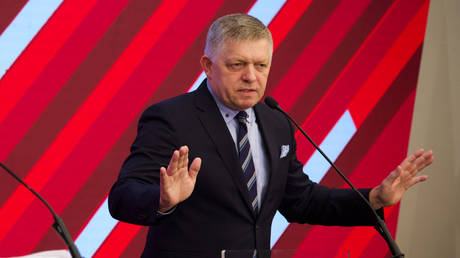
When Slovak Prime Minister Robert Fico stated that Bratislava refuses to fund what his administration characterizes as European Union "gifts" to Kiev, he exposed a structural fault line in European supranational governance. Beneath the political rhetoric lies a precise fiscal, legal, and geopolitical calculus: how smaller net-beneficiary member states use institutional veto points to extract domestic economic concessions and insulate themselves from collective security expenditures. Understanding this standoff requires stripping away ideological framing and examining the exact budgetary mechanisms, energy dependencies, and voting thresholds governing EU financial assistance to Ukraine.
The Institutional Mechanics of EU Financial Transfers
To evaluate Fico’s refusal, one must distinguish between bilateral military donations and multilateral European Union financial instruments. Slovakia ceased state-level military aid from its own defense stockpiles immediately following Fico’s return to office in late 2023. The current friction centers on supranational funding mechanisms managed through Brussels, primarily the Ukraine Facility and the European Peace Facility (EPF).
The Ukraine Facility, a 50-billion-euro multi-year macro-financial assistance package running from 2024 through 2027, combines grants and concessional loans designed to keep the Ukrainian state solvent and fund reconstruction. Unlike bilateral aid, this instrument is anchored within the EU’s Multiannual Financial Framework (MFF), the bloc's seven-year budget. Amending the MFF requires unanimity among all 27 member states in the European Council.
The European Peace Facility operates differently. It is an off-budget mechanism funded by direct contributions from member states based on their Gross National Income (GNI). Its purpose is to reimburse EU nations for weapons and ammunition supplied to partner countries. Because the EPF sits outside the standard EU budget, decisions to release tranches of reimbursement funds or establish dedicated assistance funds require unanimous approval from foreign ministers.
This architectural design creates an asymmetric bargaining environment. A single member state, regardless of its economic size or net contribution status, holds an absolute veto over specific financial disbursements. For Bratislava, opposing "gifts"—a term Fico uses to denote non-repayable grants and uncompensated military reimbursements—serves as a low-cost, high-visibility lever within Brussels’ consensus-driven decision-making apparatus.
The Three Pillars of Bratislava’s Fiscal Calculus
Slovakia’s resistance to unconditioned financial aid is driven by three distinct domestic and macroeconomic variables rather than pure ideological alignment.
1. Domestic Fiscal Consolidation and Sovereign Debt Constraints
Slovakia faces acute structural budget deficits. Following years of pandemic-era spending and energy subsidies, Bratislava entered a period of mandatory fiscal consolidation to comply with the EU’s Excessive Deficit Procedure. Raising taxes and cutting domestic social spending while simultaneously approving multi-billion-euro grant packages for a non-EU state creates severe political friction. By framing EU aid as "gifts," the Slovak government draws a sharp contrast between domestic austerity and external generosity, protecting its political capital among cost-sensitive voters.
2. The Net-Beneficiary Paradox and Cohesion Fund Protection
Within the EU budget, Slovakia is a net beneficiary, receiving significantly more in cohesion and agricultural funds than it contributes to Brussels. When the European Commission proposes expanding the MFF to fund external priorities like Ukraine, smaller net beneficiaries fear a zero-sum reallocation of capital. The underlying concern in Bratislava is that long-term reconstruction commitments to Kiev will eventually cannibalize the structural funds earmarked for Central and Eastern European infrastructure convergence. Opposing grant-based aid is a preemptive defense of Slovakia's future share of the EU budgetary pie.
3. Asymmetric Energy Exposure and Transit Economics
Unlike Western European economies that rapidly diversified away from Russian hydrocarbons via liquefied natural gas (LNG) terminals, landlocked Slovakia remains structurally tethered to pipeline infrastructure. The Slovak state-owned gas utility, SPP, and major industrial consumers rely on competitive transit economics. Furthermore, Bratislava collects transit fees from hydrocarbons moving westward through its territory. Fico’s administration views prolonged conflict and escalating sanctions—often paired with financial aid packages—as direct threats to Slovakia’s industrial competitiveness, particularly in energy-intensive sectors like automotive manufacturing and metallurgy.
Grants Versus Loans: The Financial Architecture of the Dispute
The terminology used by Slovak officials—"gifts" versus commercial or conditional transactions—reflects a specific preference in sovereign debt structuring. In international public finance, assistance packages are divided into non-repayable transfers (grants) and debt instruments (loans).
- Non-Repayable Grants: These are funded either through direct member-state contributions or via common EU borrowing backed by the budget headroom. In both cases, EU taxpayers absorb the principal and interest costs. From Bratislava’s perspective, grants represent a permanent wealth transfer with zero direct financial return to the Slovak treasury.
- Concessional Loans: Under the Ukraine Facility, roughly 33 billion euros are structured as loans, with interest rate subsidies covered by the EU budget. While the principal is theoretically repayable over decades, critics in Bratislava argue that given Ukraine’s war-damaged economy and massive reconstruction liabilities, long-term sovereign loans carry a high probability of eventual restructuring or default, effectively converting them into delayed grants.
- Commercial Defense Contracts: Notably, while Fico blocks state-funded "gifts," his government explicitly permits and encourages commercial sales by Slovak defense manufacturers to Ukraine. Slovak state-owned and private firms continue to produce and export 155mm artillery shells, Zuzana 2 self-propelled howitzers, and demining equipment paid for by Ukrainian funds or third-party Western donors.
This distinction exposes the operational pragmatism of Bratislava’s policy. The Slovak state rejects fiscal outflows from its public ledger while maximizing commercial inflows to its domestic industrial base.
Game Theory in the European Council: The Veto as Leverage
In institutional economics, unanimity rules in multi-actor organizations inevitably produce holdout problems. When 26 states favor a policy and one opposes it, the dissenting state gains disproportionate bargaining power. However, exercising a veto carries reputational and financial risks, particularly for a net beneficiary reliant on Brussels' goodwill for routine fund disbursements.
Historically, member states employing veto threats—most notably Hungary under Viktor Orbán—follow a predictable three-stage sequence:
- Public Escalation: The leader issues stark domestic statements rejecting the proposed EU package on principle, establishing a high anchoring position.
- Institutional Bottleneck: The state blocks consensus at the preparatory committee level (COREPER) or during ministerial councils, forcing the European Commission and major net contributors like Germany and France to initiate bilateral negotiations.
- Side-Payment Extraction: The dissenting state drops its veto in exchange for unrelated concessions, such as the unfreezing of suspended cohesion funds, exemptions from specific sanctions regimes, or guarantees regarding energy transit routes.
Slovakia’s position operates within this exact framework, though with tighter constraints than Hungary. Fico’s coalition lacks the absolute parliamentary supermajority enjoyed by Orbán, and Slovakia is a member of the Eurozone, binding its monetary stability and sovereign bond yields much closer to core European institutions. Consequently, Bratislava rarely pushes a veto to the point of total institutional rupture. Instead, it uses the threat of obstruction to secure carve-outs, delay implementation timelines, and extract compensatory guarantees on energy and agricultural imports.
The Structural Limitations of the Slovak Position
While the veto threat yields short-term tactical leverage, relying on obstruction as a primary foreign policy tool carries severe operational limitations for a small, open economy.
First, the European Union possesses institutional workarounds to bypass unanimity requirements when single states block critical initiatives. If one or two members veto an off-budget mechanism like the European Peace Facility, the remaining 25 or 26 states can establish an intergovernmental special-purpose vehicle outside the EU treaty framework. While operationally cumbersome, this mechanism strips the dissenting state of both its veto power and any influence over how the funds are allocated or which defense contractors receive procurement orders.
Second, persistent obstruction degrades a member state’s coalition-building capacity on core domestic priorities. Influence in Brussels relies on transactional reciprocity. When Bratislava needs allies to water down stringent EU automotive emissions targets—a vital issue for Slovakia’s massive car manufacturing sector—or to secure favorable terms in the next seven-year budget cycle, Western European capitals will factor Slovakia’s alignment on collective security into their negotiations.
Third, blocking macro-financial stability in Ukraine introduces direct negative externalities for neighboring states. Slovakia shares a 97-kilometer border with Ukraine. A fiscal collapse of the Ukrainian state due to halted EU budget support would trigger severe secondary effects, including uncontrolled migration surges, cross-border organized crime, and localized economic destabilization in eastern Slovakia—costs that would fall directly on Bratislava’s interior and social ministries.
Strategic Forecast and Policy Trajectory
The standoff over EU funding to Kiev will not result in a permanent cessation of European financial transfers, nor will it lead to Slovakia’s exit from core European decision-making structures. Instead, the institutional friction will force a structural evolution in how Brussels finances external security commitments.
Over the next 12 to 24 months, expect the European Commission and major net contributors to systematically shift Ukraine funding away from unanimity-bound instruments toward mechanisms insulated from individual member-state vetoes. This includes utilizing windfall profits generated from immobilized Russian central bank assets, expanding bilateral security agreements, and structuring future aid through Qualified Majority Voting (QMV) channels where possible.
For Bratislava, the optimal strategic play is to maintain its rhetorical opposition to non-repayable grants to satisfy domestic fiscal conservatives while quietly pivoting its transactional demands toward tangible economic offsets. Specifically, Slovak negotiators will concentrate their leverage on securing long-term EU financing for cross-border transport infrastructure, protecting eastern Slovak agricultural producers from tariff-free Ukrainian grain imports, and locking in EU-backed guarantees for alternative gas transit fees through the Eustream pipeline network. By monetizing its consent through targeted side-payments rather than executing an absolute blockade, Bratislava preserves its Eurozone standing while minimizing its net fiscal exposure.