The stadium lights of Arthur Ashe or Centre Court at Wimbledon have a specific, predatory hum. Underneath those lights, you either conquer your doubts or they swallow you whole. For decades, we watched a young woman from Long Beach, California, walk into those gladiatorial arenas and systematically dismantle every barrier placed in front of her. She possessed a fierce, baseline-to-net urgency that redefined modern athletics. We thought we knew the full scope of her victories. We counted the Grand Slams. We memorized the Battle of the Sexes in 1973.
We were wrong.
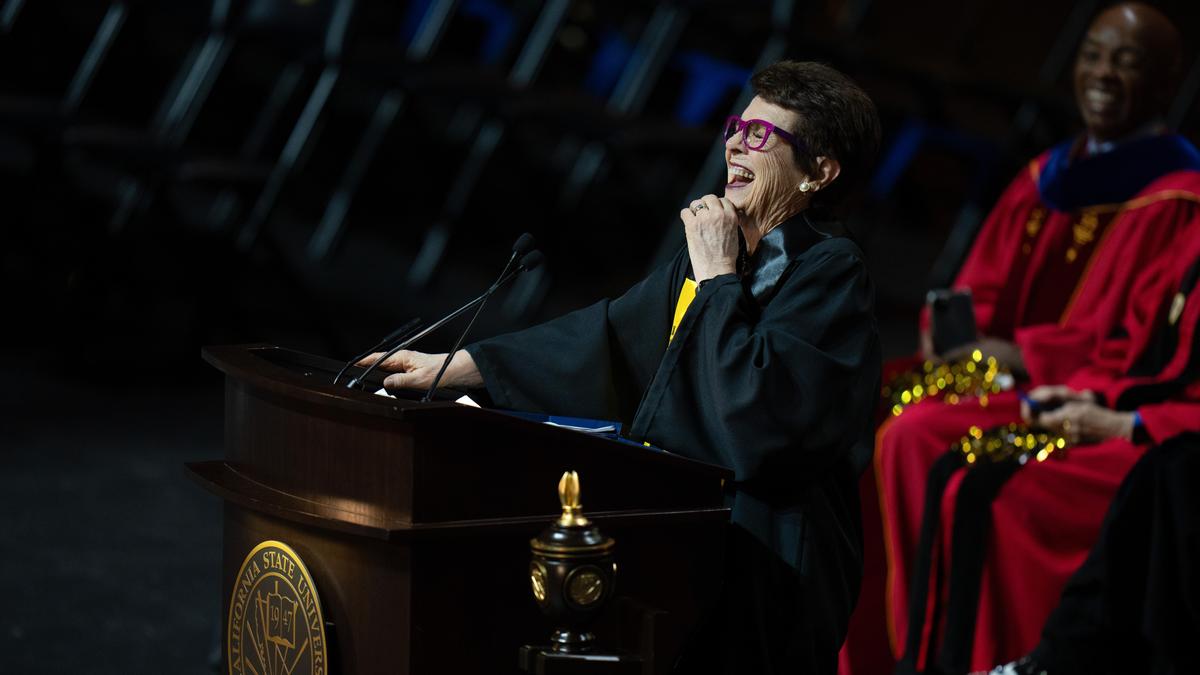
The most profound victory of her life did not happen on grass or clay. It did not involve a racquet, and there was no opponent standing across a net trying to break her serve. It happened quietly, inside the brick-and-mortar halls of California State University, Los Angeles. At eighty-two years old, Billie Jean King finally finished what she started before the world claimed her. She graduated.
To understand why this matters, you have to look past the bronze statues and the lifetime achievement awards. You have to look at the girl who existed before the icon.
In 1961, the institution was known as Los Angeles State College. A teenage Billie Jean Moffitt enrolled as a history major. She was already a phenomenon on the courts, but amateur tennis in the early sixties was not the multi-million-dollar empire it is today. It was a sport of polite nods, strict country club rules, and severe financial limitations, especially for women. She worked two jobs while trying to maintain her studies and her training. She scraped by, earning eleven dollars a week sorting playground equipment for the Los Angeles Parks and Recreation Department.
Imagine the sheer physical exhaustion. Picture a young woman running from a morning history lecture to a grueling afternoon practice session, her muscles burning, her mind racing with dates of treaties and geopolitical shifts, only to spend her evenings counting tennis balls and patching nets just to pay for her tuition.
Then, the world intervened.
Her talent was too massive for the confines of a standard semester. The international tennis circuit called. Wimbledon demanded her presence. The demands of a burgeoning historic career clashed violently with the rigid schedule of higher education. The textbooks were shelved. The notebooks were packed away into a closet. She left college to change the world.
She succeeded, spectacularly. She won thirty-nine Grand Slam titles across singles, doubles, and mixed doubles. She stared down Bobby Riggs in front of ninety million television viewers and delivered a masterclass in poise and precision, proving that women could handle pressure just as well as, if not better than, any man. She founded the Women's Tennis Association. She fought for equal pay, dragging a reluctant sporting establishment into a future where women were treated as professionals rather than novelties.
By any conventional metric, her education was complete. She had educated the global public on equality. She had written chapters of cultural history with her own hands.
Yet, an unfulfilled promise can linger in the back of a mind like a persistent, low-grade fever.
There is a distinct vulnerability in returning to a goal left abandoned decades prior. Most people who achieve global fame allow their past unfinished business to dissolve into the background. They hide behind honorary doctorates. It is easy to accept a ceremonial robe, wave to a crowd, and give a commencement speech filled with platitudes about lifelong learning. It is an entirely different matter to actually look at an transcript from 1964 and say, "I want to finish the work."
The return was not a publicity stunt. It was a reckoning with a personal narrative.
When we look at the statistics of adult education, the numbers tell a story of systemic hesitation. Millions of people walk away from degrees due to financial hardship, family obligations, or sudden shifts in career trajectories. The shame of the unfinished degree is a quiet burden carried by many. The common perception is that education belongs strictly to the young, a structured rite of passage confined to the late teens and early twenties. After that window closes, society whispers that it is too late, that the brain loses its elasticity, or that the effort is redundant once a career is already established.
King shattered that script.
She did not return to school because she needed a degree to build a resume. She did not need it to impress a hiring manager or secure a promotion. She did it for the purest, most terrifying reason imaginable: she wanted to prove to herself that she could.
The process required navigating a modern academic environment that looked vastly different from the one she left behind in the mid-sixties. The digital shift alone can be a daunting wall for an octogenarian. The libraries of her youth relied on card catalogs, physical encyclopedias, and the smell of aging paper. Today, research is a landscape of online databases, digital portals, and algorithmic searches. The tools had changed, but the fundamental human drive to comprehend the world remained identical.
Consider the psychological weight of that classroom dynamic. She was not just an ordinary student; she was a living historical figure sitting among peers who were young enough to be her great-grandchildren. Her own name appears in modern history textbooks. Yet, there she was, engaging with the material not as a monument, but as a participant.
This is where the true essence of her legacy crystallizes.
We often view heroes as static entities. We freeze them in the moments of their greatest triumphs. We want Billie Jean King to eternally remain twenty-nine years old, arms raised in victory on the Houston Astrodome court, wearing that iconic blue and white dress. We want our legends to stay safely captured in the archival footage, flawless and untouchable.
But humans do not live in archival footage. They age. Their joints stiffen. The roar of the stadium crowd eventually fades into the quiet routine of daily life. The real test of greatness is not how you perform when ninety million people are watching, but what you choose to do when the cameras are off and you are facing the uncompleted parts of your own soul.
Her graduation from Cal State LA with a Bachelor of Arts in History is a masterclass in human resilience. It redefines our cultural understanding of aging. We live in a society that frequently dismisses the elderly, treating the later decades of life as a period of inevitable decline and passive waiting. We relegate our seniors to the sidelines, assuming their stories have already been written and all that remains is the editing.
King rejected the sidelines. She approached her eighties with the same aggressive, baseline-hunting mentality that made her the terror of the court.
Think about the message this sends to anyone who has ever abandoned a dream because they felt the clock had run out. Think of the sixty-year-old who wants to learn an instrument, the forty-five-year-old considering a complete career pivot, or the thirty-year-old sitting on a half-written novel. The excuse of "I am too old" loses all validity when a woman who changed the cultural fabric of the twentieth century decides she still needs to finish her homework.
The diploma she received is more than a piece of parchment. It is a symbol of completeness. It represents the closing of a circle that remained open for sixty-one years. It proves that the pursuit of knowledge does not have an expiration date, and that true champions do not leave unfinished business behind.
On the day she finally wore the cap and gown, she was not just representing her younger self, the exhausted girl working the playground shift for eleven dollars a week. She was representing every person who ever had to pause their dreams to handle the immediate, pressing realities of survival.
The stadium lights are long gone, replaced by the warm, steady glow of an academic hall. The applause this time was different. It wasn’t for an ace or a cross-court volley. It was for a lifetime of refusing to let the world dictate when a story is over.
She walked across that stage not as an aging icon looking backward at her glory days, but as a student graduating into her next chapter. The lesson she delivered was silent, profound, and absolute.
The match isn't over until you decide to walk off the court.