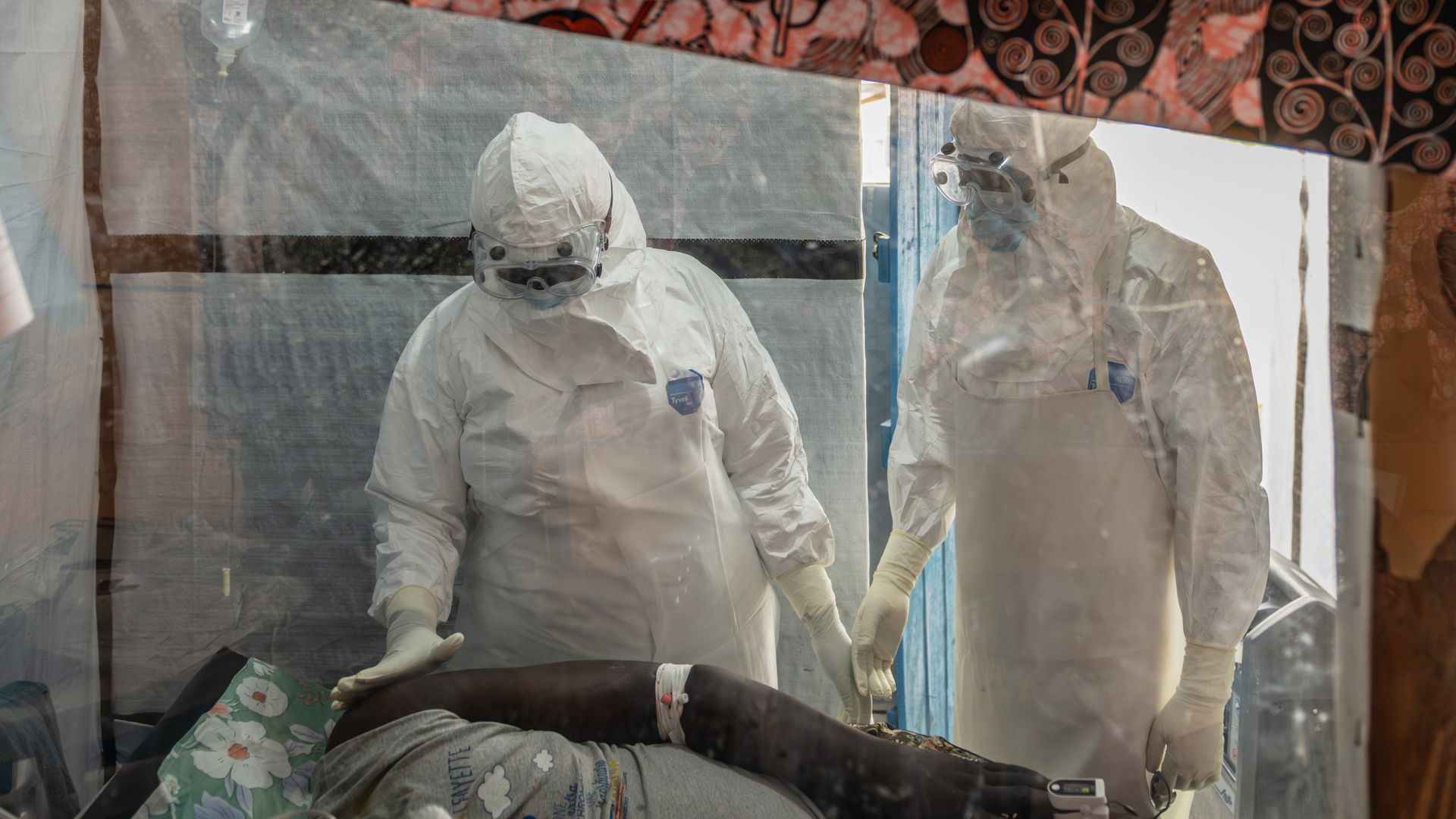
The heat inside a plastic biosafety suit does not circulate. It traps. Within ten minutes of zipping up, the air turns soup-thick, heavy with the scent of your own breath and the sharp, chemical sting of chlorine. Sweat runs down your forehead, pools in your goggles, and blurs your vision. You cannot wipe it away. To touch your face is to risk everything.
For seventeen men and women in the Democratic Republic of the Congo, that stifling, claustrophobic air was among the last things they experienced. They were not patients. They were the people who stood between the living and the dying. Doctors, nurses, and laboratory technicians who understood exactly how Ebola destroys a human body from the inside out, yet walked into the isolation wards anyway.
They lost their lives to a virus that measures just eighty nanometers in width.
When an outbreak hits, we tend to look at numbers. We track curves, calculate mortality rates, and map geographic vectors. But statistics do not bleed. They do not leave behind empty desks or hollowed-out clinics. To understand the true weight of the current crisis in the DRC, you have to look at the points where the system fractured—at the bedside, where the thin barrier between safety and infection finally gave way.
The Cost of Care
Ebola is uniquely cruel to those who try to treat it. Unlike airborne pathogens that can be blocked by standard masks, this filovirus demands absolute perfection from healthcare workers. It spreads through direct contact with bodily fluids. A single drop of sweat, vomit, or blood carried on an improperly removed glove is enough to pass the death sentence.
Imagine a rural clinic under the midday sun. Resources are scarce. The electricity flickers. A nurse, exhausted after a fourteen-hour shift, reaches up to adjust a fogged pair of goggles. It is a completely unconscious, deeply human gesture. In that half-second of fatigue, the virus finds its window.
The loss of seventeen medical professionals is not just a tragedy for seventeen families; it is a catastrophic blow to the region’s entire healthcare infrastructure. In parts of North Kivu and Equateur provinces, a single doctor might be responsible for tens of thousands of lives. When that doctor dies, the clinic closes. The surrounding villages lose their only defense against malaria, typhoid, and complicated births. The ripple effect of a single caregiver's death can devastate a community for a generation.
This is the invisible math of an epidemic. The virus kills by direct infection, but it also kills by creating medical vacuums.
A Knock at the Border
As the local healthcare system reeled from these losses, a charter flight touched down on the tarmac in Kinshasa. On board was a specialized medical team sent by the Chinese government. They arrived carrying crates of personal protective equipment, thermal scanners, and antiviral supplies.
International aid during an epidemic is often viewed through a lens of cold geopolitics. Critics analyze trade agreements and diplomatic leverage. But on the ground, the arrival of foreign medical teams feels entirely different. It is a logistical lifeline tossed to a drowning frontline.
The incoming team brings something that money alone cannot buy: recent, institutional memory of high-consequence pathogen containment. China’s medical infrastructure has spent decades refining its response to viral outbreaks, dating back to the original SARS crisis and reinforced by extensive field experience during the 2014 West African Ebola epidemic. They understand the grueling discipline required to maintain a sterile field in a tropical climate.
Yet, foreign intervention introduces its own complex friction.
A medical team cannot simply parachute into a crisis zone and expect to solve it with superior technology. In the DRC, the enemy isn't just the virus; it is deep-seated community mistrust. Decades of conflict, exploitation, and broken promises from the outside world have left local populations deeply suspicious of figures arriving in white biohazard suits. When stranger-scientists show up speaking foreign languages, rumors spread. Families hide their sick relatives. They bury their dead in secret, bypassing the safe burial protocols that are vital to halting transmission.
The Chinese team faces a challenge that cannot be solved in a laboratory. They must integrate with local Congolese health workers who are grieving their fallen colleagues. They have to listen before they can treat.
The Vulnerability of the Frontline
We often call healthcare workers "heroes," a term that feels noble but carries a hidden danger. When we turn people into heroes, we forget that they are made of flesh and bone. We forget that they get tired, that they feel terror, and that they need the proper tools to survive.
True safety in an isolation ward requires an intricate, multi-layered ritual. Putting on the gear—donning—takes twenty minutes of deliberate, checked steps. Taking it off—doffing—is even more perilous. A trained observer must watch every movement, spraying the worker with chlorine water at each stage. You peel the outer gloves inside out. You step out of the chemical boots. Every motion must be slow, deliberate, and perfect.
When a clinic is overwhelmed with patients screaming for help, maintaining that agonizingly slow pace is an act of supreme psychological willpower.
The seventeen workers who died were likely masters of this ritual. But human beings are not machines. Fatigue degrades cognitive function. Chronic stress narrows focus. When a healthcare system is underfunded and understaffed, perfection becomes an unsustainable expectation.
The arrival of international reinforcements helps redistribute this crushing weight. It allows local nurses to sleep. It replaces torn suits and supplies reliable electricity to run diagnostic equipment, cutting down the time it takes to confirm a case from days to hours.
Beyond the Horizon
The fight in the DRC is far from over. The virus will continue to seek out weak points in the perimeter, searching for the unwashed hand, the torn glove, or the unmonitored burial.
The true measure of the global response will not be found in the press releases issued from Beijing or Geneva. It will be found in whether a nurse in a remote provincial clinic can count on a steady supply of clean gloves tomorrow morning. It will be found in whether the families of the seventeen fallen workers receive the support they need to survive the absence of their providers.
Epidemics end when the chain of transmission is broken. Sometimes that break happens through a vaccine, sometimes through strict quarantine. But most often, it happens because human beings continue to put on the heavy suits, walk into the stifling heat, and reach across the biohazard barrier to hold a patient's hand.
Inside the isolation zone, the world shrinks down to the space between two people. The foreign doctor and the local nurse stand side by side, their faces hidden behind identical layers of plastic and glass, speaking in nods and hand gestures over the constant hum of the decontamination sprayers. They work in the shadow of those who came before them, entirely aware of the stakes, watching each other's hands for the slightest tear in the latex.