The thumb scrolls. It is a reflex of the modern age, a mindless sedation for a Tuesday morning. Ronaldo Salgado was doing what millions do, looking at a screen, waiting for the day to sharpen into focus. Then the algorithm delivered a video that made the world stop spinning.
The footage was raw, shot through a car window by a passerby on her way to drop her son off at summer school. It showed a street in Magnolia Park, a historic Latino neighborhood in Houston. It showed an unmarked black vehicle angled sharply against a white construction van. Doors flung wide. On the pavement lay a man, handcuffed, face down, bleeding into the concrete. His leg was shaking. A low, agonizing groan vibrated through the speaker of Ronaldo’s phone.
Ronaldo stared at the white van. He stared at the boots of the federal agents standing over the body. He stared at three other men lined up in zip-ties nearby.
The man groaning on the ground was his father.
Lorenzo Salgado Araujo was fifty-two years old. He had lived in the United States for nearly thirty-five years, building a life out of sheetrock, concrete, and sweat. He had no criminal record in the state of Texas. On this particular morning, at 6:30 a.m., he had done what he always did: climbed into his work van to pick up his crew—including his brother—to head to a construction site.
He never made it past the barbershop on the corner.
By the time Ronaldo realized what he was looking at, his father was already dying in a hospital bed from a gunshot wound to the abdomen. His uncle and two other co-workers had been packed into the back of government vehicles, vanished into a federal detention apparatus that has yet to let them speak.
The official statement from Immigration and Customs Enforcement arrived with the standard, clinical rhythm of bureaucracy. The agency did not name a human being; they identified a "Mexican national" and an "illegal alien" who was the subject of a "targeted enforcement operation." According to ICE, Lorenzo weaponized his vehicle, attempting to ram an officer after ignoring multiple verbal commands. The agent, they claimed, fired in self-defense.
But for those who know the history of these streets, the script sounds entirely too familiar.
Consider what happens when the cameras are turned around. Just months earlier, federal immigration authorities insisted that a woman in Minneapolis had tried to run them down before they shot her in the head. Local witnesses and video later proved she was simply trying to drive away from unmarked cars. In another case, assault charges against an immigrant were quietly dropped after text messages and bystander footage revealed the government’s initial story was a fabrication.
We are asked to believe that a fifty-two-year-old family man, with three children, a wife, and a clean record, suddenly decided to use a work van to assault heavily armed federal agents in unmarked vehicles. We are asked to believe this even though the government has released no dashcam footage, no bodycam video, and no photos of the alleged damage to their vehicles.
The reality of immigration enforcement in America has mutated. It is no longer just a matter of borders and checkpoints; it is an unpredictable force that materializes on quiet residential streets as families are waking up. Massive congressional funding has fueled a sudden surge in enforcement, resulting in thousands of arrests over a matter of days. Magnolia Park, a neighborhood that has celebrated Día de Los Muertos for a century, became a tactical zone before the sun was fully up.
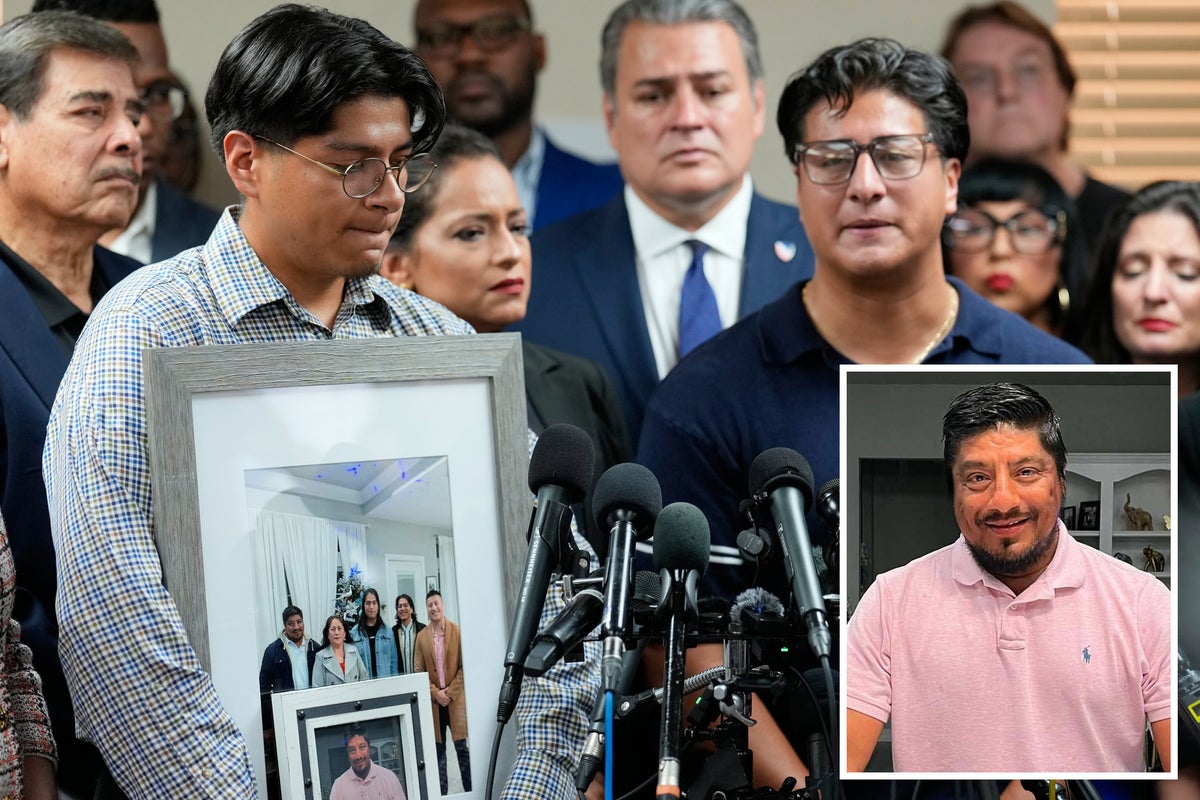
"My father did not deserve this," Ronaldo wrote in a public post, his grief laid bare for the world to see. "He was on his way to work."
The League of United Latin American Citizens has since stepped in, offering a reward for any local business surveillance or bystander video. They are begging witnesses not to turn their footage over to federal investigators, fearing it will disappear into the black hole of an internal review. The FBI has sent an evidence team, but only to investigate a potential assault on an officer—not the killing of the man on the pavement.
The neighborhood is quiet now, save for a small group of protestors gathering near the meat market and the psychic shop where the blood dried on the asphalt. They chant into the humid Houston air, their voices a mixture of anger and exhaustion.
A son is left to mourn a father he discovered through a viral video. A family is left wondering where an uncle is being held. And a community is left with the chilling realization that a routine morning commute can turn fatal in the blink of an eye, leaving nothing behind but a 15-second clip on a social media feed and a family trying to prove that a hardworking man feared for his life.