Stop Praising Ferdinand Cheval's Loneliness
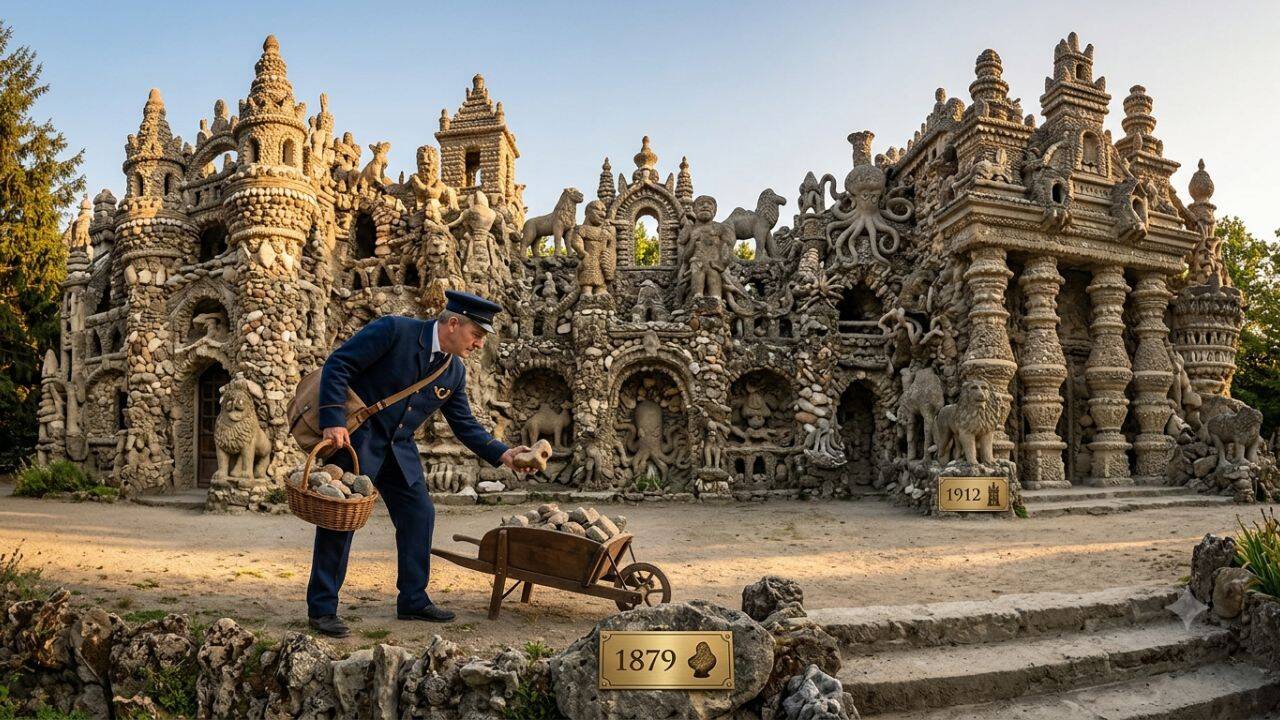
For over a century, art historians, tourists, and romantic idealists have fawned over the Palais Idéal. They swoon over the narrative: a humble French postman stumbles over a funny-looking rock in Hauterives in 1879, gets hit by a lightning bolt of divine inspiration, and spends 33 years filling a wheelbarrow with stones to build a naïve architectural wonder.
It is sold to us as the ultimate triumph of the human spirit. An outsider artist overcoming poverty and lack of formal education to create something immortal.
That narrative is entirely wrong.
What Ferdinand Cheval actually built was a monument to unmitigated, hyper-individualistic hubris. Society’s obsession with his story reveals a grotesque cultural fetish: we love praising solitary, exhausting suffering because it allows us to ignore the far more difficult art of building community. We exalt the lone genius straining under a sack of rocks, yet we overlook the reality that his grand achievement was fundamentally an exercise in deep personal alienation.
The Fetishization of Outsider Isolation
Let's strip away the postcard romanticism and look at the actual mechanics of what took place in Hauterives between 1879 and 1912.
Cheval walked roughly 30 kilometers a day on his mail route. On top of that physical toll, he spent hours dragging heavy limestone, molasse, and tufa back to his garden. He worked by candle lantern. He worked through freeze and thaw. He ignored local skepticism and carved out decades of his finite life to assemble a grotesque hybrid of Hindu temples, Christian cathedrals, medieval castles, and organic grottos.
Conventional View:  Obsession -> Isolation -> Genius Masterpiece
The Reality:        Isolation -> Self-Indulgence -> Architectural Monologue
In the art world, this gets stamped with the cozy label "Outsider Art" or Art Brut. The moment you slap that label on something, critical thinking stops. We are instructed to gasp in awe at the sheer endurance required to build it.
I have spent years watching cultural commentators fall into this exact trap across every creative discipline. They mistake endurance for brilliance. They confuse relentless stubbornness with depth.
Cheval wasn't engaging in a dialogue with his environment or his peers. He was running a 33-year monologue. True architecture is an act of civic dialogue—it considers human movement, utility, shelter, and communal purpose. Cheval’s palace accommodates none of these. It is hollow. It is uninhabitable. It is a stone manifestation of a man who decided that his internal obsession was worth more than his relationship with the living world around him.
The Economic Myth of the "Free" DIY Masterpiece
Look at the way media outlets write about Cheval today. They focus entirely on the zero-dollar price tag of his raw materials. Look, he used stones from the side of the road! He used wire and cement bought with pennies!
This is the original "hustle culture" myth, repackaged for history buffs.
Calculated in real terms, the Palais Idéal was astronomically expensive. It cost thousands of hours of unrecoverable human capital. Cheval sacrificed family life, community integration, and physical health to haul stones. His personal life was littered with tragedy—he lost two wives and two children during his lifetime. While it would be unfair to directly blame his obsession for these deaths, his journal entries reveal a man whose psychological real estate was overwhelmingly occupied by stone and mortar rather than the living, breathing humans in his home.
+-----------------------------------------------------------------------+
|                       THE TRUE COST OF THE PALACE                     |
+-----------------------------------------------------------------------+
|  Visible Cost:   Zero-dollar raw materials, local stones, wire       |
|  Hidden Cost:    33 years of complete civic withdrawal                |
|                  Permanent physical damage from micro-trauma          |
|                  Zero functional or communal utility                  |
+-----------------------------------------------------------------------+
When you examine the mechanics of long-term solo projects, you realize that total self-reliance is almost always a net negative for the creator's broader environment.
Why the "DIY Outsider" Model Fails
- Zero Feedback Loops: Without collaborators, bad ideas are never filtered out. The Palais Idéal is a chaotic mashup of styles because nobody was there to say, "Ferdinand, this wall makes no structural or aesthetic sense."
- Resource Misallocation: Decades of manual labor spent on a non-functional sculpture could have yielded real, transformative infrastructure for a struggling rural community.
- Romanticizing Burnout: Celebrating a man who worked 18-hour days until he was nearly 80 normalizes the toxic idea that self-destruction is the price of creative validity.
The Architectural Reality: Sublime Vision or Naïve Clutter?
When André Breton and the Surrealists "discovered" Cheval in the 1930s, they turned him into a martyr for automatic creation. Breton praised the palace as the purest expression of surrealist architecture. Max Ernst loved it. Pablo Picasso visited it.
The Surrealists were hypocrites. They were elite Parisian intellectuals playing at raw, unrefined passion. They loved Cheval because he represented the "noble savage" of the art world—a man who worked without intellectual pretense. They fetishized his lack of education because it made their own dense theory feel grounded by comparison.
Strip away the Surrealist endorsement, and what are you left with?
You are left with a massive, structurally questionable block of reinforced concrete and porous stone that requires constant, expensive restoration just to prevent it from melting back into the soil.
SURREALIST CLAIM:                      STRUCTURAL REALITY:
"A spontaneous flood of pure visual"    A chaotic collage of incoherent styles
"unconscious poetry in stone."          held together by unstable early cement.
The concrete Cheval used was primitive. Water ingress has been an ongoing nightmare for French heritage authorities since André Malraux declared it a protected landmark in 1969. The site requires continuous climate monitoring, chemical stabilization, and precise physical interventions just to keep the postman's dream from collapsing under its own weight.
We are spending millions today to preserve an object whose sole origin was one man's absolute refusal to cooperate with anyone else.
"People Also Ask": Dismantling the Common Myths
When people research Ferdinand Cheval, they ask the same surface-level questions, expecting inspiring, Hallmark-card answers. The truth is far colder.
"Was Postman Cheval a genius or just crazy?"
This is a false dichotomy. Framing the debate between "genius" and "insanity" lets us avoid examining his actual behavior. Cheval was neither a madman nor a hidden visionary; he was an obsessive neurotic with a high pain tolerance and a massive ego. He left extensive writings on his own monument, carving sentences directly into the stone like: "1879-1912: 10,000 days, 93,000 hours, 33 years of struggle. Let those who think they can do better try."
That is not the signature of a humble, eccentric artisan. That is the signature of a man obsessed with his legacy, desperate to prove his superiority over his neighbors.
"How did he build it without modern technology?"
He used a wheelbarrow, a basket, basic mason tools, and sheer, bone-grinding repetition. But asking how he built it obscures the far more important question: Why do we venerate manual labor when it produces no practical utility? If a modern individual spent 33 years digging a 500-foot hole in their backyard using a spoon, we wouldn’t declare them a genius. We would stage an intervention.
"Is the Palais Idéal worth visiting?"
Only if you treat it as a warning rather than a shrine. Go to see what happens when a human life is completely consumed by a singular, unyielding fixation. Do not go to be inspired to abandon your friends, family, and community to build your own personal monument.
The Ultimate Trap of the Lone Pioneer
We live in a culture that still desperately wants to believe in the lone genius. We see it in tech, where we celebrate single founders while ignoring the thousands of engineers beneath them. We see it in writing, in art, and in architecture.
The story of Ferdinand Cheval is the ultimate comfort food for this delusion. It tells us that you don't need a team. You don't need money. You don't need training. You just need a wheelbarrow and an unshakeable belief that your internal landscape is so important that the world needs to see it stamped onto stone.
It is a lie.
The greatest achievements of human civilization—from the aqueducts of Rome to the Apollo program—were not built by solitary obsessives hoarding rocks in a basket. They were built through synthesis, compromise, shared vision, and organized labor. They were built for people to use, live in, and thrive around.
Cheval’s palace is an impressive artifact of human stamina, but stamina is not wisdom. The Palais Idéal is a tomb for 33 years of a man's life, holding nothing inside it except the echo of his own voice.
Stop building monuments to your own isolation. Put down the wheelbarrow. Go talk to your neighbors.