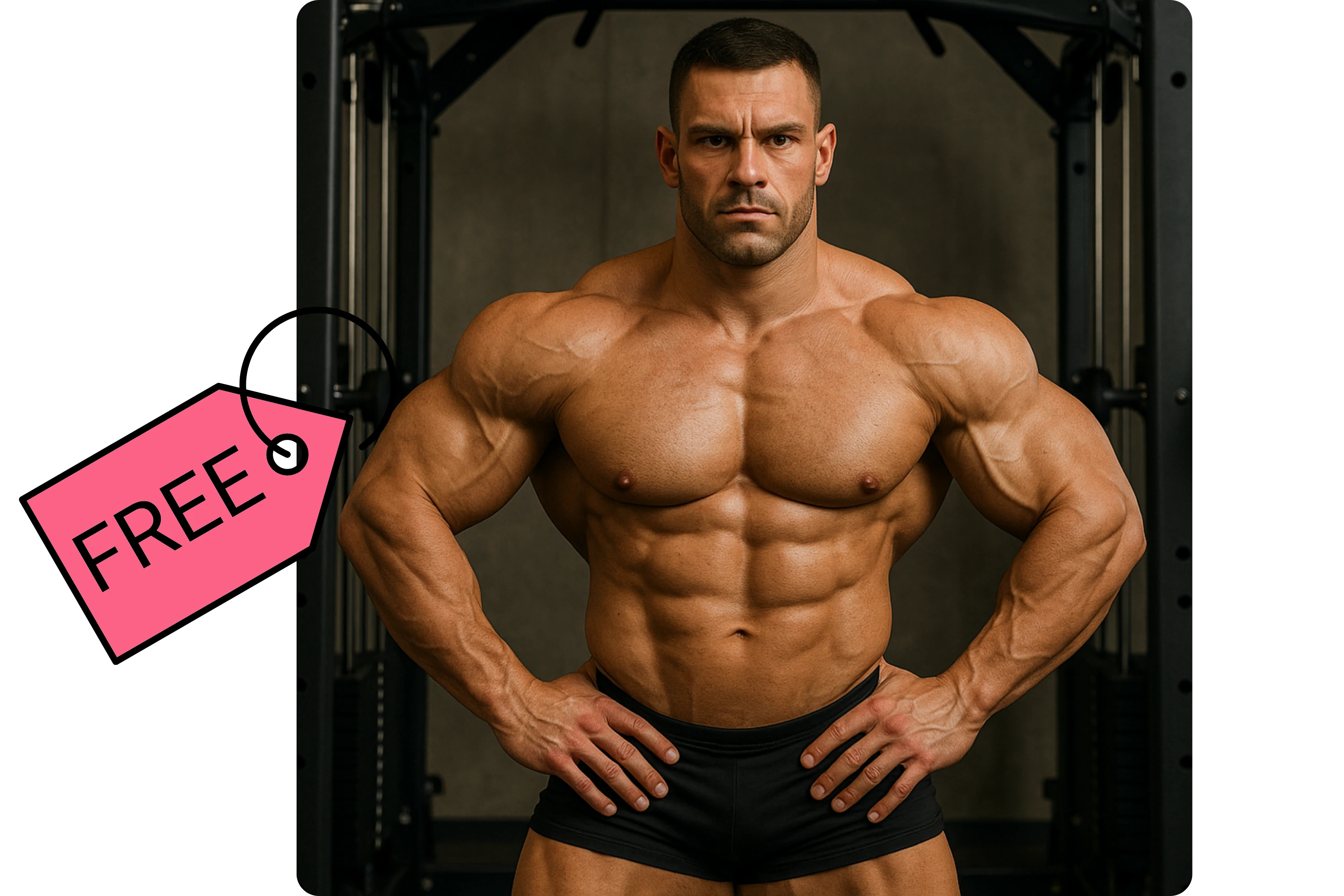
Let’s be real for a second. If you’ve ever tried to generate female bodybuilder AI art, you probably ended up with something that looks... off. Maybe the muscles look like inflated balloons, or the skin texture feels like shiny plastic, or—the classic AI blunder—the hands have seven fingers clutching a barbell that defies the laws of physics. It’s frustrating. You want the aesthetic of peak physical condition, the vascularity, the "dry" look of a competition-ready physique, but the models like Midjourney or Stable Diffusion often give you a weirdly smoothed-over version of reality.
Or worse. They give you something hyper-sexualized that ignores the actual anatomy of a professional athlete.
The truth is that AI struggle with niche aesthetics. It knows what a "muscular woman" looks like in a general sense because it has seen thousands of photos from the IFBB Pro league and fitness influencers. But it doesn't intuitively understand the difference between a Figure competitor, a Physique athlete, and a true heavyweight Bodybuilder. To the AI, it’s all just "muscles." If you want quality, you have to guide it with a surgeon's precision.
The Data Bias Problem in Female Bodybuilder AI Art
Training sets are biased. That isn't a political statement; it’s a technical reality of how Large Language Models (LLMs) and diffusion models work. Most images tagged with "strong woman" in the massive datasets used to train these models are actually of fitness models or cross-fitters. They aren't mass monsters.
When you prompt for female bodybuilder AI art, the machine is pulling from a skewed pool of data.
This leads to a "uncanny valley" effect. You get a face that looks like a supermodel pasted onto a body that doesn't quite match the skeletal structure. Real female bodybuilders, especially those in the "Wings of Strength" circles like Andrea Shaw or Margie Martin, have specific muscle insertions and traps that AI frequently interprets as "male" traits, leading the AI to accidentally masculinize the jawline or chest beyond what the user actually asked for. It’s a tug-of-war between the prompt and the training data.
Why Anatomy is the Ultimate Boss Battle
Diffusion models don't "know" anatomy. They predict where pixels should go based on probability. This is why a lat spread often looks like wings growing out of the ribs rather than a functional muscle group.
In professional bodybuilding, the "V-taper" is everything. AI usually gets the wide shoulders right because that's a high-contrast feature. But it fails miserably at the lower lats and the "sweep" of the quads. If you're looking for realism, you’ll notice the AI often misses the separation between the vastus lateralis and the rectus femoris. To a casual observer, it looks fine. To a fan of the sport, it looks like a mess of skin-colored clay.
How to Actually Get Results
Stop using the word "muscular." It’s too vague.
If you want to create high-tier female bodybuilder AI art, you need to speak the language of the sport. Use terms like "striated," "vascular," "dry," and "granularity." Tell the AI about the lighting. Hard overhead lighting (the kind you see at the Arnold Classic) creates shadows that define the muscle. If you don't specify the lighting, the AI defaults to "soft studio lighting," which flattens all that hard-earned muscle detail you’re trying to generate.
Specifics matter. Mentioning "peak biceps" or "teardrop quads" helps the model focus on those specific areas.
Kinda weird, right? You have to be a part-time kinesiologist just to get a decent image. But that’s the state of the art in 2026. Models like Stable Diffusion XL or the newer Flux iterations are getting better at following complex anatomical prompts, but they still need a human in the driver's seat to correct the "weirdness."
The Role of LoRAs and Fine-Tuning
For the real power users, base models aren't enough. Most of the high-quality female bodybuilder AI art you see on platforms like Civitai or DeviantArt isn't made with a simple prompt. It’s made using LoRAs (Low-Rank Adaptation). These are tiny "add-on" files trained on very specific datasets—in this case, thousands of photos of actual female bodybuilders from different eras.
- 80s/90s Era: Think Corinna Everson or Lenda Murray. The look was more "feminine aesthetic" with significant mass.
- Modern Era: More mass, more "freak factor," and extreme conditioning.
- Fantasy/Amazonian: This is where AI usually shines, blending realism with stylized proportions.
Using a LoRA allows you to bypass the generic "fitness" look and force the AI to respect the density of a pro bodybuilder’s physique. It’s the difference between a sketch and a photograph.
Ethical Waters and the "Deepfake" Dilemma
We have to talk about the elephant in the room. A huge portion of the AI art community is obsessed with generating images of real-life athletes. This is where it gets murky.
While generating a generic "female bodybuilder" is harmless fun or a creative exercise, using the names of actual IFBB pros to train models or generate content raises massive consent issues. Most platforms are cracking down on this. If you’re a creator, it’s honestly better to focus on "original characters." Not only does it keep you out of legal hot water, but it also allows for more creative freedom. You aren't limited by the physical realities of a specific person.
The bodybuilding community has always been about pushing boundaries. AI art is just the latest tool for that, but it needs to be used with a bit of respect for the athletes who actually put in the years of grueling work to build those bodies.
The Technical Stack: What Works Now
If you’re serious about this, Midjourney is the "easy mode." It produces beautiful, artistic results but lacks precise control. If a leg is missing a calf muscle, you're stuck with it.
Stable Diffusion (especially when run locally) is the "pro mode." You can use "Inpainting" to fix a specific bicep or "ControlNet" to pose the character exactly like a classic front double-bicep pose. Honestly, if you aren't using ControlNet, you're just gambling. You're throwing dice and hoping the AI knows how a human body should twist during a side tricep pose. Spoiler: It usually doesn't.
Common Misconceptions About Muscle Art
People think AI is "stealing" photos. That’s not how it works. It’s learning patterns. It learns that when the word "deltoid" is used, there’s usually a rounded shape with three distinct heads.
Another misconception? That AI can’t do "ugly" or "real." Most AI art looks too perfect. In bodybuilding, "perfection" is actually quite gritty. There are veins. There are stretch marks. There is sweat. If you don't prompt for those "imperfections," your female bodybuilder AI art will look like a 3D render from 2010.
You’ve got to add the grit.
- Add keywords like "skin pores," "sweat beads," and "magnesium chalk."
- Specify the outfit: "posing suit," "glittering bikini," or "powerlifting singlet."
- Use "negative prompts" to get rid of things like "deformed limbs" or "extra fingers."
It’s a process. It’s almost like a digital workout. You start with a weak base, you refine, you iterate, and eventually, you get something that looks like it could stand on a stage in Las Vegas.
Looking Forward: The Future of Hyper-Realism
We are moving toward a world where AI can generate video of these physiques. That’s the next frontier. Imagine a 10-second clip of a posedown where the muscles actually contract and relax realistically. We aren't quite there yet—the "shimmering" effect where muscles morph into each other is still a big problem—but by the end of this year, we’ll likely see models that understand muscle tension.
For now, the focus remains on the still image.
Whether you're using this for character design, artistic inspiration, or just to see "what if," the key is understanding the anatomy better than the AI does. You have to be the coach. The AI is just the athlete with a lot of potential but no direction.
Actionable Steps for Better Renders
- Switch to Flux or SDXL: If you're still using older models, you're fighting an uphill battle. The newer architectures understand "female bodybuilder" much better without default sexualization.
- Learn the Poses: Use the actual names of the mandatory poses (e.g., "Most Muscular," "Lat Spread"). This helps the AI orient the limbs correctly.
- Master Inpainting: Never settle for the first render. If the body is perfect but the face is wonky, mask the face and regenerate just that area.
- Balance your Prompts: Don't just stack "muscle" keywords. Balance them with environmental descriptors like "industrial gym," "dramatic rim lighting," or "cinematic atmosphere."
- Use Reference Images: If your software supports it (like Midjourney's
--crefor Stable Diffusion's IP-Adapter), use a photo of a real pose as a structural guide.
Creating high-quality art in this niche requires a blend of technical AI knowledge and a genuine appreciation for the sport of bodybuilding. It’s not just about clicking a button. It’s about refining a vision of human strength through a digital lens. Stop settling for the plastic look and start demanding the grit of the iron.