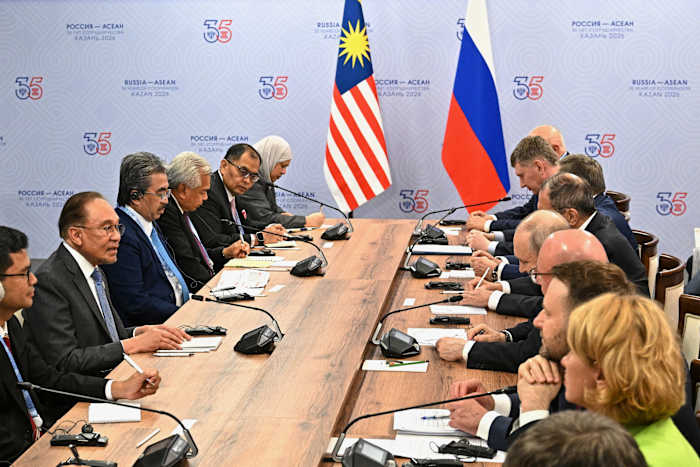
Mainstream media looks at Vladimir Putin hosting Southeast Asian leaders and sees desperation. They paint a picture of a sanctioned, isolated Kremlin begging for economic lifelines from Vietnam, Indonesia, and Malaysia. They tell you Russia is trying to pivot its economy eastward because the West shut the door.
They are completely wrong.
The lazy consensus ignores how global trade actually operates. Russia is not begging. Southeast Asia is not doing favors. What we are witnessing is not a frantic diplomatic scramble, but a cold, calculated exercise in economic arbitrage. Western analysts miscalculate because they measure global influence using twentieth-century metrics like formal summits, public communiqués, and bilateral trade percentages.
The real action is happening beneath the surface, hidden in plain sight through secondary markets, re-routed commodities, and alternative payment clearing networks.
The Myth of Russian Isolation
The foundational error of Western commentary is the assumption that sanctions have isolated the Russian economy from the global marketplace. This narrative assumes that if you cut off direct access to New York and London, a country simply stops trading.
I have spent years analyzing capital flows and supply chain data. The reality on the ground is that commodities always find the path of least resistance. If Russia produces crude oil, diesel, fertilizers, and grain at a lower cost than the rest of the world, those goods will find a buyer. Capital does not care about flags; it cares about margins.
When Putin meets with Southeast Asian heads of state, the press focuses on the optics. They dissect the handshakes and analyze the joint statements for signs of diplomatic alignment. This misses the point entirely. These summits are not about building alliances. They are public cover for private infrastructure coordination.
Consider the energy sector. Mainstream outlets report that Southeast Asian nations are cautious about buying Russian oil due to the risk of secondary Western sanctions. The data tells a completely different story.
Imagine a scenario where a tanker leaves a Russian port in the Far East, unloads its cargo at an intermediary hub or via a ship-to-ship transfer in international waters, mixes that crude with another blend, and suddenly it enters the Southeast Asian market as a completely compliant product.
This is not a conspiracy; it is standard operating procedure in the modern commodities market. Singapore, Malaysia, and Indonesia have become vital nodes in this shadow distribution network. The trade does not show up as "Russia-to-Vietnam" on standard customs declarations, so Western pundits assume the trade does not exist.
ASEAN Is Buying Distressed Assets Not Political Ideology
Let us look at the motivation of the Association of Southeast Asian Nations (ASEAN). The conventional view is that these countries are walking a tightrope, trying to balance their relationships with Washington and Moscow. This framework frames ASEAN as passive actors caught between superpowers.
In truth, Southeast Asian leaders are acting with pure, unadulterated pragmatism. They see Russia as a massive warehouse of distressed assets selling at a permanent discount.
When a Western company pulls out of a joint venture in the region or stops buying Russian raw materials, it creates an immediate value vacuum. Southeast Asian conglomerates and state-owned enterprises are stepping into that vacuum to secure cheap energy and agricultural inputs. They are doing this to lower their own domestic production costs and make their own exports more competitive on the global stage.
- Energy Arbitrage: Countries like Indonesia and the Philippines face rising domestic energy demands. Buying discounted Russian crude, either directly or through intermediaries, acts as an economic subsidy for their manufacturing sectors.
- Agricultural Security: Russia remains one of the largest exporters of fertilizers in the world. Southeast Asian agriculture depends heavily on these inputs. Access to affordable fertilizer prevents domestic food inflation, which is the number one driver of political instability in developing nations.
- Defense Procurement Procurement: For decades, countries like Vietnam and Malaysia relied on Russian military hardware. Maintaining, upgrading, and replacing these systems requires ongoing cooperation. You cannot switch an entire army's logistics system from Russian to American architecture overnight without spending billions of dollars that these nations prefer to invest in infrastructure.
The idea that Southeast Asian leaders are being seduced by Russian diplomacy is a paternalistic fantasy. They are exploiting the geopolitical rift to maximize their own national interests. They are buying the product, not the politics.
The Infrastructure of the Parallel Financial Network
The real story of these state visits is the plumbing. To bypass the Western financial architecture, Russia and its partners must build an entirely separate transactional network. This is where the real work occurs, far away from the cameras.
The West weaponized the SWIFT messaging system and the US dollar clearing network, believing it would paralyze Russian commerce. Instead, it accelerated the development of alternative mechanisms. Russia's System for Transfer of Financial Messages (SPFS) and China's Cross-Border Interbank Payment System (CIPS) are no longer theoretical projects. They are processing real volume.
Furthermore, the push for local currency settlement is fundamentally changing how bilateral trade functions in Asia. When Russia sells oil to India or Indonesia, the transaction increasingly occurs in rubles, rupees, yuan, or dirhams.
The Real Clearing Mechanics
| Mechanism | Conventional View | Reality on the Ground |
|---|---|---|
| Currency Settlement | De-dollarization is a slow, ineffective political stunt. | Local currency pools are actively used to settle trade balances directly, cutting out Western intermediary banks. |
| Banking Channels | Sanctioned banks cannot operate internationally. | Non-sanctioned, mid-tier regional banks are establishing direct correspondent relationships to facilitate trade flows. |
| Logistics Cover | Lack of Western maritime insurance halts shipping. | State-backed reinsurance firms in non-aligned nations are providing the necessary underwriting for shipping fleets. |
This alternative financial architecture has a massive downside for its participants: liquidity is lower, and transactional friction is higher than using the traditional dollar system. It is less efficient and more expensive.
Yet, the fact that these nations are willing to endure this friction demonstrates that they view financial autonomy as a higher priority than optimal efficiency. They are willing to pay a premium to ensure their economies cannot be shut down by a policy shift in Washington or Brussels.
Dismantling the People Also Ask Premise
If you look at public interest queries around this topic, the premises are flawed from the start. People ask: "Is Southeast Asia turning its back on the West by trading with Russia?"
This question assumes that international relations are binary. It assumes you must choose a side. Southeast Asian nations have spent centuries navigating the rivalries of foreign empires. Their entire diplomatic tradition is built on strategic ambiguity. They will gladly welcome an American trade delegation on Tuesday and sign an energy deal with a Russian state enterprise on Thursday.
Another common query is: "Can Russia replace its lost European trade with Southeast Asian markets?"
The honest answer is no, not in terms of direct, raw volume for finished goods. Southeast Asia does not possess the consumer capacity to absorb the exact mix of products Russia used to send to Western Europe.
But that is the wrong question to ask. Russia does not need Southeast Asia to replace Europe. Russia needs Southeast Asia to act as a clearinghouse and a transshipment hub. The goal is liquidity and access to the broader global market, not isolated bilateral autarky.
The Execution Error Western Corporate Leadership Is Making
Western multinationals are misreading this dynamic entirely, and it is costing them market share. Many corporate boards assumed that because their governments levied sanctions, the rest of the world would fall in line. They paused investments, pulled out of joint ventures, and ceded territory in Southeast Asia.
Local competitors and non-aligned multinational entities did not hesitate. They moved into the space vacated by Western firms. They secured the cheap inputs, established the alternative supply routes, and locked down long-term contracts.
I have watched Western firms blow millions of dollars exiting markets prematurely, only to watch their rivals buy those exact same assets via third-party holding companies based in Dubai or Singapore at a ninety percent discount. The assets keep running. The commodities keep flowing. The only thing that changes is who gets the profit.
If you are a business leader operating in this environment, you must discard the moralistic language of geopolitical commentary. You must look at the structural reality. The world is splitting into two distinct financial and logistical tracks. One is transparent, highly regulated, and controlled by the West. The other is opaque, transactional, and distributed across non-aligned hubs.
Trying to force the second track to adhere to the rules of the first track is a fool's errand. It will not happen because the financial incentives against it are too powerful. As long as there is a price differential between Russian commodities and global benchmarks, there will be sophisticated financial actors in Southeast Asia willing to bridge the gap.
The summits we see on the evening news are not a sign of a new bloc forming. They are simply the public acknowledgment of a permanent, parallel economic reality that the West has failed to prevent.