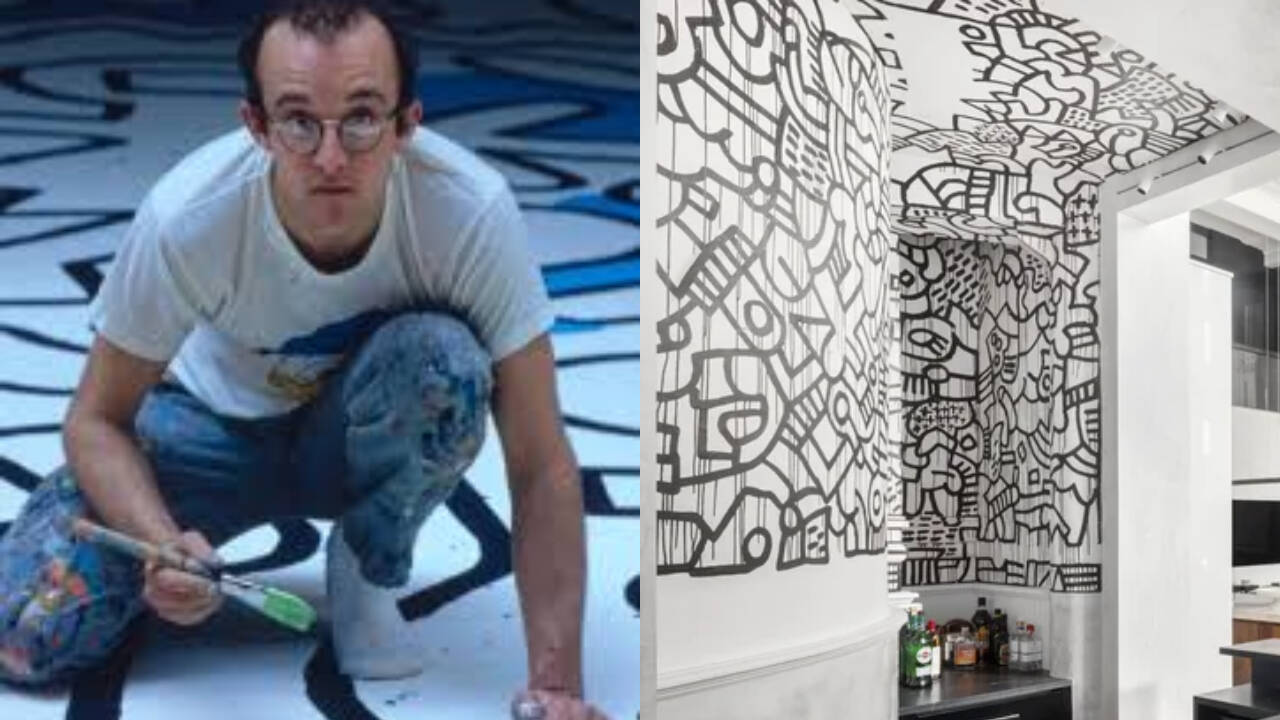
Resurfaced art in a luxury listing is rarely a gift. Usually, it is a marketing ploy.
Every time a headline screams that a forgotten Keith Haring sketch or mural just turned up behind drywall in a multimillion-dollar Manhattan loft, the real estate press swoons. They treat the wall like a lottery ticket. A priceless relic. A romantic collision of gritty downtown street history and ultra-prime luxury real estate.
That story is lazy. Worse, it is financially dangerous for buyers who swallow it whole.
I have spent years in the art advisory and luxury property trenches watching wealthy buyers light money on fire over "historic" walls. I have seen developers slap a famous name on a rough wall to justify an extra eight figures on an asking price. I have watched buyers celebrate a "hidden treasure" only to discover months later that authentication is murky, conservation costs are brutal, or the artwork is legally tethered to the building in ways that trap their capital.
When a Keith Haring work from 1979 surfaces in a $25 million New York loft, the real story is not romance. It is incentives, provenance, and liquidity.
The Lazy Consensus Around "Lost" Street Art
Standard real estate reporting runs on a predictable script. A broker or seller announces a discovery. Maybe a contractor pulled down paneling, or an old partition came out during a gut renovation. Suddenly, a piece tied to 1979—a year when Haring was still a student at the School of Visual Arts, absorbing ideas from William S. Burroughs and Brion Gysin, filling notebooks and sketching in the streets before his iconic subway chalk drawings even hit their stride—becomes the headline hook.
The lazy consensus assumes three things:
- Rarity automatically equals massive financial upside. People hear "Keith Haring" and mentally attach a seven- or eight-figure auction tag to whatever is on the wall.
- A discovery inside a private residence is a clean windfall. Buyers imagine they are getting both a trophy home and an appreciating blue-chip asset under one roof.
- Street art and downtown history make a luxury loft feel authentic. A raw mark on plaster or brick supposedly cures the sterile polish of modern ultra-luxury real estate.
Every one of those assumptions breaks down under pressure.
Provenance Is Not a Vibe
In the secondary art market, provenance is not a good story told over espresso by a listing agent. Provenance is a paper trail. It is chain of custody, contemporaneous documentation, exhibition or studio records, physical material analysis, and scrutiny from specialists who know Haring's early mark-making inside and out.
Haring's career moved fast, and his output was prolific. Between late 1970s experiments, public interventions, club walls, and the subway drawings that began in 1980, plenty of marks exist in New York that look tempting at a glance and fall apart under serious inspection. Even when a work is genuine, authenticity and marketability are not twins. A small, informal, or damaged wall piece from 1979 is a very different creature from a major painted canvas or tarpaulin with clean exhibition history.
If a listing leans heavily on the words "hidden" and "resurfaced" while glossing over formal authentication and estate or specialist review, treat the romance as a smokescreen. Ask what is proven on paper, not what sounds thrilling in a press release.
The Trap of Immovable Assets
Fine art thrives on portability. You can pack a canvas in a climate-controlled crate, ship it to Geneva or London, insure it on a standalone policy, and sell it into a deep global auction pool if your priorities change.
A mural fixed to a wall inside a $25 million loft does not pack into a crate easily. Removing a wall or extracting a plaster or masonry fragment is an invasive surgical procedure with real risk of damage, loss of context, and steep conservation bills. Leaving it in place means your "art asset" is welded to your real estate asset.
That creates a classic illiquidity trap. Suppose you want to sell the apartment five years from now. Does the mural widen your buyer pool, or shrink it? Some buyers will pay up for the cachet. Others will view a fixed mural as an aesthetic constraint, a conservation headache, or a valuation dispute waiting to happen. When your exit depends on finding a narrow slice of buyers who love both the floor plan and the wall, your liquidity suffers.
You Are Asking the Wrong Question
Most buyers and readers look at a headline about a 1979 Haring mural in a $25 million loft and ask: How much is that wall worth?
Wrong question.
The right question is: What is the net risk-adjusted value of this property with that wall attached to it?
Pricing a $25 million New York loft is already an exercise in micro-economics. At that tier, square footage alone stops explaining price. Buyers are paying for light, views, layout, building reputation, privacy, and scarcity. When a seller introduces a purported Haring work into the pitch, they are trying to shift the valuation framework from real estate comps to trophy-asset speculation.
Consider how those two worlds collide:
| Factor | Standard Luxury Loft Comps | Loft With a "Hidden" Haring Mural |
|---|---|---|
| Primary Valuation Anchor | Price per square foot, views, building tier, turnkey condition | Speculative art premium plus property fundamentals |
| Liquidity & Exit | Broad pool of high-net-worth homebuyers | Narrower pool; potential friction over wall value and upkeep |
| Maintenance & Risk | HVAC, plumbing, finishes, board rules | UV exposure, humidity swings, conservation, structural limits |
| Negotiation Leverage | Clear comparable sales data | Subjective debate over provenance and aesthetic value |
Notice how the seller captures the upside narrative while the buyer absorbs the friction. If the wall is real and beloved, the seller wants top dollar upfront. If the wall turns out to be complicated, fragile, or polarizing later, that headache belongs to the owner.
Dismantling Common Buyer Questions
"Is a resurfaced Haring mural automatically a great investment?"
No. Calling a fixed wall mural an "investment" confuses excitement with financial discipline. Blue-chip art investing requires clear title, verifiable authenticity, strong condition, and an exit path. A wall inside a residence can fail on exit friction or conservation cost even if the artist's market is strong. Buy it because you genuinely love living with it and can afford to absorb any valuation ambiguity—not because a broker called it a hidden gold mine.
"Doesn't a 1979 work make it even rarer?"
Rarity alone does not set prices; demand and clarity do. Yes, 1979 was an early, formative year for Haring before his global pop-art explosion and his work with the Pop Shop and AIDS activism in the 1980s. Early works can be fascinating to scholars and collectors. Yet early, informal, or domestic marks can also be harder to authenticate and less iconic to casual trophy buyers than signature works from his peak periods. Rarity without clean documentation and broad market appeal can easily turn into a stalemate at the negotiating table.
"Can you just cut the mural out of the wall if you sell later?"
Technically, specialists sometimes remove murals or wall sections, but "just cutting it out" is fantasy talk. Extraction requires structural planning, conservation expertise, permits or building approvals where applicable, and acceptance that the work—and the surrounding wall—may change in value or appearance. Worse, stripping a signature feature out of a home can leave behind a patched wall and a confused buyer.
"Why do developers and sellers love these stories so much?"
Because headlines do half the selling for them. A $25 million listing competes with dozens of other expensive homes. A story about a secret 1979 Haring mural cuts through the noise, gives brokers a hook to call journalists, and frames the property as singular. Even if the art adds only modest real value—or none at all—the story builds urgency and prestige.
Imagine a Scenario Where the Wall Is a Liability
Imagine a scenario where a buyer pays a $3 million premium on top of a fair $25 million property value because the seller pitches a resurfaced 1979 Haring mural as a priceless bonus. The buyer falls in love with the downtown provenance and skips deep independent diligence, relying on an enthusiastic letter rather than rigorous art-market and conservation vetting.
Two years later, the buyer relocates and lists the loft. A prospective buyer's art advisor points out gaps in the documentation, notes sensitivity to sunlight from floor-to-ceiling windows, and argues the wall should carry zero premium—or a discount due to restoration risk. Suddenly, the seller cannot recover that $3 million premium, and the sale drags on for months.
That scenario is not far-fetched. It happens whenever people confuse a captivating story with a bulletproof asset.
What Heavy Hitters in Art and Real Estate Actually Look At
Serious collectors, museum curators, and seasoned art advisors—people who spend their careers studying post-war and downtown New York art—do not get swept away by breathless listing copy. They look at fundamentals that rarely make the headline:
- Chain of custody: Who owned or occupied the space when the mark was made, and how has title passed since?
- Condition and environment: Is it exposed to direct sunlight, cooking grease, drywall settling, or drastic humidity shifts?
- Legal and building constraints: Are there co-op or condo rules, landmark considerations, or third-party claims to consider?
- Standalone value: If you stripped away the real estate hype, would a serious collector pay for the work on its own merits?
In luxury real estate, top brokers and seasoned buyers apply the same discipline. They separate the brick-and-mortar value of the apartment from any artistic premium. If the numbers only work when you assume a massive, undisputed art windfall, the deal is fragile.
Where My Contrarian View Can Bite You
Let's be honest about the downside of being a skeptic. Cynicism can cost you, too.
If you reflexively dismiss every resurfaced work as hype, you might walk away from a rare, authentic piece of New York history that genuinely enriches a home—or even holds real long-term value if properly vetted. Not every headline is a scam. Sometimes real history really does hide behind old plaster in downtown Manhattan.
The trick is not blind skepticism or blind gullibility. It is disciplined verification. Push past the romance, check the receipts, price the home on its real estate merits first, and treat any authentic artwork as a bonus unless the documentation and economics prove otherwise.
Unconventional Moves That Actually Protect You
If you ever find yourself eyeing a property with a "resurfaced" Keith Haring work—or any celebrated street-art find—skip the standard tour script and do this instead:
- Underwrite the loft at zero art premium first. Decide whether you would buy the apartment at a fair market price if the wall had plain white paint over it. If the answer is no, walk away.
- Hire your own independent art specialist. Do not rely solely on the seller's narrative or a casual opinion. Bring in someone experienced with downtown New York art and condition assessment before you commit serious money.
- Audit the microclimate immediately. Check where sunlight hits the wall, how HVAC vents blow across it, and whether humidity swings are warping the substrate. Art preservation is chemistry and physics, not wishful thinking.
- Clarify transfer terms in writing. Spell out what stays, what is warranted, and how any existing documentation transfers at closing so there are zero surprises on moving day.
A resurfaced 1979 Keith Haring mural in a $25 million New York loft makes a great headline. Whether it makes a smart buy depends on what happens after the applause dies down.
Do not fall in love with a wall just because it has a famous name on it.