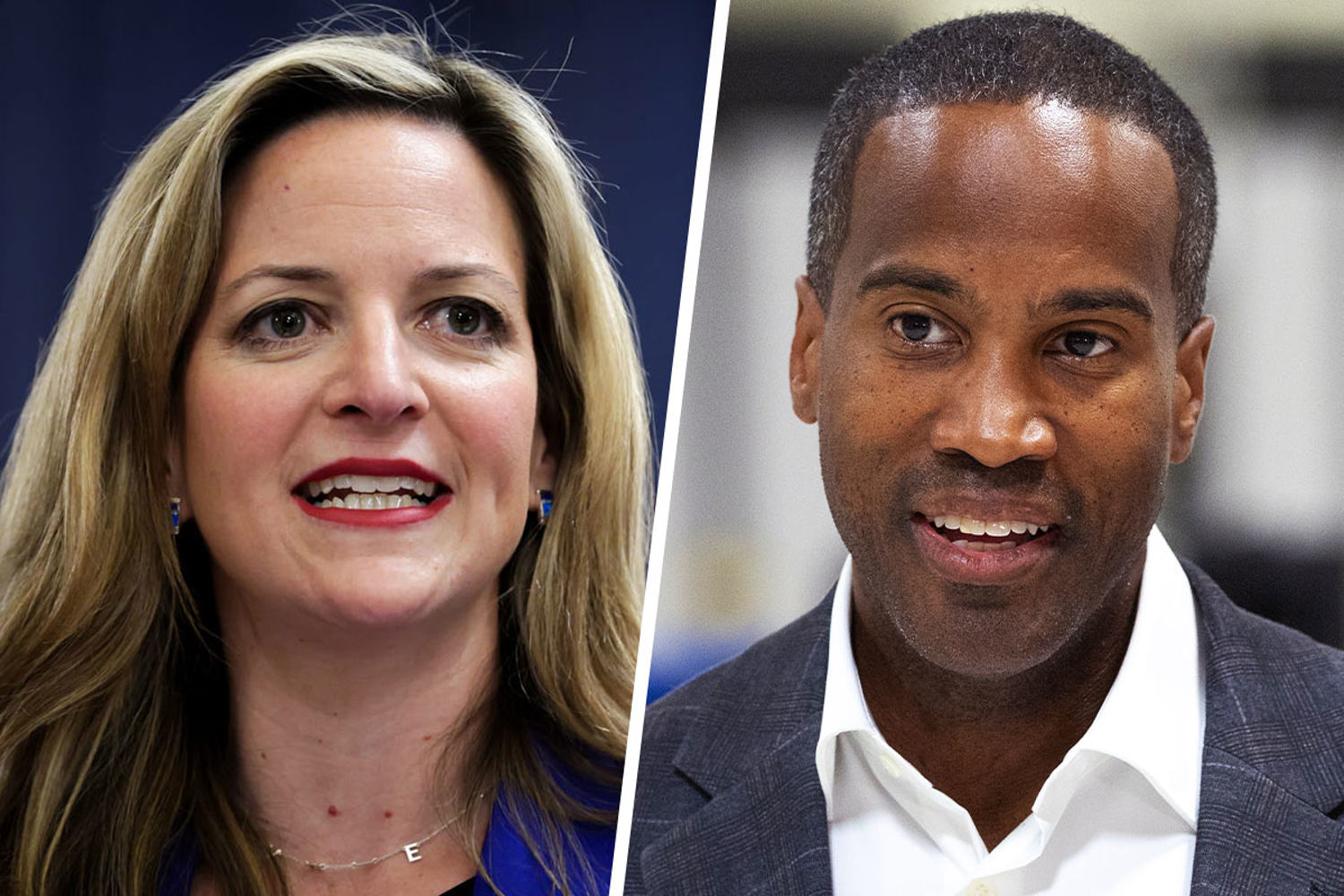
Mainstream political coverage treats state-level debates like a cable news shouting match. When former Atlanta Mayor Keisha Lance Bottoms and Republican healthcare billionaire Rick Jackson met for their sole general election town hall on October 6, 2026, the national press corps immediately reached for its favorite lazy framing: Candidates spar over the economy and Donald Trump.
That headline completely missed the real story.
Political reporters are wired to view every swing-state race as a simple proxy war over whoever sits in the White House. It is an easy story to write. You count how many times the Democrat mentions the president's name, watch the Republican squirm on a political tightrope, and file your copy before midnight.
But if you actually watched the October town hall—and if you look at how Georgia voters subsequently broke on November 3—the conventional wisdom falls apart. The lone Georgia gubernatorial debate wasn't a referendum on Donald Trump's personality or a generic clash over inflation. It was a collision over physical infrastructure, grid capacity, and who actually pays the bill for the artificial intelligence boom.
The Lazy Consensus of Political Journalism
Let’s look at the standard media autopsy of the 2026 race. On one side, you had Keisha Lance Bottoms, a seasoned executive and former White House advisor. On the other, Rick Jackson, a self-funded healthcare magnate who rose from foster care to build a massive staffing empire.
The predictable narrative went like this:
- Bottoms attacked Jackson for embracing Trump and questioned his past comments about deploying the National Guard around elections.
- Jackson blamed Bottoms’ tenure as mayor for local costs, touted his personal rags-to-riches biography, and argued that his business background made him a natural job creator.
- Both offered familiar campaign-trail promises: higher teacher pay, cracking down on insurance denials, and cutting taxes.
If you read the standard wire summaries, you would think the entire night was spent trading talking points from 2020 and 2024.
I’ve spent years watching political operatives and corporate lobbyists burn millions of dollars misreading voter anger because they refuse to look past partisan labels. In Georgia, the national media fell into the exact same trap. They assumed "the economy" meant the price of eggs or federal tariff policy. In reality, when Georgians talked about the economy in the fall of 2026, they were talking about their monthly power bills, water tables, and why massive windowless warehouses were suddenly swallowing up rural farmland.
What "The Economy" Actually Meant on That Stage
During the town hall, the sharpest friction didn't come from abstract macroeconomics. It came from data centers.
For years, Georgia’s economic development pitch—championed by outgoing Governor Brian Kemp—relied on rolling out the red carpet for massive corporate investments, including hyperscale data centers. The consensus among the business class was simple: tax breaks bring construction jobs, and construction jobs mean prosperity.
By October 2026, that consensus had curdled into open voter revolt.
Here is the economic reality that conventional political coverage flattens into a single buzzword:
- The Asymmetric Cost Trap: Hyperscale AI data centers require staggering amounts of electricity and cooling water, yet once built, they employ a fraction of the permanent staff of a traditional manufacturing plant.
- Socialized Grid Upgrades: When utilities build new transmission lines and generation capacity to feed these facilities, residential ratepayers frequently end up subsidizing the infrastructure through higher monthly utility bills.
- The Tax Break Illusion: State and local governments routinely hand out tens of millions of dollars in sales and property tax exemptions to lure tech giants, starving local school boards and county budgets of the very revenue meant to justify the disruption.
When Bottoms and Jackson clashed over data centers on the debate stage, they weren't having a side conversation. They were arguing over the defining economic tension of the decade. Voters didn't care about partisan cable-news crossfire; they wanted to know why their utility rates were climbing while tech conglomerates received sweetheart deals.
The Billionaire Outsider Myth vs. Voter Reality
Another massive blind spot in the standard coverage was the assumption that Rick Jackson’s personal fortune and outsider biography would insulate him from economic criticism.
On paper, Jackson looked like a political juggernaut. He had the resources to outspend Bottoms dramatically, a compelling life story of overcoming childhood poverty, and a message tailored to working-class frustration. In Republican primaries, being a self-funding businessman who promises to run the state like a corporation is usually an unbeatable formula.
Why did that formula stall out in the general election? Because voters are much smarter about business incentives than political pundits give them credit for.
Consider a simple thought experiment: Imagine you are a hourly worker in suburban Atlanta or rural middle Georgia struggling to cover rent and groceries. You ask a billionaire candidate a direct question about Georgia's $7.25 minimum wage—one of the lowest statutory floors in the country—and whether families can survive on it. His response is, "Hopefully, you're not the one that is getting the $7.50 an hour," followed by a pivot to how many jobs he has created in his career.
To a boardroom executive, that answer sounds entirely rational. Market wages exceed the statutory minimum, so raising the floor seems unnecessary to a business owner.
To a working-class voter watching a town hall, it sounds completely out of touch. It reinforces the exact suspicion that sinks self-funded candidates: that an executive's definition of "a strong economy" measures corporate margins and capital investment, while the voter's definition measures household purchasing power and monthly overhead. Bottoms didn't win the argument simply because she proposed doubling the minimum wage; she won it because she understood that voters viewed corporate power—from health insurers to data center developers—as an adversary rather than a savior.
The Trump Distraction
What about the other half of the competitor's headline—Donald Trump?
Yes, Trump was an unavoidable presence in the race. Jackson walked a delicate line, embracing the president's endorsement-adjacent orbit and appearing alongside him at rallies in Dalton and Perry while trying to maintain independent appeal among moderate suburbanites. Bottoms, naturally, tied Jackson to Trump at every opportunity, particularly over past remarks regarding election monitoring.
Yet treating the Trump dynamic as the primary driver of the debate gets the causality backward.
In 2020 and 2022, Georgia politics revolved around Trump’s grievances over past election results. By 2026, Trump was the sitting president. That changes the political gravity entirely. When your party holds the White House, you no longer get to run purely as an anti-establishment insurgent. You own the economic anxiety on the ground.
Jackson couldn't simply run against "Washington" when his own party controlled the executive branch. Meanwhile, his refusal to participate in more than a single debate—declining four other invitations, including from the Atlanta Press Club—meant that the October 6 town hall became the sole high-stakes pressure valve of the entire fall campaign.
By limiting his appearances, Jackson magnified every unscripted moment. Instead of diffusing tough questions across five separate forums, he compressed the entire election's scrutiny into one ninety-minute broadcast.
The Real Lesson for Political Strategists and Voters
If you want to understand why Keisha Lance Bottoms defeated Rick Jackson on November 3 to become the nation's first elected Black female governor, stop reading surface-level debate recaps that reduce politics to personality clashes.
Look at the structural shifts that actually moved the needle:
- Infrastructure is now a kitchen-table issue: You cannot separate "tech growth" from household budgets anymore. Any governor—Democrat or Republican—who signs off on massive industrial or data center projects without ironclad ratepayer protections is handing their opponent a loaded weapon.
- The "lone debate" strategy backfires: Candidates who duck debates think they are minimizing risk. In reality, they are depriving themselves of the chance to recover from a bad night and signaling to undecided voters that they are afraid of unscripted scrutiny.
- Biography isn't policy: A compelling personal story gets voters to listen to you once. It does not answer how you will lower their insurance premiums or keep their electric bill from spiking.
To be fair, taking a hard line against rapid infrastructure development carries real risks of its own. Over-regulating data centers or slapping moratoriums on new tech facilities can chill capital investment, drive high-paying engineering contracts to neighboring states like North Carolina or Tennessee, and slow down the tax-base growth that fast-growing metro areas rely on to fund transit and schools. Bottoms will quickly discover as governor that campaigning against corporate tax breaks is far easier than balancing a state budget without corporate expansion.
Stop Reading Debate Headlines Like Box Scores
The biggest mistake observers make after any major political debate is asking, "Who landed the best zinger?"
Debates rarely turn on a single rehearsed applause line. They reveal which candidate understands the specific, tangible friction points in a voter's daily life—and which candidate is still fighting the last election's war.
In Georgia, the pundits saw two candidates arguing about Donald Trump and generic economic talking points. Voters saw something much clearer: a choice between an executive asking them to trust corporate trickle-down growth, and a former mayor promising to put guardrails around the industries reshaping their neighborhoods.
When the ballots were counted in November, Georgia didn't just make history. It proved that when you ignore what is actually costing families money, no amount of campaign cash can buy you the governor's mansion.