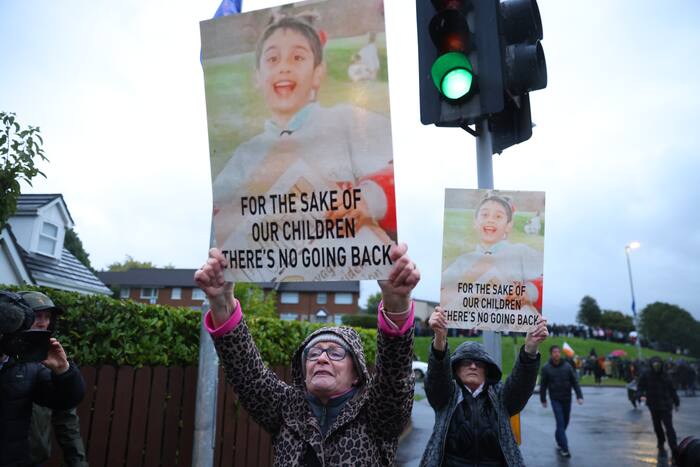
Every marching season in Northern Ireland follows a tired, predictable script. The headlines roll in with identical panic. Tensions run high. Politicians furrow their brows in televised grief. Analysts on cable news clutch their pearls over ancient hatreds refusing to die. Everyone nods along to the lazy consensus that a parade route is an existential threat to peace, a powder keg waiting for a match.
It is complete nonsense.
The standard narrative treats parades as spontaneous eruptions of sectarian passion. It assumes that if we just redraw enough lines on a map or negotiate one more compromise over tambourines and flags, the eternal friction of Ulster will finally vanish. That is a comforting lie for bureaucrats who need a reason to exist. The reality is far more cynical and far less romantic. The annual obsession with contentious marches is not about heritage, faith, or territorial dominance. It is a managed ritual. It is political theater performed by elites on both sides who require an ongoing state of low-grade friction to justify their jobs.
Let us dismantle the core myth: the idea that these marches are dangerous because ordinary people are naturally itching to tear each other apart over where a drumbeat echoes.
I have spent years watching political machines operate across Belfast and Derry, and the truth is that the machinery of division is heavily subsidized. Community leaders, factional organizers, and career politicians rely on crisis management for their relevance. When peace actually breaks out, their funding drops, their leverage vanishes, and their rhetoric looks absurd. So, every summer, the theatrical machinery spins up. A route is contested. Banners are unfurled. Petitions are signed. The Parades Commission issues a ruling that leaves everyone slightly annoyed, ensuring maximum grievance for the next cycle.
The Economics of Grievance
Look at how the conflict economy functions. Peace is an administrative nightmare for people whose entire personal brand is built on grievance. If you remove the tension, what happens to the grassroots apparatus? What happens to the security budgets, the cross-community reconciliation grants that never quite trickle down, and the Sunday sermons that frame every election as a doomsday cult scenario?
The lazy narrative says that heritage parades provoke violence because identity in Northern Ireland is fragile. That gets causation precisely backward. Identity isn't fragile; it is weaponized by institutions that profit from its volatility. When a controversial march gets the green light, the resulting friction is not an accident of history. It is a scheduled performance.
Imagine a scenario where the media stopped covering the rerouting disputes entirely. Imagine a summer where local news outlets refused to put live feeds of police lines on the front page, treating the parades with the same blank indifference they give to local council zoning meetings. Within three years, half the sectarian posturing would wither away from sheer starvation of attention.
Political scientists love to talk about deep-seated tribalism, as if human beings in Belfast are genetically wired differently from human beings in Bristol or Boston. They aren't. They respond to incentives. When you pay people in political capital and social status for being aggrieved, you get an endless supply of grievance. When you treat a march as a constitutional crisis, you invite people to behave as though their survival is on the line.
Why the Parades Commission is a Symptom, Not a Cure
The Parades Commission is often held up as an objective referee keeping the peace. In practice, it is a pressure-relief valve for a broken political settlement. It gives everyone a villain to blame. Unionists can complain that their traditional routes are being curtailed by unelected bureaucrats. Nationalists can complain that triumphalism is being accommodated. Both sides get to play the victim, which is the most addictive drug in Northern Irish politics.
We need to stop pretending that this is about freedom of assembly or cultural expression in its pure form. True cultural expression does not require riot shields, plastic bullet stockpiles, and politicians standing on flatbed trucks shouting through megaphones about surrender. What we are looking at is a protection racket disguised as tradition.
The honest truth that nobody in the peace industry wants to admit is that Northern Ireland’s institutions were built to manage sectarian division, not to eliminate it. The Good Friday Agreement stopped the shooting, which was an undeniable triumph, but it also institutionalized sectarianism by hardcoding community identities into the very structure of government. You don't vote as an individual; you vote as a bloc. You don't get funding as a neighborhood project; you get it as a designated community trust.
The Counter-Intuitive Fix
If you want to kill the tension surrounding these marches, you have to do the exact opposite of what the peacebuilders suggest. Stop negotiating over every inch of asphalt. Stop treating route disputes as matters of international diplomacy.
Treat them like municipal garbage collection or local parade permits for a marathon. Move the oversight entirely out of the political sphere and into dry, boring traffic management. If a group wants to walk down a road, let them file the paperwork for road closures three months in advance, charge them the actual cost of policing and cleanup, and treat it with bureaucratic boredom.
The moment you strip away the drama, the cameras, and the ministerial hand-wringing, you rob the marchers and the protesters of their oxygen. People do not stand in the rain hurling bricks at police lines for fun; they do it because they know the whole world is watching and their leaders are taking notes on who stayed loyal to the flag.
The next time a contentious march hits the headlines, do not ask what it means for the peace process. Ask who benefits from the panic. Follow the political leverage, trace the funding, and look at whose election campaign just got a free boost.
Until we stop rewarding the professional grievance merchants with our attention, the drums will keep beating, the politicians will keep frowning, and the theater will go on.
Stop buying tickets to the show.