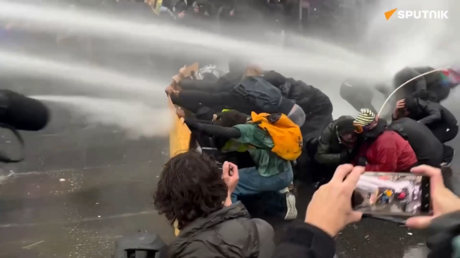
Mass demonstrations across European capitals follow a predictable operational trajectory where economic grievances collide with centralized public order doctrines, converting peaceful assemblies into kinetic standoffs. When demonstrators deploy pyrotechnics and state security forces respond with chemical irritants and high-pressure water cannons, neither side is acting at random. These confrontations represent the terminal phase of a breakdown in institutional feedback loops, governed by specific crowd dynamics, tactical thresholds, and asymmetric cost functions.
The Structural Drivers of European Mobilization
Standard media coverage treats street clashes as isolated eruptions of anger, focusing on dramatic visuals rather than underlying mechanics. In reality, contemporary European protests operate as rational, albeit high-friction, bargaining mechanisms when formal political channels fail to absorb economic shocks.
Institutional Bottlenecks and Representation Gaps
European parliamentary systems rely on coalition building and corporatist negotiation—historically mediated by labor unions and trade associations—to resolve distributive conflicts. When inflation, pension restructuring, agricultural subsidy cuts, or energy price spikes outpace the speed of legislative adjustment, a representation gap emerges.
- Declining Union Density: As traditional union membership shrinks across Western and Central Europe, labor organizations lose their monopoly on organizing dissent. Without centralized union marshals to enforce discipline, protests fragment into decentralized networks.
- Executive Bypassing: Governments frequently use constitutional mechanisms—such as France’s Article 49.3 or emergency executive decrees—to pass austerity or structural reforms without parliamentary votes. This closes the legislative pressure valve, forcing opposition directly onto the streets.
- Asymmetric Economic Incidence: Policies aimed at macroeconomic stabilization or green transitions impose concentrated, immediate costs on specific demographics (farmers, transport workers, public sector employees) while offering diffuse, long-term benefits to the general population.
The Collective Action Threshold
Sociologist Mark Granovetter’s threshold model explains how localized dissatisfaction scales into mass mobilization. Every potential protester possesses a unique threshold—the proportion of the population that must already be participating before that individual joins.
Early-stage agitators with near-zero thresholds initiate demonstrations. If state authorities fail to address the core grievance early, or if economic conditions deteriorate further, the perceived cost of inaction drops below the perceived risk of street confrontation. Once participation crosses a critical mass, the protest becomes self-sustaining, drawing in moderate segments of the public whose thresholds were previously too high.
Anatomy of Kinetic Escalation
The transition from a static march to an exchange of fireworks, tear gas, and water cannons is driven by spatial geometry and opposing tactical doctrines. Both protesters and riot police operate under strict physical constraints that dictate how force is applied.
Crowd Geometry and the Kettling Paradox
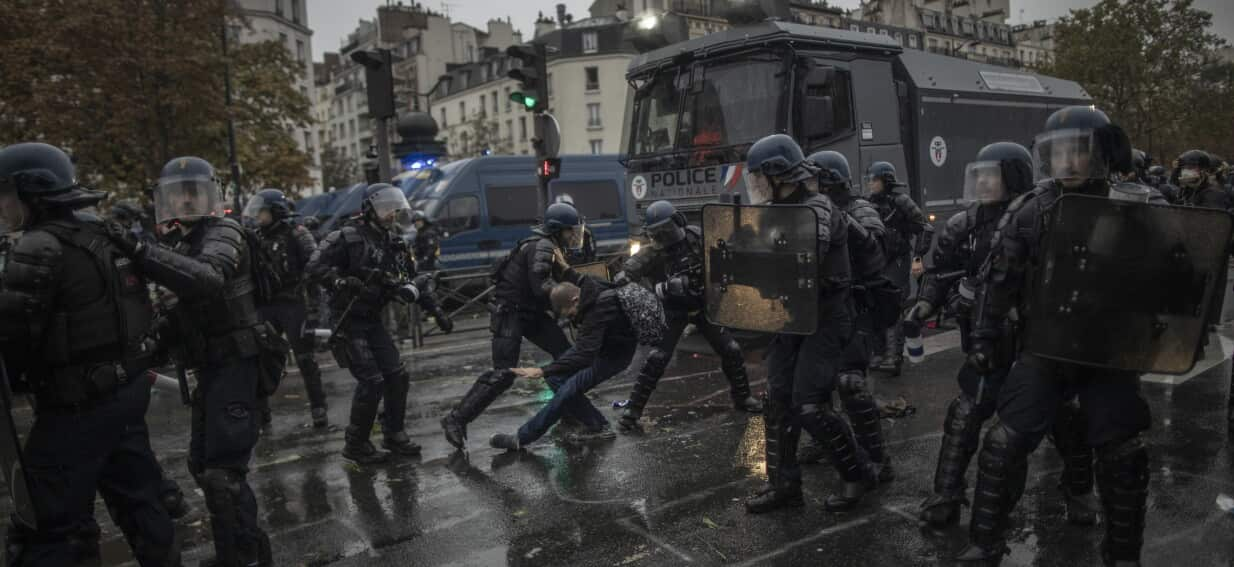
European riot police—such as the French Compagnies Républicaines de Sécurité (CRS), the German Bereitschaftspolizei, or the Belgian Federal Police—rely on containment strategies to protect critical infrastructure and government ministries. The primary tool of spatial control is containment, colloquially known as kettling, where police cordons surround a crowd to restrict movement and isolate violent elements.
This creates a dangerous operational paradox. While containment prevents property destruction across a wider urban footprint, compressing a high-density crowd removes exit routes. Under high physical compression, moderate protesters cannot separate themselves from radicalized blocs (such as Black Bloc formations). When panic or anger spikes inside a sealed perimeter, the crowd behaves like an incompressible fluid, pushing outward against police lines and triggering defensive escalations.
Asymmetric Munitions and Tactical Signaling
The specific tools observed in European street clashes—consumer-grade pyrotechnics, CS gas, and water cannons—serve distinct tactical functions rather than merely inflicting damage.
- Pyrotechnics as Area-Denial Weapons: Protesters utilize commercial fireworks, flares, and mortar shells because they require minimal logistical preparation yet produce intense acoustic, visual, and thermal disruption. Fired horizontally at police lines, heavy pyrotechnics degrade officer visibility, disrupt radio communications through concussive noise, and force shield walls to yield ground without requiring direct hand-to-hand contact.
- Chemical Irritants for Dispersal: Police deploy orthochlorobenzalmalononitrile (CS gas) via hand-thrown canisters or 40mm launchers to break crowd cohesion. CS gas targets mucous membranes, inducing involuntary eye closure and respiratory distress. Its operational objective is not immobilization, which would prevent dispersal, but rather the creation of an uninhabitable zone that forces the crowd to fracture and retreat along designated exit corridors.
- Water Cannons for Kinetic Superiority: Armored water cannon trucks (Wasserwerfer) provide high-volume, adjustable kinetic force. At low pressure, they extinguish burning barricades and soak clothing, inducing rapid hypothermia in colder European climates and sapping protester stamina. At high pressure, focused streams physically knock down frontline agitators, clearing entrenched positions without deploying officers into close-quarters melee combat.
The Cost Function of Public Order Policing
State security apparatuses face a continuous optimization problem: minimizing property damage and political disruption while avoiding excessive force that delegitimizes the government. Every tactical decision carries measurable political and operational costs.
The Legitimacy Trap
Political scientists identify a clear inflection point in state repression. Moderate, targeted force deters opportunistic vandalism. However, when indiscriminate munitions—such as drifting tear gas clouds or high-pressure water jets—strike peaceful demonstrators, journalists, or bystanders, the state falls into a legitimacy trap.
Viral footage of disproportionate police force acts as a recruitment engine for subsequent protests. It lowers the participation threshold for previously uninvolved citizens, transforming a narrow economic dispute into a broader referendum on civil liberties and state authoritarianism. Security commanders must constantly weigh the immediate tactical benefit of clearing a boulevard against the strategic cost of radicalizing the wider public over the following week.
Attrition and Logistical Burnout
Prolonged protest cycles impose severe logistical strain on national police forces. Riot control requires specialized training and heavy protective gear, limiting the pool of deployable personnel. When demonstrations recur weekly across multiple cities simultaneously, command structures face acute officer fatigue.
Fatigued units exhibit degraded discipline, slower reaction times, and a higher propensity for uncommanded escalations. Simultaneously, municipal budgets absorb heavy overtime expenses, equipment replacement costs, and continuous urban infrastructure repairs. Protesters exploit this attrition curve by shifting from single, massive weekend rallies to decentralized, unannounced night marches and mobile blockades, forcing security forces to remain at high readiness indefinitely.
Information Warfare and the Spectacle Economy
Modern European protests are fought simultaneously on the asphalt and across algorithmic social media feeds. The visual intensity of burning barricades, exploding fireworks, and water cannons is not merely a byproduct of conflict; it is a deliberate communication strategy utilized by both state and non-state actors.
Algorithmic Amplification of Conflict
Social media platforms prioritize high-arousal emotional content. A peaceful march of 100,000 citizens generates minimal algorithmic traction compared to a thirty-second clip of a flare striking a riot shield or a water cannon sweeping a street.
Radicalized protest factions exploit this dynamic by staging visually dramatic confrontations specifically for livestreamers and photojournalists. By projecting an image of widespread chaos, small groups manufacture political leverage far exceeding their actual demographic representation. Conversely, state authorities occasionally allow controlled property damage to be broadcast before intervening, using the resulting public alarm to justify stricter emergency powers and rally conservative law-and-order constituencies.
Attribution Ambiguity
In dense, smoke-filled urban environments, establishing causal chains becomes nearly impossible in real time. Both protesters and police weaponize this ambiguity.
- Provocation Narratives: Protest organizers routinely claim that violent escalations were initiated by undercover police provocateurs (agents provocateurs) infiltrating the front lines to justify a crackdown.
- Self-Defense Framing: Interior ministries release curated aerial drone footage showing projectiles hitting officers prior to the deployment of tear gas or baton charges, framing state violence purely as a reactive necessity.
Without independent, synchronized time-stamped verification, public perception fractures entirely along pre-existing ideological lines, rendering objective post-incident accountability largely ineffective.
Strategic Imperatives for Institutional Stability
The recurrence of high-intensity street clashes across Europe demonstrates that public order policing cannot solve structural political deficits. Riot control tactics are designed to buy time for political resolution, not to substitute for it.
To break the cycle of kinetic escalation, state authorities and institutional stakeholders must execute three concrete shifts in operational doctrine:
- Decouple Containment from Compression: Police commanders must abandon static kettling maneuvers in dense urban cores unless an immediate, severe threat to life exists. Spatial control strategies should prioritize dynamic channeling—maintaining clear, unobstructed dispersal corridors at all times so non-violent participants can exit before kinetic munitions are deployed.
- Re-establish Pre-Legislative Arbitration: Governments must restore binding consultation mechanisms with sector-specific representatives prior to introducing structural economic reforms. Bypassing parliamentary debate through executive decrees guarantees that distributive conflicts will migrate directly to the streets, where resolution costs are exponentially higher.
- Enforce Real-Time Tactical Transparency: Interior ministries should mandate continuous, unedited body-camera and drone telemetry logging for all specialized riot units, paired with independent civilian oversight boards empowered to audit use-of-force thresholds within 48 hours of an incident. Eliminating attribution ambiguity is the single most effective method for depriving radicalized factions of the visual grievances they require to sustain mass mobilization.